

Retainer or Success Fee: Pick a Dental Recruiter
By Dr. Brian Passell and the DDS Recruit team ·
Summary: When choosing between a recruitment retainer and a success fee for dental hiring, consider the role's demands and the practice's needs. A retainer offers dedicated attention for critical or hard-to-fill roles, while a success fee aligns with cash flow and is suitable for more common positions. A hybrid model balances upfront commitment with placement risk sharing, ideal for roles needing focus but with some flexibility.
A one-year placement guarantee shifts the recruiter-pricing question away from who looks cheaper at the start and toward who stays responsible after the hire begins. Dental practices comparing a recruitment retainer with a success fee are not buying the same promise under two invoices, because each model changes when cash goes out, how much effort the recruiter puts in, and what happens when the first candidate turns out to be a poor fit. The practical choice is not retainer good, success fee bad, or the reverse. A PPO-based practice hiring an associate dentist in a crowded suburb faces a different risk profile from a DSO adding a Chief Clinical Officer or a seller planning a succession hire. The pricing model should follow the difficulty of the search, the cost of delay, and the damage a culture mismatch would cause.
Dental hiring gets expensive when the fee model hides the real trade-off. A low-friction success-fee search protects cash until a hire sticks, while a retained or hybrid search asks the practice to fund dedicated work before the result is final. The choice starts with what the role demands, not with which proposal feels easier to approve.
What are you really buying with a retainer?
A retainer buys reserved recruiting time before a placement is made, which makes it better suited to searches that need steady attention than to cases where a practice is only testing the market. Hyring's retained search glossary describes retained search as an arrangement where an employer pays a recruiter to conduct a dedicated search, which is why the model shows up more often in executive or hard-to-fill hiring. A dental practice usually looks at a retainer when the role is too important to leave to whoever happens to respond first. C-level executive search, such as a Chief Clinical Officer or COO, carries operational consequences beyond one operatory schedule. A DSO expansion lead can affect site openings, doctor relationships, and the pace of growth, so the recruiting work needs focus before any offer letter exists.
A retainer also fits succession planning because the search is not just a vacancy fill. A seller, partner group, or acquiring practice needs a dentist or leader who can carry patient relationships, staff trust, and clinical continuity. Practices considering that path should treat practice succession hiring as a risk-management project rather than a job ad with a closing date. The drawback is cash exposure before proof of outcome. A pure retainer asks the practice to pay before knowing whether the hire will accept, start, or remain. That can be reasonable for a confidential specialist search or executive role, but it is harder to justify when the practice already has a steady candidate pipeline and only needs transactional help.
A retained model also asks the practice owner or DSO leader to be clear about the role before the recruiter begins. Vague compensation, unresolved partnership expectations, or a shifting office-manager scope makes an upfront commitment harder to manage. The next question is whether the practice wants to pay only when the market produces a result.
What success-fee only changes in a dental search
With a success-fee-only setup, payment waits until the search produces a placement. That keeps cash in the practice until the recruiter brings in a hire. RecruitBPM's retained and contingency comparison describes contingency recruiting as payment after a successful hire, and that is why many owners treat it as the lower-risk place to start. A private dental practice that needs an associate dentist often prefers this setup because the need is plain and easy to measure. An open provider chair means fewer exams, fewer treatment plans, and more pressure on the owner-doctor. Paying after placement fits the practice's cash flow, especially after money has already gone to job boards with no lasting result.
A success-fee-only search also puts pressure on the recruiter to care about results. The practice pays for the hire, not for effort, dashboards, or activity reports. The signal is simple: no hire, no fee. That discipline matters when the role is common enough that several recruiters or sources can work on it without muddying the market. There is a trade-off, and it sits with recruiter attention. Contingency searches sit beside other open roles because the recruiter eats the cost until someone is placed. A dental associate role with ordinary compensation, vague hours, or weak relocation pull may fall behind searches that look easier to close. The practice pays nothing at the start, but the search may get less dedicated attention than the owner expects.
Success-fee only fits best when the role is ordinary, the practice can move quickly, and the owner is willing to manage the candidate experience directly. A single-location office with a clear associate package, fast decisions, and active referrals from local dentists may not need to fund a retained search before testing the market. The model starts to strain when the practice needs confidentiality, relocation persuasion, or leadership judgment that a job board cannot supply.
Job postings still matter in this model because active candidates want to see real openings, not just recruiter claims. DDS Recruit publishes current openings on its dental jobs page, including an associate general dentist in Bishop, so a practice can see how live roles are presented to the market. The stronger the role looks on paper, the more room a success-fee model has to work with.
Where a hybrid search fee fits
A hybrid model gives the recruiter some upfront commitment while tying the larger fee to a successful placement. KORE1's comparison of contingency, retainer and engaged search places engaged search between pure contingency and full retainer, which is the useful middle ground for many dental practices that need focus but dislike a large upfront bet.
A hybrid structure fits dental searches where the role is important, but the practice still wants the recruiter to share placement risk. Associate dentist recruiting in a difficult suburb, in-house specialist placement or hygienist recruiting for a practice with limited local supply can fall into this category. The upfront portion signals that the practice is serious, while the success component keeps the recruiter tied to the finish line.
Its current offer includes a one-year placement guarantee, free replacement search if a hire leaves within the first year.
That wording matters because it is not the same as a large traditional retainer that is fully committed before the practice sees a result. The structure fits owners who want dedicated recruiting attention without treating placement risk as entirely theirs.
A hybrid model is especially useful when culture fit is the fear behind the pricing question. A bad associate hire does not only cost a fee, because the wrong doctor can unsettle assistants, change patient tone and force the owner back into production. The fee model should make room for fit, not just a résumé match, which is why practices worried about misalignment should read more about culture mismatch in dental hiring before choosing the cheapest route.
The cost of a hybrid model is administrative discipline. The practice must know who approves compensation, how fast interviews will be scheduled and what deal terms cannot move. Paying a nominal monthly amount while delaying feedback wastes the very focus the model is meant to buy, which makes internal readiness the next decision point.
How do the models compare on risk, attention and fit?
The cleanest comparison is by risk location: the practice carries more upfront risk in a retainer, the recruiter carries more upfront risk in success-fee only, and both sides share risk in a hybrid model. PIN's retained versus contingent search discussion separates the models by when payment is made and how recruiter commitment is structured, which is the distinction dental owners should keep in view.
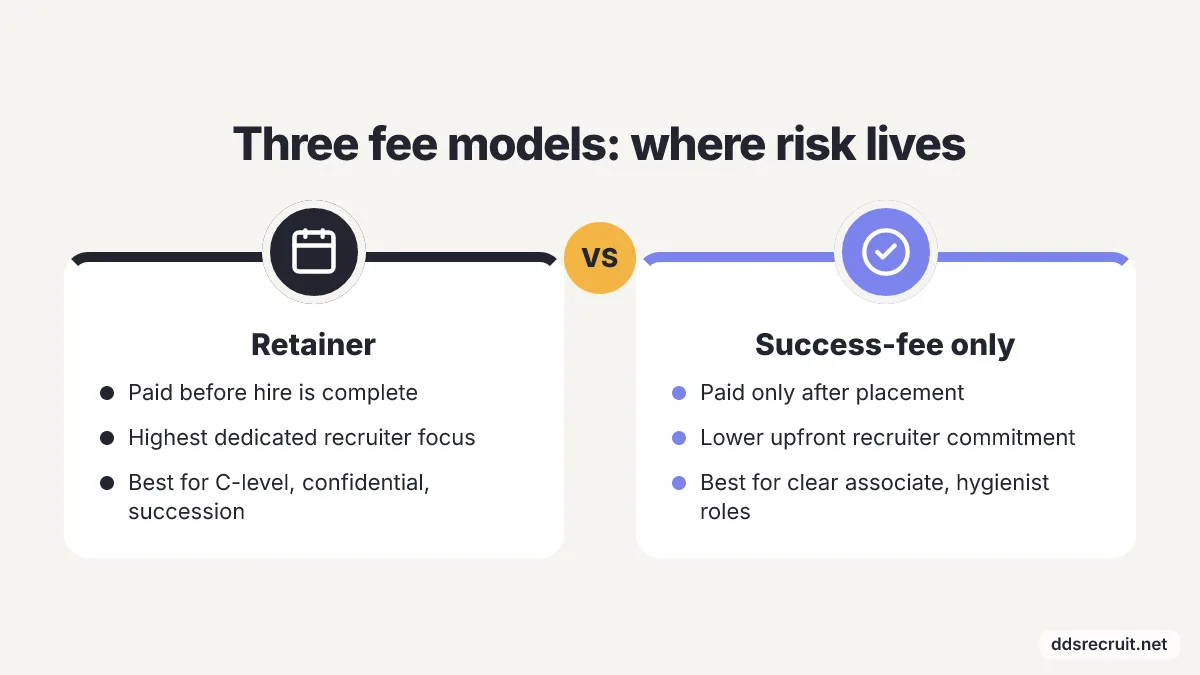
| Pricing model | Cash timing | Recruiter focus | Dental roles that tend to fit | Main trade-off |
|---|---|---|---|---|
| Retainer | Paid before the hire is complete | Highest dedicated commitment when the scope is clear | Chief Clinical Officer, COO, confidential specialist, succession planning hire | Practice carries more upfront financial risk |
| Success-fee only | Paid only after a successful placement under the agreement | Lower upfront commitment, strongest when the role is easy to present | Associate dentist, hygienist, office manager or key team member with clear terms | Search may receive less focus if the role is harder to close |
| Hybrid or engaged | Some upfront commitment, larger fee tied to placement | Shared commitment, useful for competitive or fit-sensitive searches | Dental associate, in-house specialist, DSO expansion lead, difficult suburban search | Practice must stay responsive or the monthly commitment loses value |
The table shows why the same dental practice might use different models for different seats. A hygienist search in a familiar labor market may not deserve the same fee structure as a DSO expansion leadership hire. A confidential partner-track associate search may need more focus than an ordinary associate posting, even though both use the same job title.
The model also changes how owners should think about job boards. A job board is useful when the role is attractive, the market is active and the practice can sort responses quickly.
Recruiting support should sit beside, not replace, the rest of a practice's growth decisions. Recruiter pricing should remain its own decision because the wrong fee structure affects who works the search and how long the practice waits.
The comparison stops short of proving that one model creates better hires in every dental market. The evidence in recruiter pricing pages and search-model explainers describes incentives and payment timing, not a universal outcome guarantee across associate dentists, specialists, hygienists and executives. The owner still has to match the model to role difficulty, internal speed and the cost of leaving the position open.
How should a dental practice choose for each role?
Start with what the role means to the business, then pick the fee model that puts responsibility in the right place. A practice owner who begins with the invoice total can easily underprice the search that matters most, while also overpaying for the search that could have been handled in a simpler way.
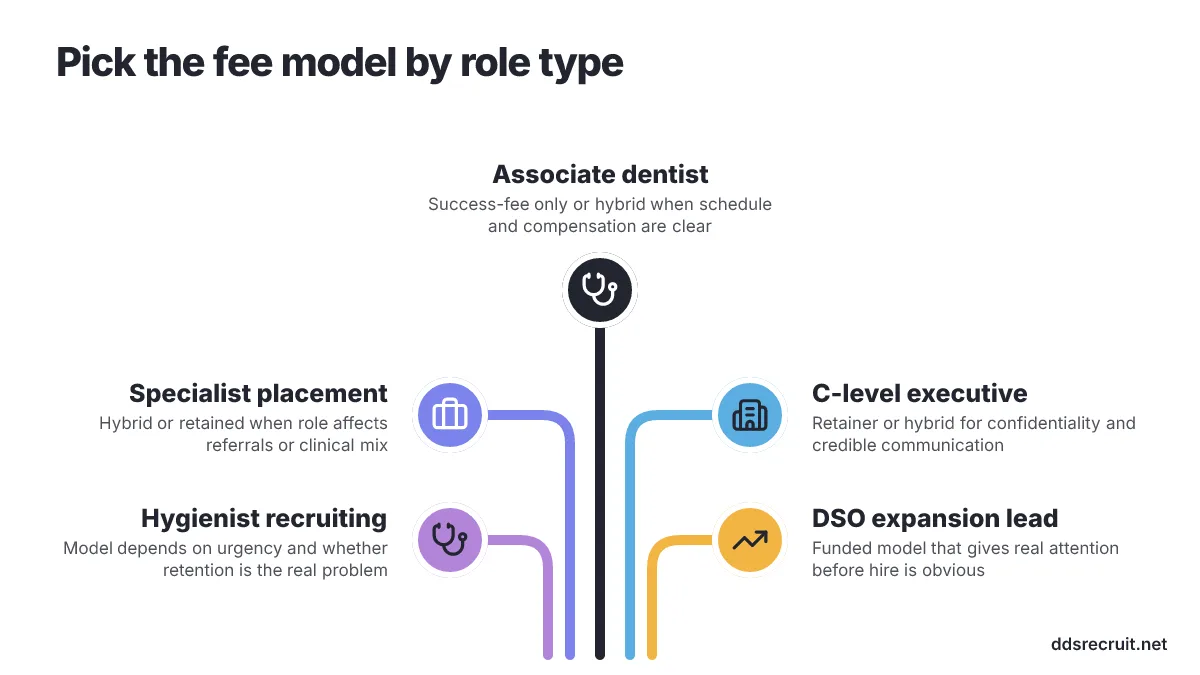
For an associate dentist, use success-fee only or a hybrid model when the practice has a clear schedule, a compensation range, and a location story. An associate search is not automatically simple, especially in a suburb where every nearby PPO office wants the same doctor.
A deeper look at associate placement for long-term fit helps when the practice has filled the chair before, then watched the hire leave. For specialist and in-house specialist placement, lean toward hybrid or retained support when the role affects referral patterns, clinical mix, or a new service line. An endodontist, periodontist, or oral surgeon brought in-house changes how the practice presents care and how the team schedules treatment. The fee model should buy enough recruiter attention to reach candidates who are not checking postings every week.
For a C-level executive search, such as Chief Clinical Officer or COO, a retainer or hybrid model usually fits the seriousness of the assignment. Executive candidates expect confidentiality, a defined mandate, and credible communication from the hiring group. Success-fee only can work when the candidate pool is already warm, but a leadership search with unclear authority or shifting strategy will suffer under any pricing model. For office manager and key team member hiring, avoid overbuilding the search unless the role carries unusual complexity. A strong local office manager role with clear pay and authority may fit success-fee only. A multi-site operations leader, however, starts to look like executive hiring because the person will influence systems, culture, and doctor support across locations.
For hygienist recruiting, the right model depends on urgency and local supply. A practice needing one day of hygiene coverage should not treat the search like a retained executive assignment. A practice trying to rebuild a hygiene department after repeated turnover has a fit and retention problem, which points toward a recruiter who stays accountable beyond the first résumé. For DSO expansion lead placement, use a model that funds real attention before the hire is obvious. The person driving market growth, de novo openings, or acquisition integration is not interchangeable with a generic operations résumé. Groups hiring for that seat should look at DSO expansion leadership before deciding whether a pure contingency search gives the role enough weight.
For succession planning hires, treat the pricing decision as part of transition planning. The incoming doctor or leader has to fit the team, patients, and future ownership path, not just fill production days. A retained or hybrid structure often fits that level of consequence because the practice is buying continuity as much as candidate access.
Recruiter marketplace models add another choice for practices and independent recruiters. Practices should still ask how fees are owed, when they are owed, and what happens if the hire leaves.
A discovery conversation should end with plain answers to four questions: what is paid upfront, what is paid only after placement, what role type the model is built for, and what replacement promise applies. The pricing model should be written clearly enough that the owner can explain it to a partner without translating recruiter jargon.
Conclusion
Pick the role before picking the fee. Write down the seat, why it is hard to fill, what delay is costing the practice, and how much culture mismatch would disrupt the team. That short brief will tell you whether upfront commitment buys needed attention or whether payment after placement is enough. The next move is a pricing conversation, not another round of job-board guessing. Ask the recruiter to state the upfront amount, the success-fee trigger, and the replacement terms in writing. If those answers are vague, stop there, because the pricing model is already creating the confusion it is supposed to remove.
Related reading
- Dental Associate Placement for Long-Term Success in the US
- Culture Mismatch in Dental Recruitment Problems
- Dental Recruiter Ambassador Program: Join for Success
- Why Success-Based Recruiting Works for Dentists