Dental Recruiter Ambassador Program: Join for Success
By Dr. Brian Passell and the DDS Recruit team ·
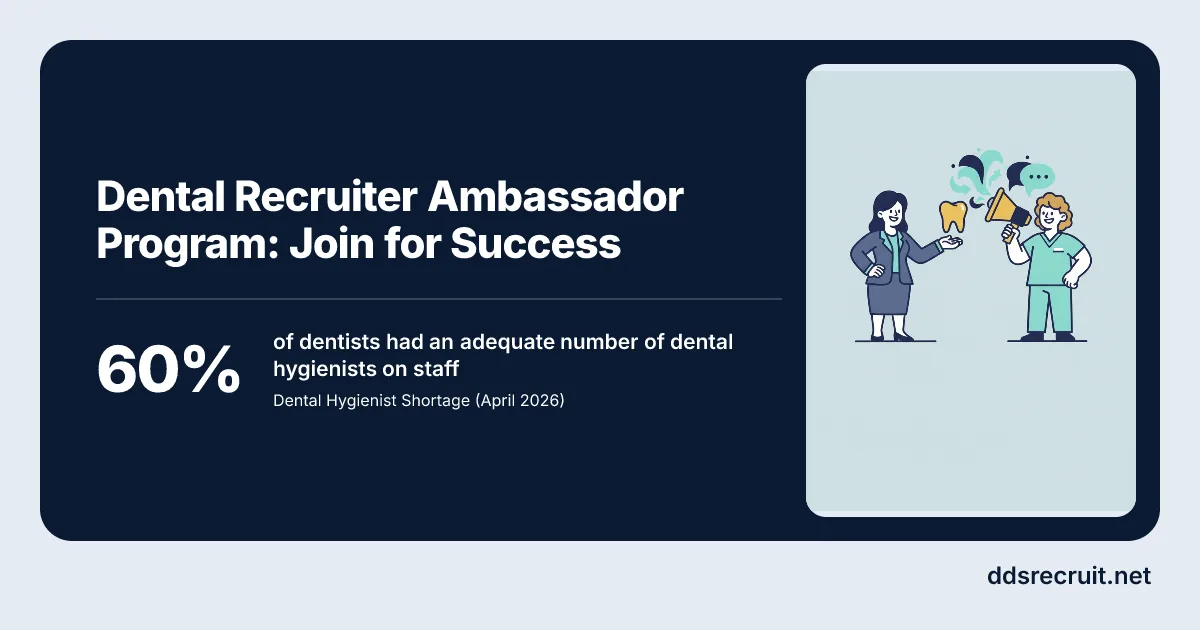
Summary: The Dental Recruiter Ambassador Program offers independent recruiters access to a dentistry-specific network, providing opportunities that go beyond generic staffing models. By joining, recruiters can benefit from a shared-fee system that enhances their ability to match candidates with dental practices, focusing on culture fit and specialized roles such as associate dentists, hygienists, and clinical leaders, ultimately improving recruitment success and retention.
ADA News in 2025 reported that about 62% said staffing shortages were the top response when dentists were asked about the biggest challenge facing their practices. For an independent recruiter, that number is not an abstract labor-market signal. It is a line of owners, office managers, and DSO operators who need clinical hiring help before empty schedules start changing production.
A dental recruiter ambassador program is worth considering when it gives an independent recruiter access to dental-specific demand without forcing that recruiter into a generic staffing model. The central point is simple: a shared-fee network is only worth joining when it adds dentistry-only opportunity, culture-fit context, and clear economics that a solo recruiter could not easily build alone.
The wrong marketplace turns independent recruiters into lead chasers with a logo. The right one lets a recruiter stay entrepreneurial while working inside a category where associate dentists, specialists, hygienists, office managers, and clinical leaders all require sharper matching than a résumé database provides.
What should a shared-fee network add for a dental recruiter?
Shared-fee value begins with access to searches a solo recruiter would not otherwise see. Independent dental recruiters usually bring relationship skill, candidate trust, and local knowledge, but they lose time when every new opening requires fresh business development before candidate work can begin.
Dental recruiting is too context-heavy for a marketplace that only passes names around. A recruiter needs to understand whether a practice is hiring an associate dentist for growth, a hygienist to recover hygiene capacity, an in-house specialist to keep referrals inside the practice, or a Chief Clinical Officer for multi-location clinical leadership. Those are different searches, and a network that treats them alike adds volume without judgment.
DDS Recruit website describes DDS Recruit as a fractional, culture-first dental recruiting team backed by 17 years of dentistry-only search experience that matches for fit, not just résumés, and backs every placement with a one-year placement guarantee unlike generic job boards or volume-based recruiters. In marketplace terms, that positioning matters because the recruiter is not just filling requisitions, the recruiter is protecting the match that has to survive after the offer is accepted.
Independent dental recruiter network opportunities should be judged by the work behind the opportunity, not by the promise of more leads. A marketplace that includes dental associate and doctor recruiting, specialist and in-house specialist placement, C-level executive search for Chief Clinical Officer and COO roles, office manager and key team member hiring, hygienist recruiting, and DSO expansion lead placement creates a wider lane for a recruiter who already understands dental employers. The next question is whether the demand is deep enough to support that lane.
The hiring demand behind the opportunity
The U.S. Bureau of Labor Statistics Occupational Outlook Handbook projects dentist employment will grow 6 percent from 2025 to 2035, with about 4,800 openings for dentists projected each year. That gives associate and doctor recruiters a durable demand base, especially in suburbs and selected metros where private and PPO-based offices compete with groups and DSOs for the same doctors.
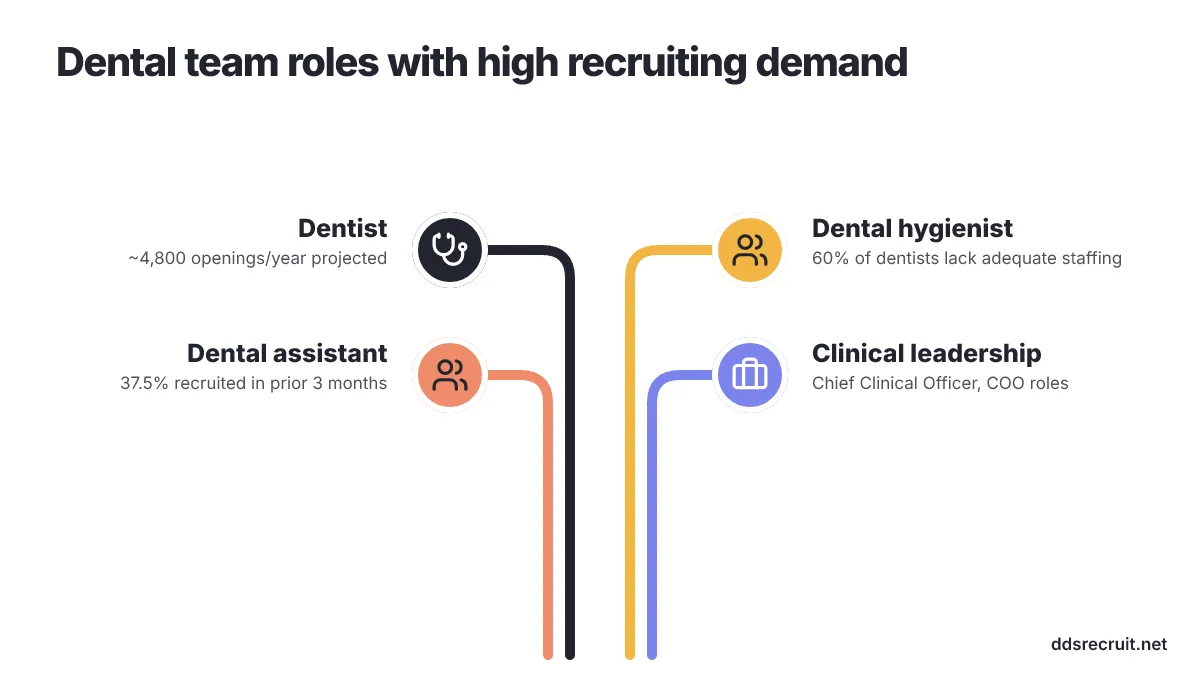
ADA Health Policy Institute in April 2026 reported that only 60% of dentists had an adequate number of dental hygienists on staff, and among dentists who were actively recruiting or had recently recruited a hygienist, 91% said recruiting hygienists was very or extremely challenging. Hygienist recruiting gives a marketplace recurring demand, but it also tests whether the network understands retention and practice fit rather than just availability.
The ADA's Q3 2025 State of the U.S. Dental Economy update found that 32.5% recruited dental hygienist positions in the previous three months, while 37.5% recruited dental assistants. Among dentists recruiting, only two out of five filled hygienist openings, with 21.5% reporting more than six months to fill the role. A recruiter marketplace earns its keep when it gives practices and recruiters a better path through that bottleneck than another listing.
Marko Vujicic, PhD, HPI chief economist and vice president, told ADA News that almost all positions on the dental team have become harder to recruit for: "For almost all positions on the dental team, recruiting has become increasingly difficult." That comment explains why a shared-fee model should not be limited to doctor searches if the network serves the whole dental team.
The American Dental Hygienists' Association, cited in Elegant Lab's 2026 discussion of the dental hygienist shortage, described the issue as a retention crisis not a supply crisis. A recruiter who hears that distinction will ask better questions about schedule design, practice culture, compensation expectations, and leadership style before presenting a role to a candidate. That is where marketplace participation starts to look less like lead exchange and more like category specialization.
What should independent recruiters ask before joining?
Start with the fee terms, because shared opportunity without clear economics becomes resentment fast. A recruiter should ask how fees are shared, when payment is earned, who owns the client relationship, what happens if a candidate is already known to more than one recruiter, and whether the network pays on placement, retention, or another defined trigger.
Ask how the marketplace defines dental focus before assuming the label means much. A serious network should be able to say whether it supports associate dentist searches, specialist recruiting, in-house specialist placement, hygienist recruiting, office manager hiring, DSO expansion lead roles, succession planning hires, and C-level executive search. A recruiter who wants to move from general staffing into dental should ask whether the network expects prior dental recruiting experience or provides only access to openings.
Ask what the marketplace shares with recruiters about the role, but do not expect an internal playbook unless the company publishes one. The useful information is practical: role type, practice setting, geography, whether the employer is a private office or group, and whether the search is for clinical production, leadership, hygiene capacity, or expansion. Anything beyond what the network makes public should be requested directly rather than assumed.
Ask where culture fit appears in the commercial promise. A recruiter joining a marketplace should look for the same alignment between what the network sells to practices and what recruiters are asked to deliver.
Ask how risk is handled when a hire leaves. An independent recruiter should ask how those public promises affect shared-fee participation before accepting work.
A recruiter who already owns enough direct dental searches, wants total control over every client communication, and does not want shared economics should stay solo instead of joining a marketplace. The trade-off in a network is real: the recruiter gains access to category demand and shared infrastructure, but gives up some independence around terms, brand presentation, and account control. A good decision starts with naming that trade-off before the first candidate call.
How should practices and DSOs use a marketplace without losing culture fit?
Culture fit belongs in the role definition before candidate outreach starts. A practice that tells a recruiter only "associate dentist needed" leaves out the details that decide whether a doctor stays, including pace, mentorship expectations, procedure mix, ownership path, clinical autonomy, and the way the team handles full schedules.
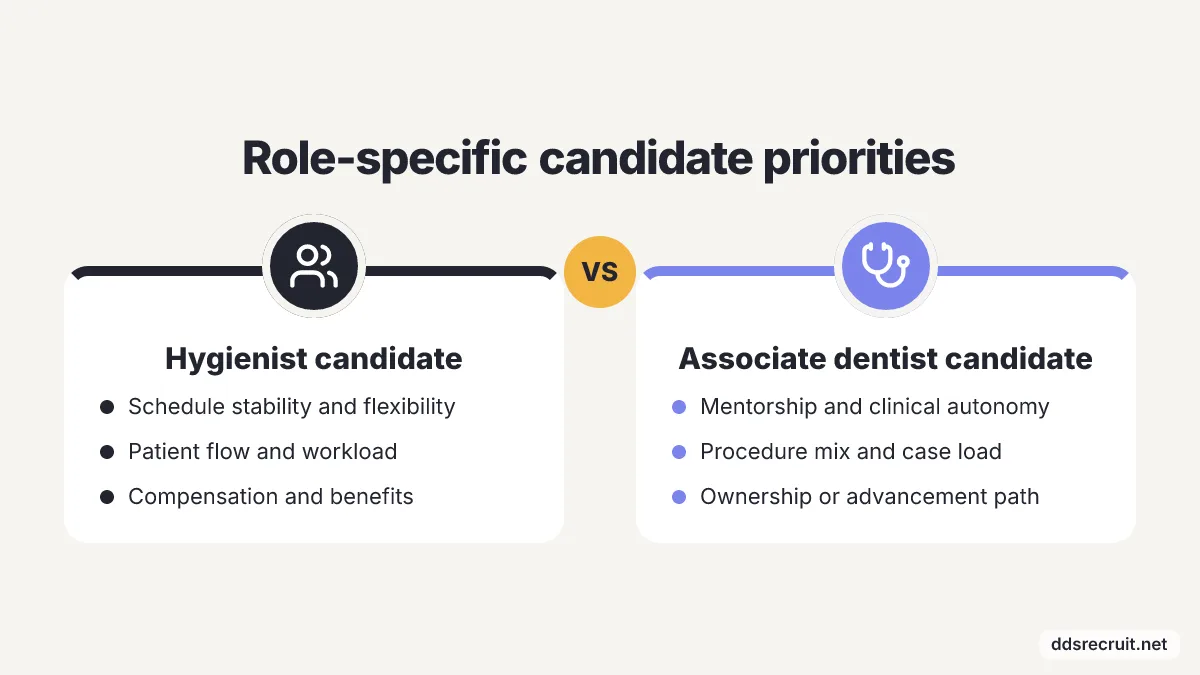
A practice owner using a recruiter marketplace should make the search specific enough for a recruiter to represent it honestly. Associate dentist recruiting is different from hygienist recruiting because candidates weigh different risks. A hygienist may be testing schedule stability and patient flow, while an associate dentist may be weighing mentorship, case mix, production expectations, and whether the role leads anywhere.
For a Chief Clinical Officer or COO role, the search shifts from provider availability to leadership fit. A DSO expansion lead, Chief Clinical Officer, or COO affects clinical standards, regional growth, and operator trust across locations. A practice group looking for that kind of specialized recruiter should ask whether the recruiter has handled dental leadership searches, not just healthcare leadership searches.
A specialist search has its own fit problem because in-house specialists change referral patterns inside a practice. A periodontist, endodontist, oral surgeon, or other specialist must fit the clinical team, the patient base, and the practice's plan for keeping care in-house.
Available job postings give recruiters and candidates a practical view of the work on the site. A marketplace that shows live roles makes the first conversation more grounded.
Generic job boards still have a place when a practice needs broad exposure and has the time to sort responses internally. A board publishes an opportunity, while a recruiter marketplace should bring human judgment to fit, timing, expectations, and follow-through.
Where does a recruiter marketplace fit in the dental business ecosystem?
A marketplace becomes more useful when it sits inside a broader dental-specific business environment. Recruiters who understand hiring often hear adjacent needs from practices, including marketing, vendor selection, peer learning, and transition planning, even when the recruiter's own role should stay focused on hiring.
A recruiter marketplace works better when each business problem has the right home.
Recruiters should protect their own lane for the same reason practices should define the role before searching. A recruiter who tries to solve compensation design, marketing volume, vendor management, clinical leadership, and associate hiring in one conversation risks losing the hiring thread. A shared-fee network is strongest when it gives recruiters enough context to speak intelligently, then keeps the work centered on placement.
Practice leaders should take the same disciplined approach when entering a marketplace search. A group opening several locations needs different support from a single-site practice replacing one associate. A succession planning hire is different again because the incoming doctor may affect ownership continuity, patient relationships, and staff confidence.
Independent recruiters should read the marketplace page, review current roles, and ask direct questions before treating an ambassador program as a revenue channel. The next useful step is not joining every network, but choosing the one where the recruiter's dental knowledge has commercial value.
Conclusion
Begin with one decision: whether shared-fee dental recruiting gives you access to searches you are qualified to work and could not reach efficiently on your own. An independent recruiter should review the marketplace terms, the types of roles available, the public promises made to practices, and the level of dental specificity before joining.
A practice or DSO should come to the same conversation with a defined role, not a vague staffing need. Culture fit takes usable detail from the employer and category knowledge from the recruiter. When both sides bring that discipline, a recruiter marketplace becomes more than a lead exchange, and the first call can focus on whether the opening, fee model, and recruiter fit are worth pursuing.
Related reading
- Dentistry-Specialized Recruiters for Long-Term Hires
- Retainer or Success Fee: Pick a Dental Recruiter
Sources
- ADA Health Policy Institute — Dental Hygienist Shortage (April 2026)
- ADA News — Five years later: Staffing shortages since the COVID-19 pandemic (Feb. 2025)
- ADA — The State of the U.S. Dental Economy, Q3 2025 Update
- ADHA shortage characterization, cited via Elegant Lab — The Dental Hygienist Shortage in 2026
- U.S. Bureau of Labor Statistics — Occupational Outlook Handbook: Dentists
- Marko Vujicic, PhD, HPI chief economist and vice president, ADA News