

Choosing Dentistry-Specialized Recruiters for Lasting Hires
By Dr. Brian Passell and the DDS Recruit team ·
Summary: Choosing a dentistry-specialized recruiter over a generalist HR firm matters most for long-term clinical and leadership hires. Brief the recruiter on the role and practice model, ask how they judge fit and what guarantee backs a placement, and save specialized search for the roles where a wrong hire costs the most.
Thirty-one percent of hygienists plan to retire within six years, according to DentalPost's 2025 Salary Survey reported by Becker's Dental Review in 2025, and that 31% of hygienists plan to retire turns one resignation into a long-term capacity problem. An empty slot on next month's schedule is part of it. The bigger hit comes later, when the wrong hire drags on patient trust, staff morale, and owner time for months.
That is why many practice owners and DSO leaders now look for dentistry-specialized recruiters who can help with long-term hires instead of just passing along résumés. For clinical and leadership roles, fit is not a nice extra. It decides whether a dentist, hygienist, specialist, office manager, or executive lasts long enough to justify the search.
A recruiter who pays attention to culture is worth a look when the practice needs judgment, not just more names. The better questions are plain ones: does this recruiter understand the role, the practice model, and the damage that follows a bad match?
What should you brief a dental recruiter on first?
A long-term dental hire needs a clear definition of fit before the search begins. Fit should describe the work setting, production expectations, patient mix, leadership style, and growth path tied to one role, because a candidate who works well in one office can stumble in another with the same title.
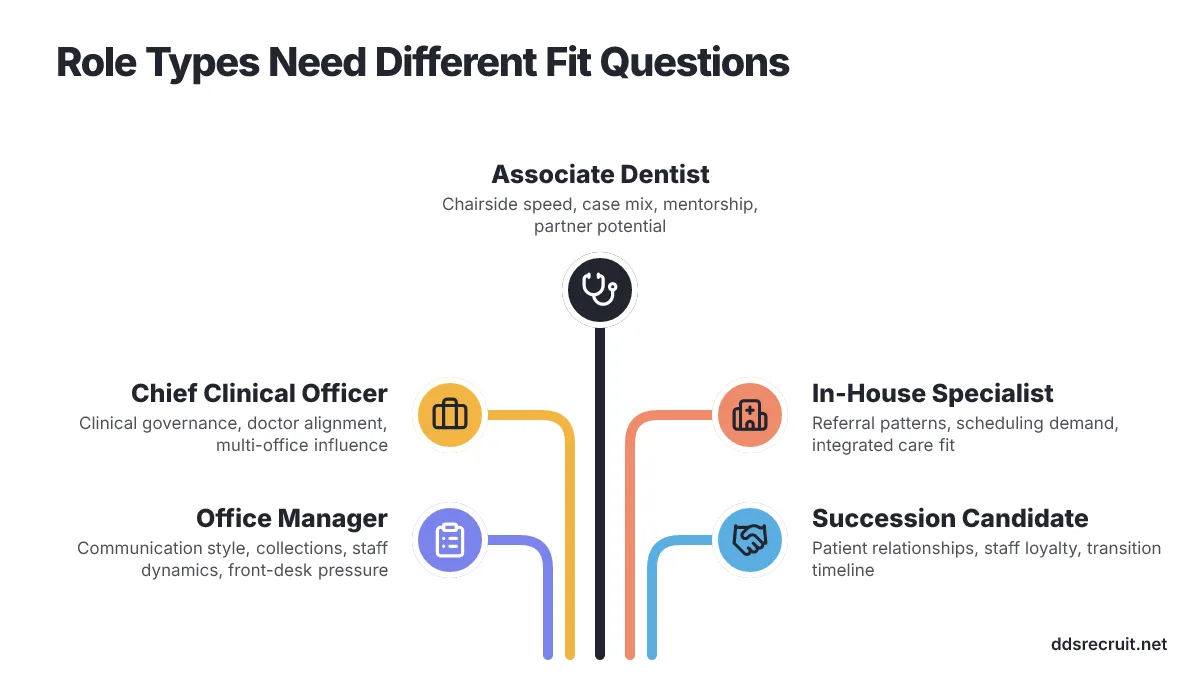
A private PPO-based practice hiring an associate dentist is solving a different problem from a DSO hiring a Chief Clinical Officer. The associate role may hinge on chairside speed, case mix, mentorship expectations, and whether the owner wants a future partner. The Chief Clinical Officer role may hinge on clinical governance, doctor alignment, and the ability to influence several offices without sending every decision back to the owner. A specialist hire brings a separate set of questions. An in-house endodontist, periodontist, or oral surgeon has to match referral patterns, scheduling demand, and the practice's expectations for integrated care. A specialist who wants a high-volume specialty center may not fit a general practice trying to build specialty access slowly for existing patients.
An office manager hire puts the fit question in front of the team every day. The right office manager has to work with the owner's communication style, front-desk pressure, collections expectations, and staff history. DDS Recruit has a dedicated office manager recruiting service for that kind of key team member hiring, and that search is different from filling a clinical chair. A succession planning hire asks for even tighter fit. A dentist who looks strong on paper still has to match the seller's patient relationships, staff loyalty, and transition timeline. The question is not whether the candidate can do the job in general. It is whether the candidate can become believable to the team and the patients who already know the practice's habits.
A useful starting brief should name the role, the practice model, the non-negotiable expectations, and the trade-offs the owner will accept. That brief gives a recruiter something real to test against, and it keeps the search from sliding into a pile of agreeable but mismatched conversations.
Specialized dental recruiters vs generalist HR firms
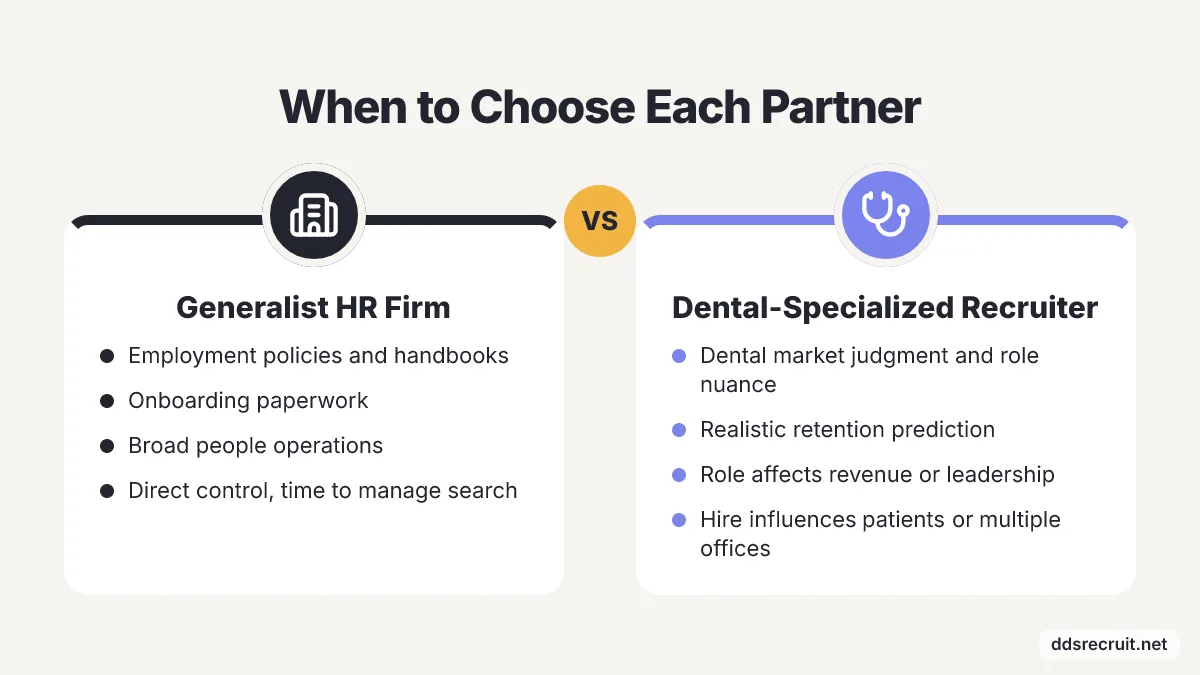
A generalist HR firm can be the right partner for employment policies, handbooks, onboarding paperwork, or broad people operations. A dentistry-specialized recruiter earns the fee when the open seat calls for dental market judgment, role nuance, and a realistic read on whether the candidate is likely to stay. ADA News reported in February 2025 that staffing shortages remained dentists' top challenge. Hiring pressure changes how owners should judge recruiting help. When the market is tight, a generic applicant funnel can create activity without lowering the risk of a bad match.
HR for Health's 2025 State of HR in Dentistry report links bad hiring fit drives turnover with first-year retention problems in dental workplaces. That point supports a practical hiring standard. The recruiter should be able to explain why a candidate would remain in the role, not just why the candidate would accept an offer.
Job boards still have a place when an owner wants direct control, has time to manage outreach, and is hiring for a role with a broad local candidate pool. The trouble is that a job board leaves the burden of fit on the practice, so the owner or office manager still has to judge whether the candidate's expectations line up with the office.
A temp staffing route belongs in the conversation when the practice needs short coverage, immediate schedule protection, or a trial period before a permanent hire.
A specialized dental recruiter becomes more valuable when the open role affects revenue, culture, or leadership continuity. The more the hire has to influence patients, doctors, or multiple locations, the less useful a résumé-only comparison becomes.
What should you ask a dental recruiter before signing?
A practice owner should ask questions that force the recruiter to connect the search to retention. The answers do not need to reveal a recruiter's internal process, but they should show whether the recruiter understands the business consequences of the hire.
Use these questions before signing a search agreement:
- Which parts of this role will make a strong candidate stay, and which parts will push a candidate away?
- How should the practice describe culture without leaning on vague words like family, fast-paced, or growth-minded?
- Which trade-offs should the owner settle before candidate conversations begin, such as schedule flexibility, mentorship, production expectations, or future ownership interest?
- What type of guarantee or replacement protection is attached to the placement, and what conditions should the practice ask about in writing?
- How will the recruiter talk about the opportunity to candidates without overselling the practice or hiding the role's hard parts?
A culture-focused recruiter should also be comfortable saying when the practice has a positioning problem. Compensation may be competitive, but a narrow schedule, unclear mentorship path, or vague leadership structure can still weaken the search. A recruiter who only says the market is hard is not giving the owner enough to act on. A guarantee should not be treated as a substitute for fit. A replacement guarantee is protection after a hire leaves, while fit work is meant to lower the chance that the practice has to use that protection. Owners should ask what the guarantee covers, what the practice must do if a hire leaves, and how quickly the replacement search can be discussed.
A recruiter should also understand the candidate side of the decision. Dental professionals comparing opportunities look for clarity around the role, the practice setting, and whether the position matches their long-term plans. Candidates can compare active opportunities through current dental job postings before deciding what kind of practice setting fits them.
Which searches need dental specialization most?
Associate dentist hiring is usually the first place owners notice the limits of résumé matching. Licensure, availability and clinical interest matter, but long-term fit also depends on whether the associate wants mentorship, autonomy, partnership potential or a defined employee role.
Specialist and in-house specialist placement needs a sharper match because the role changes the practice's clinical offering. A general dentist office adding specialty care has to consider patient demand, referral behavior and whether the specialist wants to build inside a multi-provider environment.
Hygienist recruiting deserves its own attention because the supply problem is not only local. Texas Dentists for Medicaid Reform in 2024 summarized ADA survey data on hygienist recruiting difficulty, and ADA News quoted Dr. Ricci in 2025 saying, "The number of graduating dental hygienists from allied education programs has not been enough to compensate for the losses of team members who left the profession during the pandemic" on the allied education pipeline. A practice that treats hygienist hiring as a simple posting exercise is competing against a supply issue that many owners cannot solve alone.
Leadership searches create a different risk. A Chief Clinical Officer, COO or DSO expansion lead must fit the operator's growth plan, not just the posted job description. The wrong executive hire can create confusion across offices, while the right one gives doctors and managers a clearer point of accountability.
Succession planning hires need a recruiter who understands both sides of the handoff. The selling owner may care about patient continuity, staff retention and reputation in the community. The incoming dentist may care about clinical autonomy, debt, ownership structure and whether the practice can support growth after the transition.
Key team member hiring sits between clinical and executive recruiting. An office manager, lead assistant or other practice leader can decide whether a new doctor hire succeeds after the offer is accepted. When the front office is unstable, the dentist search may look like the problem even though the practice is asking a new clinician to join a team without operational balance.
A practice hiring across several role types should not use one generic script for every search. The questions behind an associate, hygienist, specialist, office manager and C-level hire are different enough that a recruiter should discuss each role in its own business context.
How do you act without adding a full-time recruiter?
A fractional recruiting relationship makes sense when the practice needs sustained hiring help but does not want to add a full-time recruiting role. The owner gets outside search capacity tied to specific openings, while the practice keeps control of the final hiring decision.
That structure matters for owners who are skeptical of paying large sums before knowing whether a placement will work.
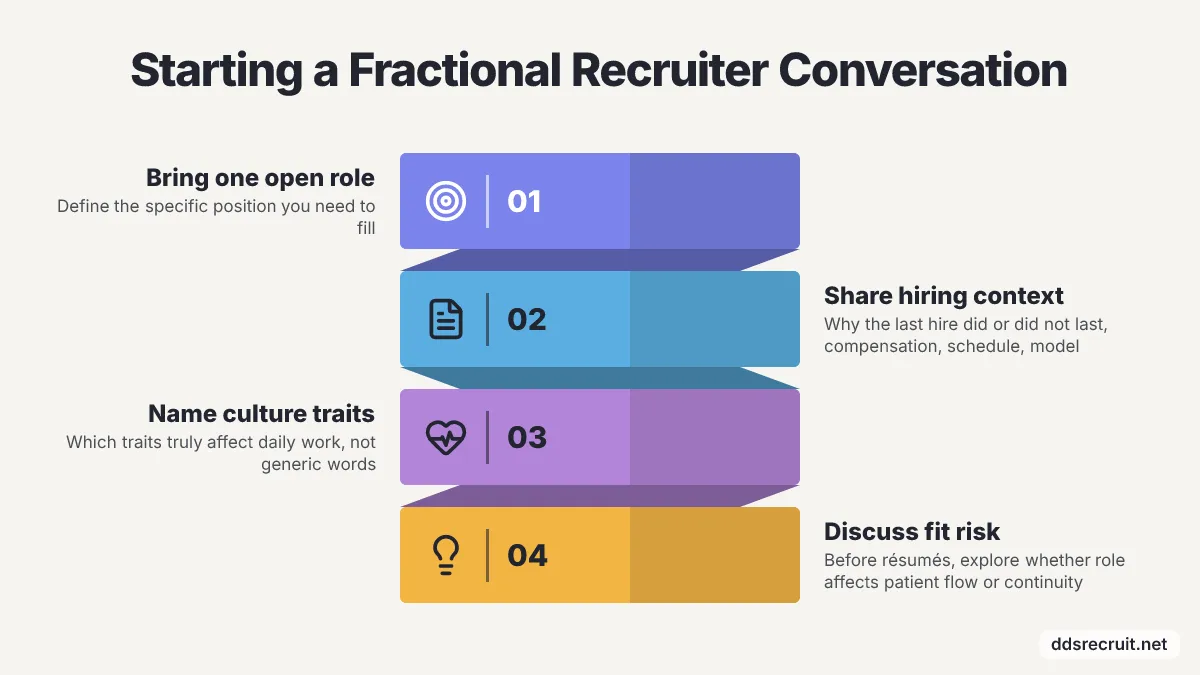
A first conversation should be narrow. Bring one open role, the reason the last hire did or did not last, the compensation range, the schedule, the practice model and the culture traits that truly affect daily work.
Practice leaders should also decide whether the opening is part of a larger growth plan. A DSO expansion lead, specialist hire or succession candidate may require more strategic alignment than a single replacement search.
Independent dental recruiters have a different path into the same market.
Related businesses can sit around the hiring decision without replacing recruiting.
The decision point is practical: if the role affects patient flow, leadership continuity or the practice's next stage of ownership, treat the recruiter choice as a business decision rather than a vendor search. The recruiter should be able to discuss the role's fit risk before anyone talks about résumés.
Conclusion
Start with the hardest open role, not the easiest one to post. Write down the role's daily expectations, the reasons someone would stay, the reasons someone might leave, and the business consequence if the hire fails. That work takes owner attention, but it gives a dental recruiter enough context to discuss fit instead of only availability.
The next step is a focused conversation with a recruiter who works inside dentistry and is willing to talk about long-term match, role risk and replacement protection in plain terms. Stop before asking a recruiter to solve compensation, leadership confusion or a poorly defined role by sending more candidates. A better search begins when the practice can name what success looks like for the person who accepts the seat.
Related reading
- How to recruit dentists who stay
- Placing a dental associate for long-term fit
- Temp vs Full-Time Dental Hire: Making the Choice
- Dental Recruiter Ambassador Program: 2026 Insights
- Retainer or Success Fee: Pick a Dental Recruiter
Sources
- ADA News: "Five years later: Staffing shortages, infection control since the COVID-19 pandemic" (Feb 2025)
- Texas Dentists for Medicaid Reform: "ADA Survey Highlights Challenges in Dental Staff Recruitment" (2024)
- Becker's Dental Review: "31% of hygienists plan to retire within 6 years: Report" (2025)
- HR for Health: "2025 State of HR in Dentistry" Report