

How to Recruit and Retain Dentists: A Fit-First Plan
By Dr. Brian Passell and the DDS Recruit team ·
Summary: To recruit dentists who stay, practices should focus on defining the role with clear expectations and retention risks before posting the job. This includes detailing the schedule mix, clinical autonomy, mentorship opportunities, and growth potential. A successful strategy connects these elements to the practice's long-term needs, ensuring candidates understand the role and its challenges upfront, reducing turnover.
A one-year placement guarantee, with a free replacement search if a hire leaves in the first year, is a reminder that a signed associate offer is not the finish line. To recruit dentists who stay, define the role around fit, expectations, and retention risk before the opening is posted. The best dental hiring plan starts with the work the dentist will actually take on: schedule mix, clinical autonomy, mentorship, patient flow, and the owner's long-term need. If a practice skips those specifics, it is not running a dental associate recruiting strategy. It is hoping the right person will read a vague job and fill in the blanks.
Start with the role the dentist is expected to keep
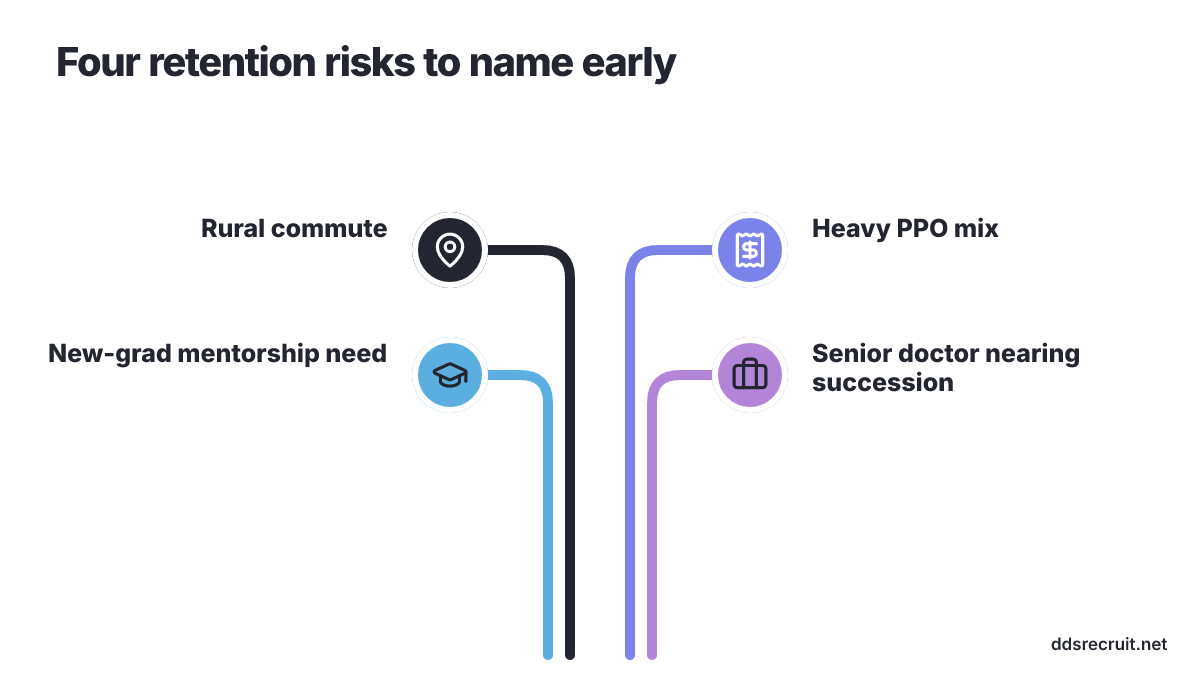
Role design should come before candidate sourcing, because retention usually breaks where the job and daily reality split apart. A private practice hiring its first associate has a different promise than a DSO adding a provider to support expansion. Both roles need a clear answer on who diagnoses, who mentors, how treatment planning works, and what growth looks like after the first months. Owner-doctors should write the retention risk into the search brief instead of hiding it until the interview. A rural commute, a heavy PPO mix, a new-grad mentorship need, or a senior doctor nearing succession can all work when named early. Each one becomes a reason to leave when the candidate finds out later.
A short-term emergency opening is the one case where a full retention-first search is the wrong first move. A practice that needs immediate coverage should separate temporary production protection from the permanent search. Urgency makes it too easy to treat availability as fit.
What belongs in a dental associate recruiting strategy?
The opening should connect chair time, mentorship, clinical autonomy, and growth before the first candidate call. A dental associate recruiting strategy is not only where the job is posted, it is the promise the practice is ready to keep after the dentist starts seeing patients.
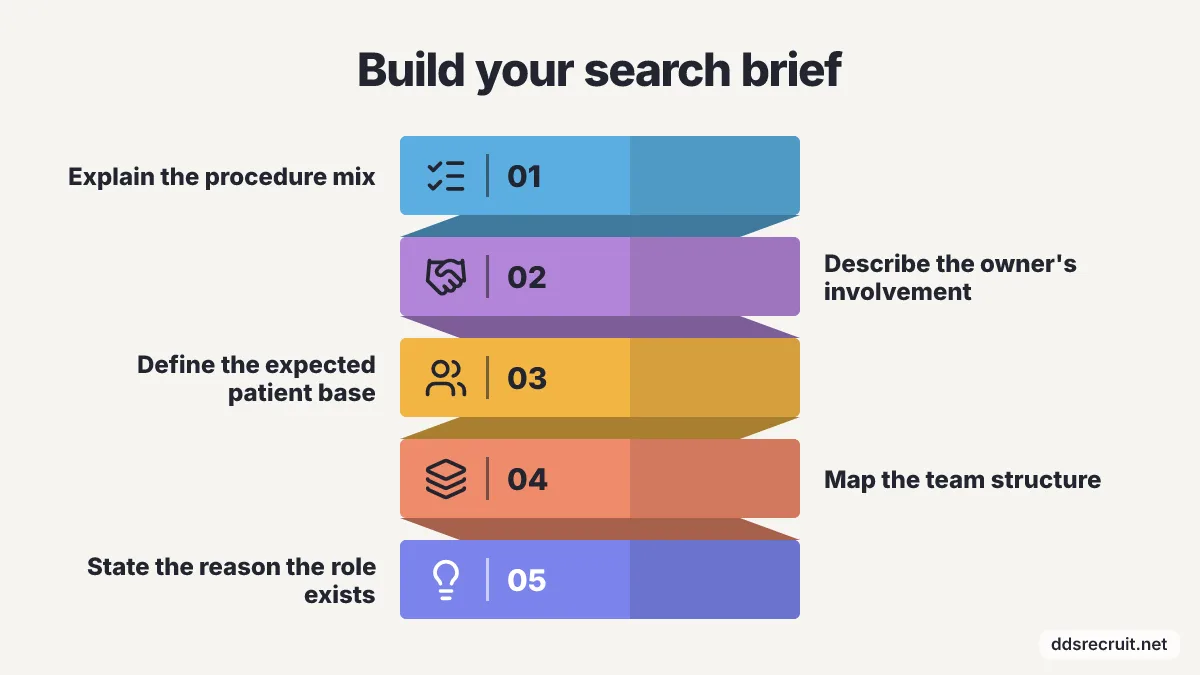
A useful search brief answers practical questions without pretending every detail is fixed. The practice should be able to explain the procedure mix, the owner's involvement, the expected patient base, the team structure, and the reason the role exists. A replacement role, an expansion role, and a succession-planning role draw different dentists, so the same ad should not be used for all of them. Current openings provide a reality check before the practice publishes its own role. Comparing the language on current dental job postings helps an owner see whether the position reads like a career move or just another chair to fill.
Practices that need help shaping this kind of search can look at associate dentist recruiting support when the core issue is doctor hiring. The same retention logic applies when the bottleneck is hygiene, because hygienist recruiting support affects whether a dentist inherits a schedule that supports diagnosis and treatment planning.
When should you stop relying on job boards?
Job boards help people find you, but they are a weak first move when the practice needs a dentist who fits the office and stays. ADA News reported in February 2025 that staffing shortages remained active in dentistry five years after the COVID-19 pandemic. That leaves a posting sitting in the same crowded feed as every other office with an opening.
The American Dental Association (ADA) noted in its 2024 Trend Report that the dental industry is experiencing significant changes in workforce dynamics. DDS Recruit is a culture-first dental recruiting team backed by 17 years of dentistry-only search experience, with Dental associate & doctor recruiting, Specialist and in-house specialist placement, and C-level executive search (Chief Clinical Officer, COO). For practice owners, the useful split is simple: this work centers on fit, not just résumés. Generic posting sites leave that burden on the hiring doctor.
A success fee model changes the practice owner's risk calculation when the search is difficult.
How do you lower the risk of a bad hire?
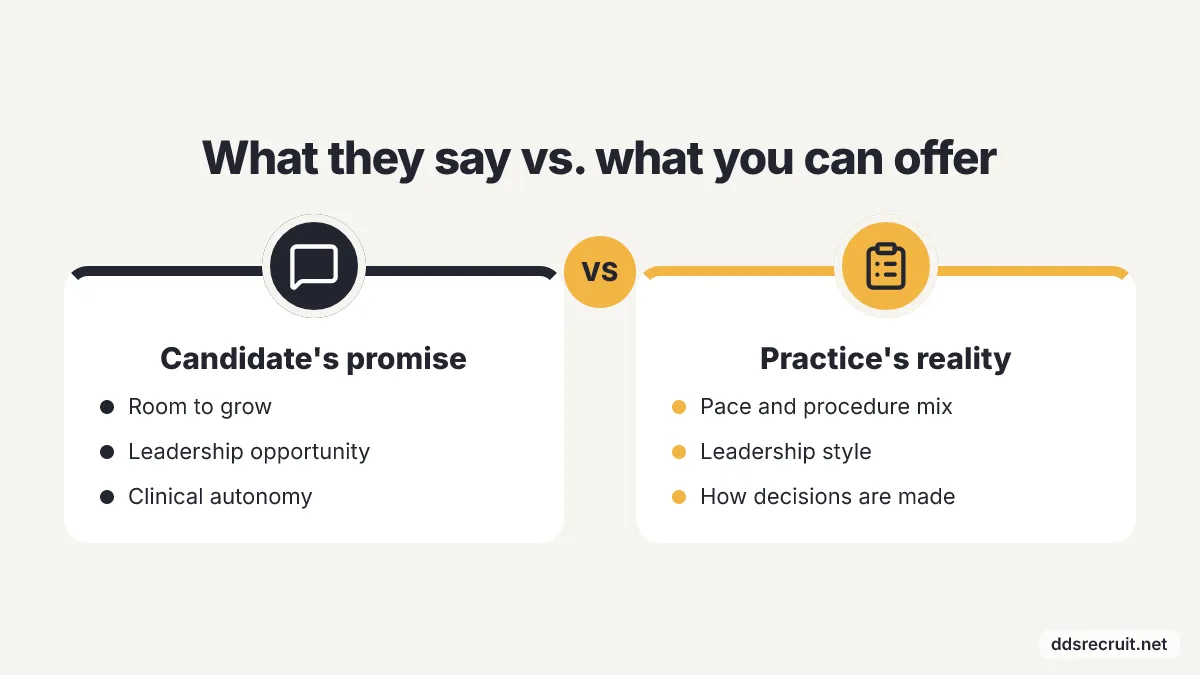
Candidate fit needs proof from the actual practice, not a pleasant interview alone. A practice should compare what the dentist says they want with what the office can honestly offer, including pace, leadership style, procedure mix, team maturity, and how decisions are made chairside. Bad hires often start with a true statement that leaves out too much to be useful. "We have room to grow" can mean very different things in a startup, a suburban PPO office, a multisite DSO, and a specialist-heavy practice. The hiring conversation should name the growth path and the support behind it.
Specialist and leadership searches need a tighter link between the business plan and the person. An in-house specialist placement changes referral patterns inside the practice. A Chief Clinical Officer affects clinical consistency across locations. A DSO expansion lead placement touches growth strategy, not just production coverage.
The wider hiring picture matters when retention depends on more than the job description. A practice that wants to pressure-test its own assumptions can start with the questions in the right dentist fit discussion. The goal is not a polished pitch. It is a role description specific enough that the right dentist says yes for the right reasons.
The Dental Workforce Shortages Labor Market report by the ADA in 2024 highlights the ongoing challenges in recruiting and retaining dental professionals, emphasizing the need for strategic hiring practices.
Conclusion
The first move is to write the real role before writing the advertisement. Name the clinical work, the leadership context, the growth promise, and the parts of the job that require the right temperament, then decide whether job posting, direct recruiting, or outside support fits the search.
A practice that has already lost time on stale applicants should not add more vague exposure and hope for a different result.
Related reading
- Choosing a dentistry-specialized recruiter
- Placing a dental associate for long-term fit
- What a culture mismatch costs a dental practice
- Turning dentist fit into hiring criteria with I/O psychology
- Why Success-Based Recruiting Works for Dentists
- 6 Best Ways to Recruit Dentists for DSO Growth
- Private Practice vs. DSO Dentist: Which Fits Your Career?