
Using I/O Psychology to Improve Dental Hiring
By Dr. Brian Passell and the DDS Recruit team ·
Summary: I/O psychology turns dental hiring into criteria you can score: the team behavior, communication habits, clinical autonomy and motivation a role needs, written down before interviews start, so candidates are judged against the practice's real conditions rather than credentials alone.
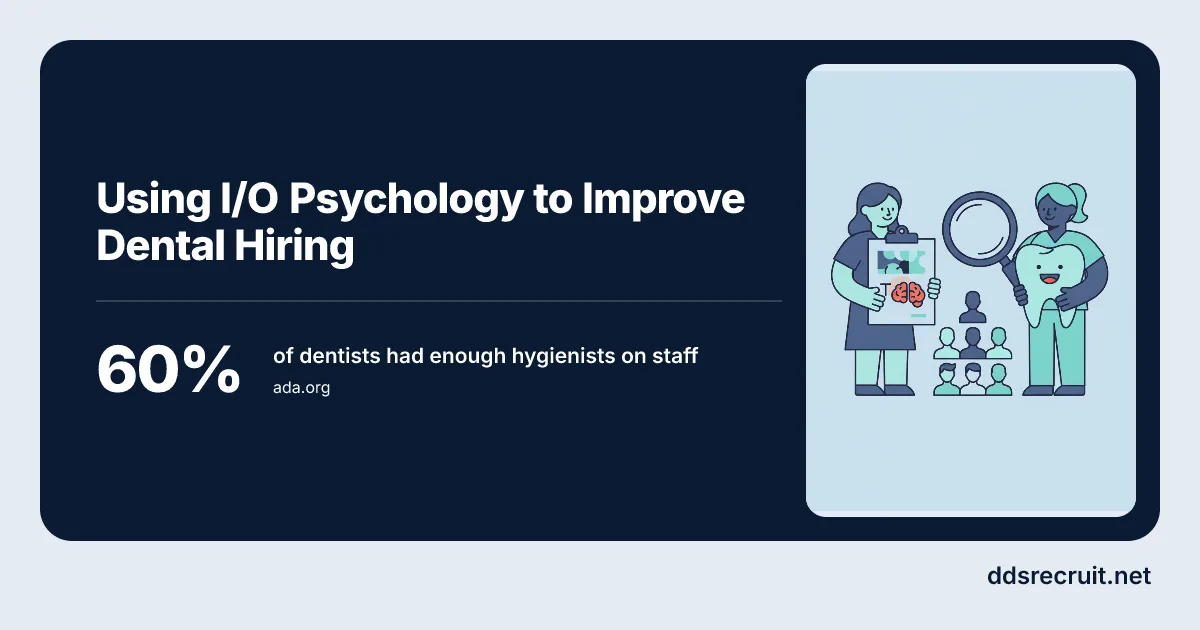
An empty operatory at 8:00 AM sends the practice owner back to chairside triage instead of running the business. When production slips because a chair stays dark, the cost of turnover shows up fast. The ADA Health Policy Institute reported in 2026 that only 60% of dentists had enough hygienists on staff, and 91% of dentists who were actively recruiting hygienists said the search was very or extremely challenging. The pain gets worse when an associate schedule sits half-booked and treatment plans stall between diagnosis and delivery.
Using dental hiring psychology is not about slapping personality labels on applicants. In a dental office, practical industrial and organizational, or I/O, psychology turns day-to-day team behavior, expectations around clinical autonomy, communication habits, and workplace motivation into hiring standards before leadership spends weeks chasing resumes that never settle into stable hires. A practice owner can fairly question the idea that clinical credentials by themselves predict retention. The team member who stays for years is usually the one with strong clinical skill, a pace that fits the office, clear patient communication, and a working style that fits with coworkers during busy stretches.
Why I/O psychology belongs in dental hiring now
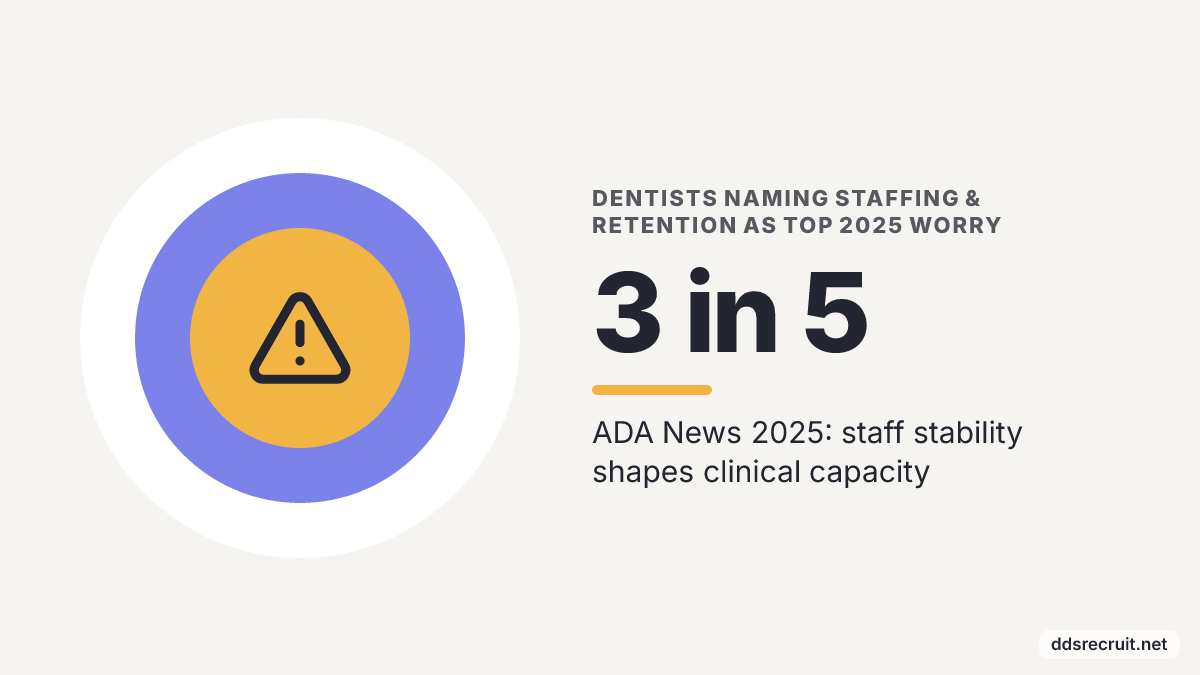
Staff stability shapes clinical capacity in modern dental practices. ADA News reported in 2025 that about 3 in 5 dentists named staffing and retention, especially hygienists, as a top worry heading into 2025. Looking only at paper qualifications misses the main reason many clinical relationships fall apart in the first year, the role was defined by credentials instead of the habits needed on the floor. Workplace psychology studies how people function inside operating settings, handle hierarchy, and manage team communication. In a clinical facility, that means practical friction points. It shows whether an associate will accept direct clinical coaching from an owner, whether an in-house specialist can protect relationships with referring colleagues, whether an office manager can lead without triggering resignations, and whether a hygienist can work inside the practice's block scheduling system.
Clinical competence stays the required baseline because no behavioral profile fixes weak diagnostic execution, incomplete licensure, or broken infection control. Behavioral fit matters only after the technical standards are checked, and it sits beside clinical evaluation instead of replacing it. A warm bedside manner does not excuse an associate who cannot complete the restorative work on the daily schedule.
Persistent labor shortages leave little room for hiring mistakes. ADA News reported that in Q3 2024, 33.9% of dentists were recruiting a hygienist, and 91.7% of those dentists said recruitment was very or extremely challenging. When applicant volume drops, a bad hire does more than restart the search. It forces the current staff through repeated onboarding, damages patient trust, and drains production while leadership begins recruiting again.
This behavioral approach shifts the evaluation from simple candidate availability to candidate durability under real clinical conditions. That matters when hiring for permanent roles like associate doctors, specialty providers, practice administrators, or executive leaders in growing dental service organizations.
What should I/O psychology change in a dentist search?
Recruitment for clinical providers has to start with the office's daily behavior, not a recycled job description. Saying an office needs an associate doctor does not pin down the role. Leadership has to spell out the pressure, the production pace, and the working relationships that doctor will deal with every day.
An associate job in an established private PPO practice often asks for patience with patient education, comfort working beside a senior clinician's long treatment philosophy, and the ability to keep going while patient volume builds slowly. By contrast, an associate role in an expanding group practice asks for standardized recordkeeping, strict attention to metrics, and direct coordination with regional clinical directors. Both jobs require the same dental license. The habits needed to do them well are different.
A thorough candidate profile sets out four operational foundations before outreach begins:
- Which procedural scopes are mandatory on day one, and which skills can develop over time through structured mentorship?
- Which internal working relationships determine success, including interactions with the senior doctor, hygiene staff, financial coordinators, and regional directors?
- Which workplace stresses are built into the position, such as rebuilding an inactive patient roster, guiding an inexperienced front office, or preparing for practice succession?
- Which applicant characteristics are personal style preferences rather than non-negotiable operational requirements, so the practice does not cut strong candidates for superficial reasons?
Dental groups often mistake casual rapport for real organizational fit. Culture fit does not mean sharing hobbies over lunch. It asks whether an applicant's usual communication style, procedural pace, comfort with decisions, and response to conflict match the office's actual workflow.
Long-term doctor recruitment calls for situational evidence from real operatories. An interviewer should ask associate applicants to explain how they handle an unaccepted comprehensive treatment plan, how they address an assistant who disputes a periodontal evaluation, or how they respond to past clinical feedback from a senior partner. Those concrete scenarios give useful behavioral data that generic interview talk will miss. Specialist recruitment adds another relationship layer. Bringing in an in-house endodontist, oral surgeon, or periodontist requires fit with internal patient routing patterns, because a specialist who does not earn respect from the practice's general doctors will produce low output even with strong training. The issue is whether that specialist speaks clearly about findings, respects established patient-doctor bonds, and works smoothly within the group's daily template.
Executive searches for roles such as Chief Operating Officer or Chief Clinical Officer carry high organizational impact. Executive leaders set the tone for doctor autonomy, compliance standards, administrative discipline, and clinician retention across multiple facilities. A resume can show multi-site oversight, but the evaluation has to ask how that executive handles tension between aggressive financial goals, doctor independence, and consistent care standards.
Locum tenens and short-term clinical coverage are the clear operational exception to this detailed behavioral screening. When an office needs immediate coverage for medical leave or a sudden schedule gap, direct availability, active credentials, and schedule fit come first over deep long-term cultural integration. Permanent recruitment calls for careful behavioral evaluation because the cost of an early departure builds across months of lost production.
How do you turn culture fit into hiring criteria?
Subjective hiring impressions start to become usable selection tools once leadership turns loose preferences into things people actually do. The hiring team has to swap vague labels like self-motivated, cooperative, and strong communicator for visible workplace habits that can be checked in interviews and reference calls.
An office looking for an associate doctor might judge fit through clear patient explanations, openness to case reviews, steady diagnostic standards, and comfort with the group's scheduling pace. When the opening is for an office administrator, fit centers on calming team conflict, protecting the day's schedule from chaos, coordinating with treatment coordinators, and holding staff members accountable when they resist workflow changes. Interview criteria work best when they point straight at situations that will come up anyway in the clinic. Applicants for administrative leadership should be evaluated on how they handle a broken hygiene day, deal with an uncooperative team member, or present changes from an owner that trigger staff pushback. When screening dental hygienists, the questions should dig into periodontal therapy beliefs, home-care coaching methods, and practical ways to stay on schedule without rushing patient care.
Focus Partners reported that hygienists most often cited poor leadership and bad culture, lack of growth opportunities, inadequate benefits, and feeling overworked before pay when naming reasons for leaving, with pay ranking sixth in that analysis of dentistry trends. That finding says compensation by itself does not drive retention. Hiring teams need to check for alignment around leadership style, schedule pace, and patient volume expectations before they assume a wage change will fix staffing friction. An objective scoring matrix keeps the interview process from drifting into personal prejudice. A working rubric looks only at the behaviors already tied to job success, including communication clarity, responsiveness to clinical guidance, treatment pacing, and alignment with clinical philosophy. Structured scorecards also give each interviewer a place for factual notes, so one strong personality does not steer hiring choices on chemistry alone.
Reference checks should follow the same structure. When speaking with references for an associate, hiring managers should skip the generic praise and ask how the doctor handled hard case feedback, settled diagnosis disagreements, coordinated care with hygienists, and responded to dissatisfied patients. For an operational leader, the questions should focus on crisis management, trust among clinical peers, and how long the systems they put in place actually held up. Hiring teams have to separate non-negotiable core values from surface-level personal habits before they pass on a candidate. A practice can require clinical integrity, clear patient dialogue, and respectful communication with peers as baseline expectations. The team should avoid rejecting someone just because they come across as introverted, negotiate compensation directly, or learned clinical speed in a different practice model. Behavioral psychology cuts down guesswork in selection instead of dressing up unexamined personal preferences.
DDS Recruit operates as a fractional, culture-first dental recruiting team that matches for fit, not just resumes, and backs every placement with a one-year replacement guarantee. This model supports practices hiring for roles that are not interchangeable, including associate doctor searches, in-house specialty additions, and executive placements for positions like Chief Clinical Officer or Chief Operating Officer.
Which hiring channels can apply these criteria?
Posting an opening publicly remains standard practice, but relying on listings alone carries distinct limits when talent pools are depleted. Becker's Dental Review reported that in an ADA poll, 33.1% of respondents were recruiting hygienists and 37.6% were recruiting assistants, while 91.5% and 86.3% respectively found those searches extremely or very challenging. When nearly all competitors run identical recruitment posts, a passive job board listing yields diminishing returns.
Job boards perform adequately when a role is standardized, local applicant activity is high, and the practice has internal staff ready to review submissions instantly. Their primary drawback is candidate composition: listings attract mostly active job seekers. An experienced associate doctor, focused specialist, skilled practice administrator, or group operations director is rarely browsing public boards daily, especially if they are currently employed and open only to targeted conversations.
Broad commercial recruiters widen candidate reach, but generalist search firms frequently lack fluency in dental workflows. Recruiters without healthcare experience miss the operational nuances of operatory turn times, specialist referral etiquette, clinical autonomy boundaries, and chairside pacing. A volume-focused staffing agency often floods an inbox with resumes, leaving practice leaders to uncover fundamental behavioral mismatches during late-stage interviews.
A fractional recruiting partner provides dedicated recruitment infrastructure without forcing the practice to fund an in-house talent acquisition department. Before retaining outside recruiting help, an owner must establish the direct communication cadence, deliverables, and regional wage realities relevant to their target market.
Recruiter marketplaces provide broader candidate access across rural regions or difficult specialties. The operational challenge in a marketplace model is coordination: expanding candidate volume without establishing clear behavioral criteria simply distributes a vague job description across more channels.
When operational challenges extend beyond staffing, dental leaders benefit from specialized external resources. Separating operational bottlenecks prevents practice leadership from misdiagnosing growth or marketing problems as staffing failures.
Practices tracking current talent markets can monitor active dental job openings to observe how target roles are framed across geographic markets.
How should practice owners act on the evidence?
Practice leaders should write an objective behavior scorecard before they draft public job ads. That exercise forces the office to name the daily standards it actually needs, and the listing can then say those expectations plainly to qualified applicants.
A scorecard for an associate dentist should cover procedural skill, openness to mentorship, chairside communication, hygiene team integration, diagnostic consistency, and the pace needed to keep the schedule moving. For an in-house specialist, the list shifts to internal referrals, doctor-to-doctor communication, and coordination with the general clinical team. A DSO expansion lead needs a different set again, centered on multi-site clinical consistency, provider retention numbers, and turning operating goals into daily habits. The recruitment ad has to describe the work as it really is. If an associate is expected to build a patient base from zero, the office should not promise immediate full production. If the practice wants an administrator who can bring order to a messy front office, it should not write as if the admin team already runs smoothly. Clear job descriptions screen out mismatched candidates early, which protects both sides from bad expectations.
Interview time should focus on concrete past actions, not guesses about what someone might do. A candidate who says patient communication is their strongest trait has offered an opinion. A candidate who walks through the exact steps they use after a refused diagnosis, a delayed operatory schedule, or a treatment dispute with a dental hygienist gives you behavior you can judge. Hiring teams need to grade final applicants against the rubric they already set, not against some impossible ideal. Competitive markets punish wishful thinking. Practices that wait for a perfect candidate often lose strong people to other offices. Someone with solid values and a fit with the culture can still do well with focused skill coaching, if the practice has the leadership bandwidth for that support.
Alignment has to happen inside the office before public recruiting starts. The primary doctor, practice manager, clinical director, and regional partner cannot walk into interviews with different priorities. If the owner wants a future partner, the office manager wants immediate production, and the clinical director wants strict operational conformity, candidates get mixed messages and interviewers read the same person in different ways.
Owners who are weighing recruitment channels can look at why a fractional model differs from traditional dental job boards before they commit money to simple listings.
Offices that need more clinical capacity can review dedicated programs for associate dentist hiring, practices adding multi-specialty care can review in-house specialist recruiting, and practices dealing with repeated chair vacancies can access hygienist recruiting support. If a practice has not spelled out the behavior expected in a role, that profile should come first, before any money goes into talent marketing. Workplace psychology only helps when one specific leader owns the selection process. An office administrator can coordinate scorecards, an owner can set clinical standards, and an executive director can confirm the role supports organizational goals. Without that internal accountability, even a strong applicant pool tends to slide back into subjective hiring, and turnover becomes a real risk.
Conclusion
Pick the position that is causing the biggest operational bottleneck in the practice right now, instead of posting whichever job is easiest to write. Spell out the observable behaviors the candidate needs during the first ninety days, the working relationships that will matter over time, and the actual operatory conditions the person has to accept.
Organizational psychology works here only with discipline, not with corporate talk. The hiring team has to document the realities of the role, ask scenario-based questions, and score applicants against standards that were set before interviews begin. For associate doctors, dental specialists, hygienists, office administrators, and executive leaders, that preparation protects production, team retention, and patient confidence. If the internal team does not have the capacity or regional reach to run an active search, schedule an initial consultation to set the hiring profile before another generic ad goes live.
Related reading
- How to recruit dentists who stay
- What a culture mismatch costs a dental practice
- Hiring a Dental Hygienist: Costs and Benefits by Route
- Navigating Dental Careers: Five Roles That Shape a Practice
- Maximize Dental Hiring with Fractional Recruiters
Sources
- ADA Health Policy Institute, "Dental Hygienist Shortage" report
- Becker's Dental Review, "Dental hygienists, assistants remained most recruited staff in March, ADA poll finds"
- ADA News, "New ADA policies empower states to alleviate dental workforce shortage"
- ADA News, "Staffing shortages top expected challenges this year"