

Hiring a Dental Hygienist: Costs and Benefits by Route
By Dr. Brian Passell and the DDS Recruit team ·
Summary: Choosing between a dental hygienist recruitment agency and self-hiring involves weighing costs and resources. Agencies incur higher fees but share the recruitment burden, making them suitable for urgent vacancies affecting practice capacity. Self-hiring is cheaper but demands significant owner time and is best when local candidate pools exist and the vacancy isn't urgent. Each option's effectiveness depends on the practice's specific needs and circumstances.
A hygienist's two-week notice can knock the production schedule sideways almost at once. Prophy appointments, periodontal maintenance blocks, and restorative exams start depending on an operatory with nobody in it. The front desk begins pulling charts apart, and the people running the practice start tallying the production that just left with the hygienist.
Owners hit a quick operational split when they look at using a dental hygienist recruitment agency versus self-hiring through local contacts, social channels, and public listings. An agency invoice looks expensive beside in-house outreach, but that comparison leaves out too much. Put the invoice beside chairside billing that never happens, leadership hours spent screening people, the chance of losing patients, and the extra cost of a hire that turns out badly.
Practices with strong local ties or close relationships with hygiene training directors do not need to spend money on recruiting by reflex. Offices already losing production blocks, wearing out administrative staff, or juggling several clinical vacancies have to count the daily vacancy cost before they brush off outside help.
Self-hiring: lower cash cost, higher owner time
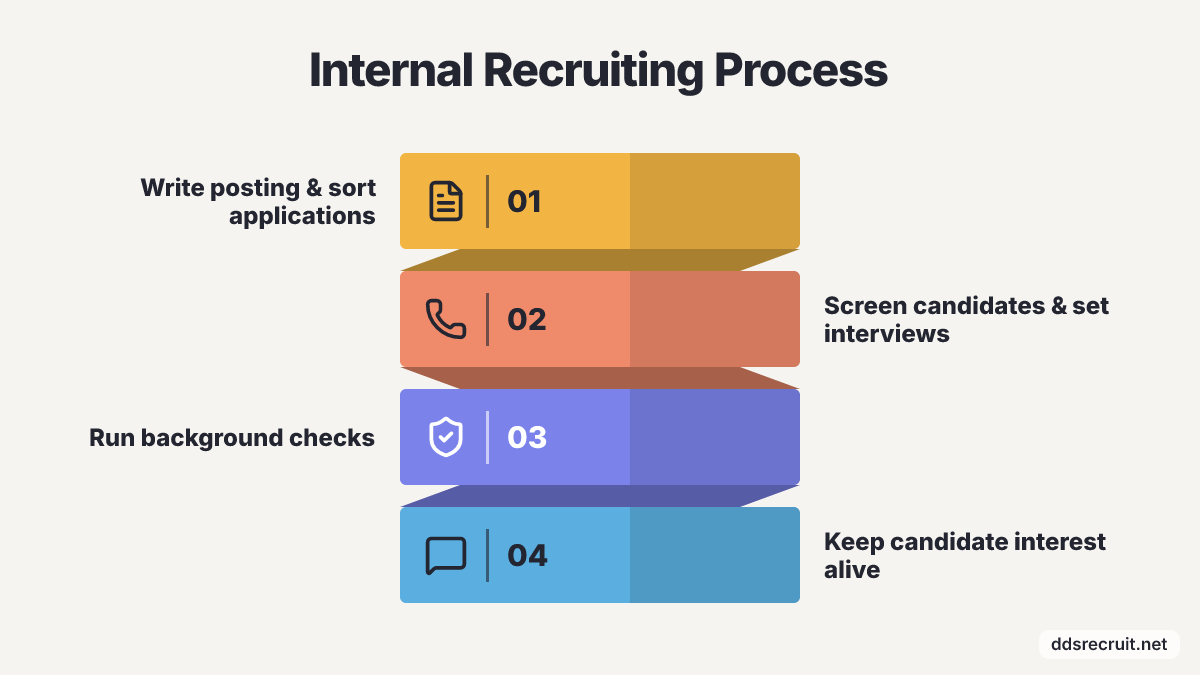
Internal recruiting skips placement fees by keeping sourcing, screening, and outreach inside the practice. Owners, clinical directors, or office managers write the posting, sort applications, set interviews, run background checks, and try to keep interest alive while the schedule keeps moving.
Pay has to match the local market from the first conversation. The U.S. Bureau of Labor Statistics Occupational Outlook Handbook documented a May 2024 median annual wage of $94,260 for dental hygienists across all clinical settings, which gives practices a realistic starting point for wage planning. Production incentives, retirement contributions, healthcare benefits, daily appointment volume, and chairside assistant support all shape whether candidates take the opening seriously. Direct outreach moves fastest when an office already has a pool of pre-vetted talent. Clinicians who have done temp shifts before, former team members looking for different days, or referrals from trusted staff members bring faster hires than public postings. Those familiar channels also shorten onboarding, since candidates already know the practice reputation and the doctor's style.
Unassisted hiring falls apart fast when administrative staff do not have dedicated time for tracking and vetting candidates. Research from the ADA Health Policy Institute reported in ADA News showed that 33.9% of dentists were recruiting or actively hiring a dental hygienist in the third quarter of 2024, which means top candidates are often sitting through several interviews at once. If communication slips by two or three business days, strong candidates usually take offers from other practices. Practice leadership also pays for DIY hiring through workflow friction and repeated interruptions. Dentists who use patient lunch hours to call applicants lose restorative planning time, treatment coordination, or their own break. Office managers who handle candidate tracking have to step away from unscheduled treatment follow-ups, overdue insurance aging, and patient collections, so the recruiting cost lands on daily cash flow.
Internal searches work best when a chair vacancy is not creating much financial strain, local contacts are still easy to reach, and administrative staff can handle daily follow-up. Practice leaders taking this route need one hiring lead, a verified pay bracket, clear schedule parameters, and a fixed review date to judge applicant traction.
Job boards: broad reach, weaker fit signal
Digital job platforms broadcast dental openings to wide geographical audiences, creating visibility that local networks cannot generate alone. Subscription costs and posting rates fit within standard operating budgets, while practice administrators retain direct authority over ad phrasing, wage transparency, shift configurations, and messaging cadence.
Public recruitment listings perform best when the practice outlines its clinical expectations with complete clarity. Ad copy must define daily patient quotas, the presence of dedicated hygiene assistants, ultrasonic instrumentation preferences, periodontal philosophies, and compensation details before publishing. Generic job listings pull high volumes of disengaged applicants who decline interviews once specific practice expectations emerge.
Resume submissions offer poor insight into genuine clinical alignment and workplace compatibility. An applicant file confirms state dental board standing, degree conferral, and previous employers, but reveals nothing about chairside velocity, communication demeanor, or soft tissue protocol adherence. The administrative burden of filtering resumes, screening candidates by phone, and assessing chairside competency remains entirely on the office team.
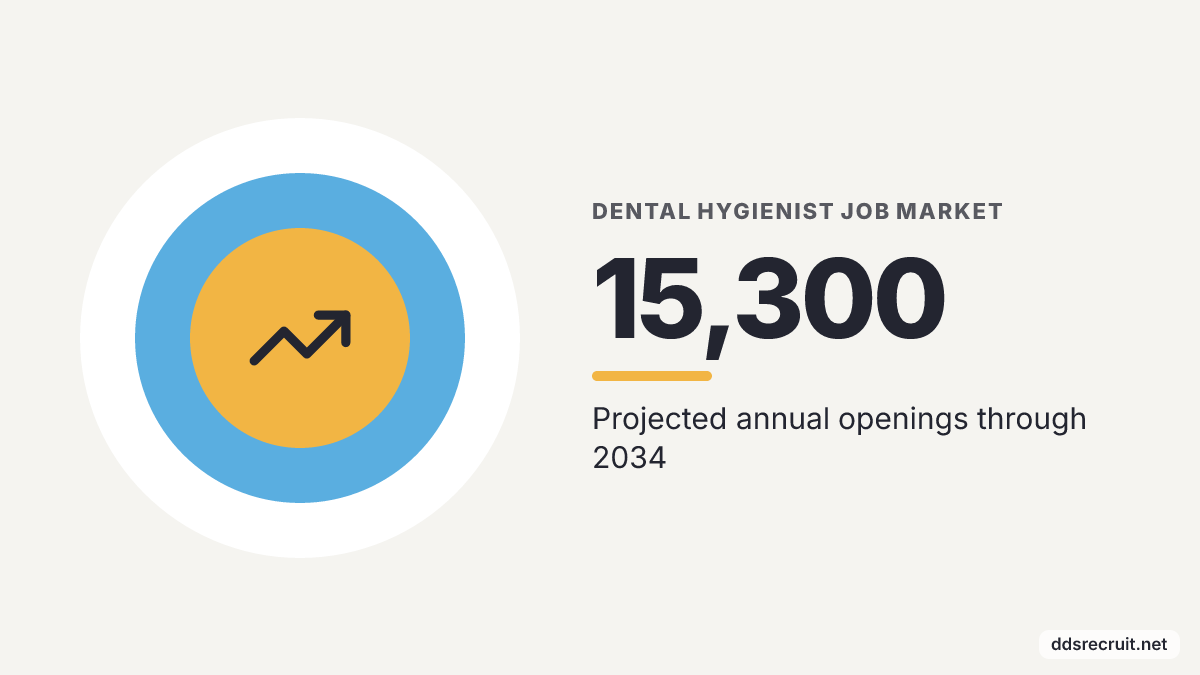
Aggregated job portals also bring competitive scheduling pressures into play. The U.S. Bureau of Labor Statistics projected 7% employment growth for dental hygienists along with roughly 15,300 openings per year through 2034, confirming that market demand will outpace candidate availability for the foreseeable future. Passively waiting for applicants on crowded boards allows aggressive local practices to secure candidates through direct outreach.
Online boards offer the greatest value to dental practices equipped to review resumes and reply within hours. Practice leadership must identify who handles candidate messaging, establish a twenty-four-hour response benchmark, prepare phone screening questions, and select an expiration date for the posting before testing other channels.
Clinical hiring candidates reviewing regional employment boards often monitor the current dental job postings catalog on DDS Recruit to compare available opportunities across multiple career tracks. Although doctor searches require different credentials than hygiene positions, traffic patterns on active dental portals prove that qualified clinicians compare terms across several local opportunities simultaneously.
Practices using board listings should enforce a strict three-week evaluation window. If active postings fail to generate qualified screenings or applicants stop responding after early contact, sheer visibility is not the root issue and hands-on recruitment methods become necessary.
Recruiting agency: higher fee, shared search burden
Placement agencies represent a larger upfront capital commitment because the dental practice purchases external recruitment bandwidth and specialized market access. Evaluating agency value requires separating the total investment into placement fees, invoice schedules, daily vacancy overhead, and replacement warranty periods.
Professional placement fees for dental hygienists vary significantly by geographic territory and representation structure. Reliable agencies provide clear agreements detailing exact fee percentages, payment due dates, candidate exclusivity windows, and replacement credit terms if a new hire departs early. Practices must demand these business terms in writing before committing search capital.
Engaging outside placement assistance becomes economically sensible when an idle hygiene chair reduces total clinic throughput. The American Dental Hygienists' Association's 2024 labor market report noted that vacancies across dental hygiene and assistant roles caused an estimated 10% national capacity loss across surveyed practices. While individual clinic losses vary based on fees and volume, calculating monthly lost production from an open schedule puts professional agency costs in proper perspective.
Agency representation shifts the time-intensive tasks of sourcing, pipeline development, and candidate qualification onto an external team. The practice owner still evaluates final candidates and conducts in-person interviews, but the front desk avoids hours of phone tag, cold messaging, and screening resumes. This operational relief allows clinical staff to focus on scheduled patients and hygiene recall blocks.
Clear warranty structures and documented refund policies protect the practice balance sheet against early staff departures. Practice leaders should verify the duration of the guarantee period and confirm whether early terminations trigger an immediate candidate search or a proportional credit on future placements.
External agency placement is not appropriate for temporary scheduling emergencies. Sudden single-day gaps, brief medical leaves, and summer vacations are better resolved through local temporary staffing pools, rather than contracting a full-service placement search for a permanent seat that is already occupied.
Agencies provide the highest return when practice schedules require immediate production stabilization, cultural and clinical compatibility outweigh raw hiring speed, and owners want active recruiting power without hiring in-house talent acquisition staff. Retainer and contingency fees must always be weighed against ongoing vacancy losses and the steep cost of misaligned hires.
Fractional recruiting: useful when hiring is bigger than one chair
Fractional recruitment services bridge the operational gap between basic job board listings and the permanent overhead of an internal human resources department. Dental groups secure external recruitment specialists on a retained or part-time schedule without absorbing permanent payroll, payroll taxes, or full-time employee benefits.
Multi-role hiring demands make fractional talent acquisition far more compelling than piecemeal searches. A clinic seeking a hygienist alongside an associate dentist, expanded-function dental assistant, or front desk coordinator faces compounding recruitment pressure. Managing several openings simultaneously requires coordinated candidate communication, unified wage modeling, and continuous outreach across competing regional clinics.
Workforce supply challenges continue to strain dental leadership nationwide. ADA News reported in 2025 that roughly 62% named staffing shortages as their single greatest operational obstacle. While hygiene school student enrollments rose nearly 20% since 2020-21 through the 2024-25 academic year according to the same ADA News report, new graduates enter a market with heavy hiring competition. Modern practices must actively market their clinical culture to secure talent from this emerging clinician pool.
Multi-site groups and expanding practices gain predictable financial advantages from fractional recruiting structures. Practice owners overseeing multi-location teams, leadership succession plans, and key executive searches require methodical talent pipelines that single classified postings cannot deliver. Clinics projecting steady clinical expansion benefit from consistent hiring workflows rather than starting cold searches each time a resignation arrives.
Solo practice owners should take care not to purchase broader recruitment services than their current clinical model demands. A mature, single-location practice seeking one part-time hygienist through known local channels does not require an ongoing fractional talent engagement. Retainer scale should always match active hiring volume, role urgency, and the operational cost of stalled outreach.
Group practice leaders mapping multi-location clinician hires will find practical staffing considerations in our analysis of DSO expansion lead placement across growing organizations.
Fractional models earn their keep when they remove recruitment friction from practice owners and office managers. When an office faces only one low-pressure hygiene opening and maintains sufficient administrative bandwidth, a self-directed local search remains the simpler, more economical choice.
How should a practice choose between the options?
Selecting an optimal hiring method requires balancing chair vacancy losses, front-office availability, local clinician availability, and long-term practice goals. Establishing explicit criteria early prevents panicked decisions, where weeks of cancelled recall appointments tempt leadership into paying high fees for poor clinical matches.
Compensation analysis provides the bedrock for any hiring decision. The BLS May 2024 median wage establishes a macro-level baseline, but each practice must build a customized offer reflecting daily hygiene hours, equipment quality, benefits packages, and assistant support. An uncompetitive hourly wage or difficult production pace will fail to recruit top talent through an expensive agency just as quickly as on an unassisted job post.
Leadership capacity forms the next practical evaluation benchmark. Unassisted hiring consumes valuable doctor and manager hours. Job platforms require direct cash outlays while still demanding prompt internal screening and applicant tracking. Full-service agencies and fractional talent services require higher visible capital but offload screening logistics. The right financial path matches vacancy urgency with the administrative time available inside the building.
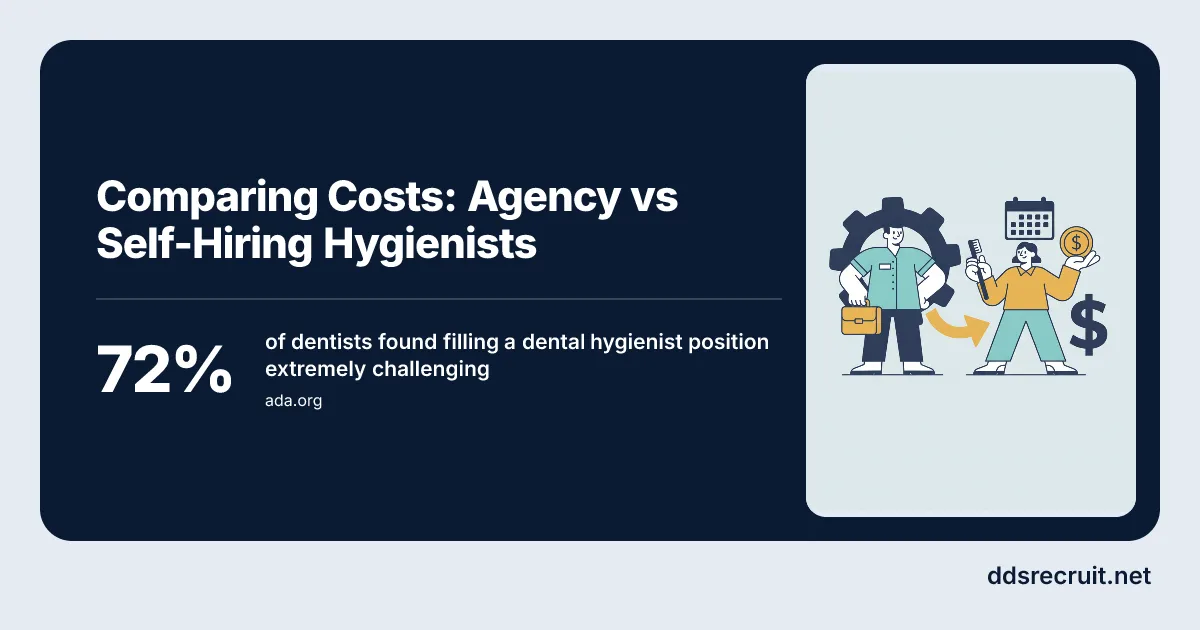
Clinical retention risks must guide every stage of the decision. Survey findings from the ADA Health Policy Institute shared in the 2024 ADA Communications Trend Report indicated that over 72% of dentists found filling a dental hygienist position extremely challenging. Extreme candidate scarcity frequently leads clinics to extend offers to the first licensed applicant who calls, but poor clinical alignment ruins hygiene recall retention, disrupts doctor exam pacing, and compromises team morale.
A concise operational framework keeps practice hiring grounded:
- Rely on self-hiring when warm candidate leads exist, the schedule can absorb moderate delays, and the practice manager can dedicate an hour each day to candidate outreach.
- Publish to reputable job platforms when broader regional reach is required and staff can respond to new applicants within twenty-four hours.
- Contract professional agency or fractional recruiters when an empty operatory compromises weekly revenue, internal outreach has stalled for three weeks, or multiple clinical seats must be filled concurrently.
Peripheral dental networks and professional directories offer specialized support across connected facets of practice expansion. Effective talent acquisition functions alongside the clinical, marketing, and operational systems that support long-term clinician retention.
Hiring policies should be anchored to specific calendar milestones rather than shifting moods. Set a firm deadline for internal outreach, and if qualified candidate conversations fail to materialize within fifteen business days, shift resources toward outside placement before schedule losses compound.
Conclusion
Quantify the daily production loss of the dark hygiene chair before debating agency fee percentages. Calculate open operatory days, identify tasks pulling team members from patient care, assess existing local contacts, and assign one person to handle candidate replies. Practices with direct connections, available staff hours, and competitive wage packages should execute a disciplined self-hiring campaign before securing outside services.
Retaining a dental recruitment agency becomes appropriate when local talent pools yield no candidates, empty operatories drain daily cash flow, or the clinic needs to staff multiple chairs at once. Set an initial consultation with prospective recruitment partners to review placement terms, candidate guarantee windows, clinical expectations, and interview timelines in writing.
Frequently Asked Questions
Who can help fill a dental hygienist position quickly?
Dental recruitment agencies, fractional talent specialists, local hygiene school placement coordinators, and regional dental job platforms all provide candidate pipelines. Rapid placement requires an attractive hourly rate, prompt interview scheduling, and unambiguous details regarding chairside expectations and scheduling flexibility.
Related reading
- DSO Expansion Lead Placement: 5 Hiring Paths for Growth
- Using I/O Psychology to Improve Dental Hiring
- Effective Dental Hiring with Fractional Recruiting
- Top Office Manager & Key Team Member Hiring Firm
Sources
- ADA News: New ADA policies empower states to alleviate dental workforce shortage (2024)
- ADA.org: ADA Communications Trend Report (2024 Council on Communications)
- ADHA: Dental Workforce Shortages — Data to Navigate Today's Labor Market (2024)
- ADA News: Five years later — Staffing shortages, infection control since the COVID-19 pandemic (2025)
- U.S. Bureau of Labor Statistics: Dental Hygienists Occupational Outlook Handbook