

Avoiding Dental Hiring Mistakes When a DSO Expands
By Dr. Brian Passell and the DDS Recruit team ·
Summary: The costliest dental hiring mistakes when a DSO opens a new location are hiring the strongest producer as the lead, labelling every new-site doctor a lead, adding specialists and hygienists too late, and widening recruiter reach before the role is defined. DDS Recruit's culture-first search, backed by 17 years of dentistry-only experience and a one-year placement guarantee, is built to avoid each of them.
The usual advice is to hire the strongest producer to lead a new DSO location. That fails when the dentist can fill a chair but cannot carry the practice culture into a team that has never worked together.
Avoiding dental hiring mistakes in DSO expansion starts with accepting that the largest candidate list is not the same as the right one. A new location needs a dentist who fits the clinical standard, the leadership load, and the local hiring reality, because the first doctor shapes how the office feels before the DSO has a second chance to explain itself.
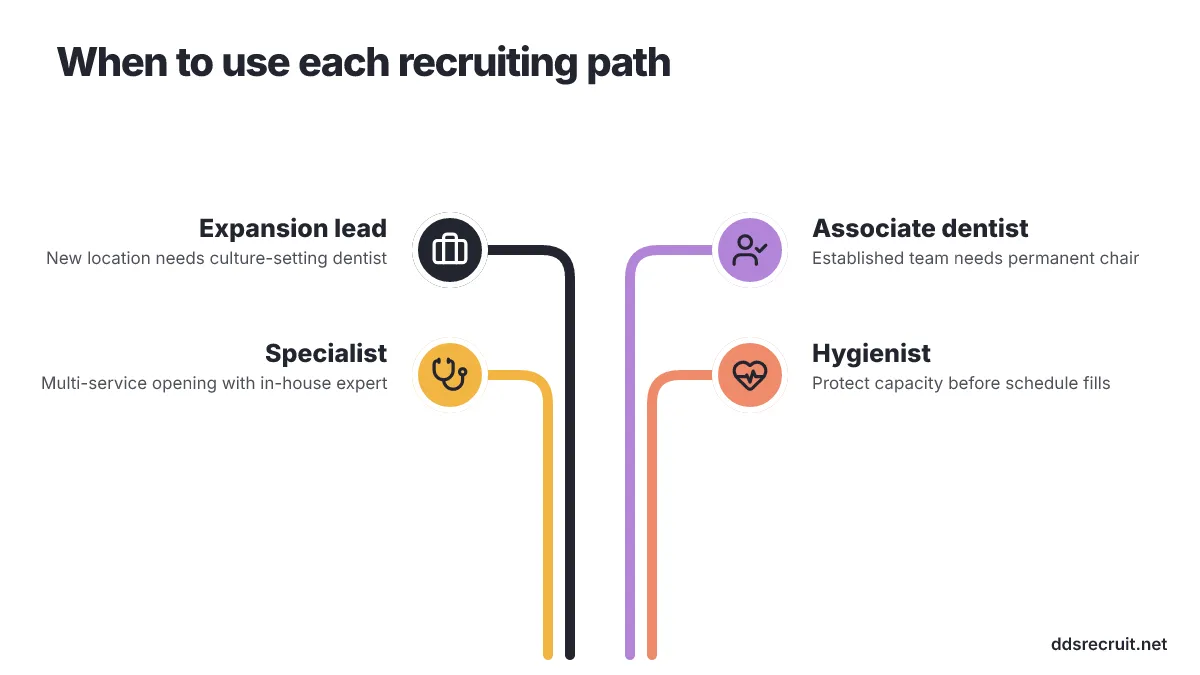
DSO leaders should treat expansion lead placement as a culture hire with production expectations, not a production hire with culture language added later. The hiring path changes when the location needs a lead dentist, an associate bench, in-house specialists, hygienists, or outside recruiting reach, so the right choice starts with the role that will decide the launch.
Mistake 1: Hiring the top producer as the expansion lead
A lead dentist for a new DSO location needs to be evaluated as the first visible carrier of the brand, not only as a clinical résumé. DDS Recruit's culture-first dental recruiting team is backed by 17 years of dentistry-only search experience and matches for fit, not just résumés, which is the point of difference when a doctor will set expectations for a new office.
DSO expansion lead placement belongs here when the open role is larger than an associate opening but not the same as a corporate executive search. The dentist may still produce clinically, but the risk sits in the first months of team formation: how the doctor communicates with assistants, how the schedule absorbs growth, and whether the practice manager has a clinical partner who supports the local standard.
The same service mix matters to a DSO because expansion lead placement sits between local clinical hiring and executive alignment, especially when a group is opening in a suburb or a metro where the talent pool is thin.
Practice leaders comparing pricing options for searches should ask how the engagement handles risk after the hire starts.
Expansion leaders should not be hired through a stale posting alone when the role carries culture responsibility.
A DSO expanding rapidly should start with a free discovery call to scope the search rather than guessing whether the job is an associate role, a lead doctor role, or an executive clinical role. The first decision is the level of leadership the site truly needs, because every other hiring path depends on that answer.
Mistake 2: Calling every new-location doctor a lead
An associate dentist search is the right path when the new location needs a dependable doctor before it needs a site-level clinical leader. Associate dentist recruiting fits the case where the practice already has operating leadership in place and the open chair needs a long-term doctor who matches the office model.
DSO leaders sometimes label every new-location doctor as an expansion lead because the site is new. The better test is whether the doctor will own culture formation or join a culture already defined by the regional team, office manager, and clinical director. If the DSO already has those supports in place, associate placement may be the cleaner brief.
An established private office hiring one associate for a full book should not frame the role as DSO expansion lead placement.
A long-term associate search still needs fit language, because a mismatch can disrupt a PPO-based practice that depends on repeat patient flow and team consistency.
Dental professionals looking for live opportunities should use the jobs page for dentists rather than relying only on informal referrals.
A DSO should move from associate recruiting to expansion lead placement when the doctor will influence hiring, day-to-day standards, and the tone of the new office. The title matters less than the decision rights attached to the job, because a dentist with lead expectations needs a different search brief from a dentist joining an established team.
Mistake 3: Hiring specialists after the lead dentist
Specialist placement belongs in the plan when a new DSO location is expected to launch with services beyond general dentistry. Specialist recruiting services matter when the expansion lead has to work beside an in-house specialist rather than refer every complex case outside the office.
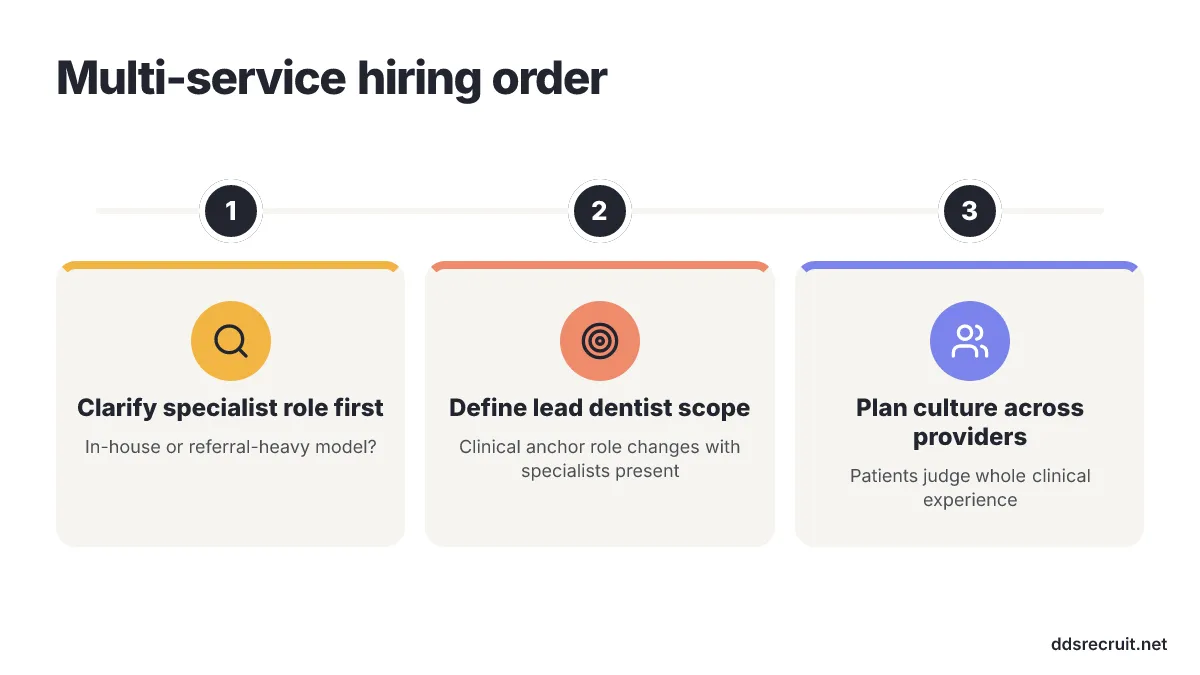
A multi-service opening changes the lead dentist profile because the doctor is no longer the only clinical anchor patients and staff will watch. The lead dentist must support a culture where specialists, assistants, hygienists, and front-office team members understand how care flows inside one location, even if the DSO has separate clinical protocols elsewhere.
Specialist and in-house specialist placement also changes the order of hiring. A location built around higher-acuity procedures may need clarity on the specialist role before the lead dentist search is final, because the lead dentist's day-to-day responsibilities depend on whether the office has in-house support or a referral-heavy model.
A DSO should not treat specialist recruiting as an add-on after the expansion dentist is hired if the business plan depends on that service line. The lead dentist will be judged by patients on the whole clinical experience, so the search should define whether the doctor is leading a general practice team, partnering with specialists, or building a multi-provider culture from opening day.
The next question is whether the hygiene team can support the schedule the new site is supposed to grow into.
Mistake 4: Leaving hygienist recruiting until the schedule fills
Hygienist recruiting should begin before the new location's recall calendar turns into the choke point. Dental hygienist recruiting fits expansion planning when a DSO expects the lead dentist to build culture and still needs hygiene capacity for exams, perio care, and patient retention.
A DSO looking for strong hygienist recruiting help is usually trying to protect provider capacity, not just fill one hygiene slot. The lead dentist's culture work gets harder when hygiene keeps shifting, because patients notice open gaps, assistants carry extra pressure, and office managers spend their time patching the week instead of building the team. Hygienist recruiting services for dental practices belong in the same discussion as expansion lead placement when the new dentist is supposed to set the clinical tone. A lead doctor cannot model a steady team rhythm if the office opens with a thin hygiene bench and then expects production to cover the strain.
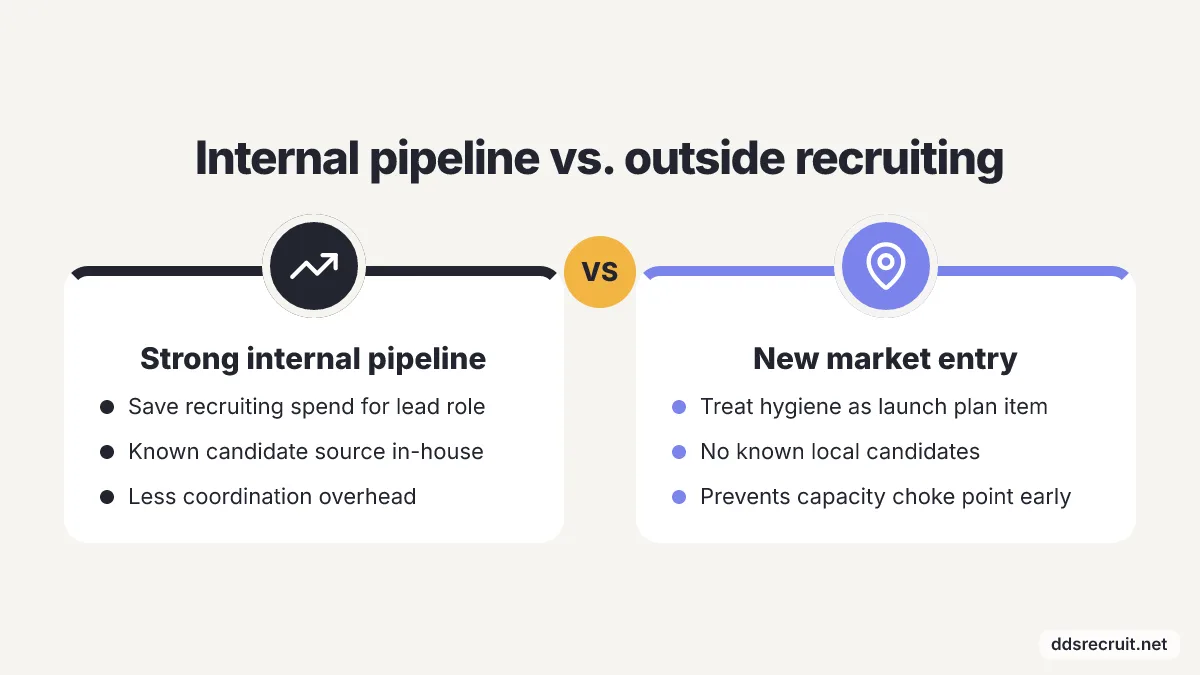
The trade-off comes down to cost and attention. A DSO with a strong internal hygiene pipeline may be better off saving outside recruiting spend for the lead dentist or specialist role, while a group entering a new market without known hygiene candidates should treat hygienist recruiting as part of the launch plan, not a later repair.
Practice managers should ask one practical question before approving the search, which unfilled role would stop the new location from delivering its planned schedule first. If the answer is hygiene, the expansion lead search still matters, but the hiring plan should not pretend the lead dentist can cover missing clinical support.
Mistake 5: Adding recruiter reach before defining the role
A recruiter marketplace makes sense when one search needs more reach than an internal team or a single relationship can provide.
DSO expansion lead placement sometimes reaches a point where the brief is clear but the geography is hard. Suburban markets, selective metros, and roles that call for both clinical production and leadership interest need candidate access beyond a passive posting, so a marketplace path may support the search without forcing the DSO to add a full-time recruiting role. Independent dental recruiters should pay attention to the shared-fee model because DSO growth creates openings across doctors, specialists, hygienists, office managers, and key team members. A recruiter who understands dental culture fit can work in a broader market while staying focused on roles where dentistry knowledge actually matters.
Some expansion leaders also need to compare adjacent dental resources while the recruiting search is underway. The recruiter marketplace path is not a substitute for defining the role. A vague expansion lead brief produces vague outreach, so the DSO should decide whether the location needs a lead dentist, associate dentist, specialist, hygienist, office manager, key team member, or C-level clinical hire before adding more recruiting reach.
Conclusion
Start by naming the job the new location actually needs. If the dentist will shape culture, support the team, and carry the clinical tone of a new office, treat the opening as DSO expansion lead placement and scope the search around that responsibility.
The advice stops at role definition, and compensation, title, and candidate details still need to be worked through for the actual market.
Related reading
- Associate Doctor Placement for Practice Transition 2026
- Dental Associate Placement for Long-Term Fit in 2026