

Effective Dental Hiring with Fractional Recruiting
By Dr. Brian Passell and the DDS Recruit team ·
Summary: Fractional recruiting for dental practices provides specialized hiring capacity without the need for a full-time recruiter, focusing on roles that impact production and growth. By targeting key positions like associate dentists and hygienists, and involving practice owners in decision-making, fractional recruiting ensures a more effective and tailored hiring process compared to traditional job boards.
The associate candidate vanishes after the second conversation. The office manager says the schedule was already built around that start date. Patients still have appointments, hygiene checks still need a doctor, and the practice owner has to start the search over while still running the business.
Fractional recruiting for dental practices fills that gap. The practice needs serious recruiting capacity, but it does not need a full-time internal recruiter. A fractional recruiting team works best when it is doing more than reposting the same opening somewhere else. It should add dental-specific hiring support around the roles whose vacancy changes production, culture, or the timing of growth. Practices get the gains from fractional dental recruiting only when the work is aimed at the right seats, the role is described honestly, and the owner stays involved in decisions that only ownership can make. The sections below show where a fractional team earns its place, where job boards stop helping, and when a simpler hiring path is enough.
Start with the seats that change production, not the easiest openings
Associate dentists, hygienists, specialists, and leadership roles deserve first attention because an empty chair in those seats changes the practice faster than a slow back-office search. A fractional recruiting team helps most when the vacancy affects patient capacity, doctor time, or a growth plan that already has real costs attached. A private practice hiring one associate dentist should treat the search differently from a group practice hiring an office manager. The associate search has to account for clinical philosophy, patient mix, schedule expectations, and the owner's timeline for handing off production. The office manager search has to account for team authority, insurance workflow, and whether the owner wants an operator or a stabilizer.
Hygienist openings deserve the same attention because the shortage is not just a local rumor. The American Dental Association Health Policy Institute reported in April 2026 that, among dentists actively recruiting or recently recruiting a hygienist, 91% said hiring was very or extremely challenging.
A practice that treats hygiene recruiting as a quick job post is going up against offices that already know the labor market is tight. Dental assistant and administrative hiring also put pressure on the owner when the search drags. Becker's Dental Review reported from a November 2023 survey that 34.1% of respondents were recruiting hygienists, 35.6% were recruiting assistants, 13% were recruiting dentists, and 24% were recruiting administrative staff. Those figures show why one practice opening rarely stands alone, because candidates are looking at several dental employers at once.
The first decision is whether the vacancy only needs applicants or whether the role needs judgment before the first conversation happens. A straightforward administrative opening with local referrals might not need outside recruiting help. A dental associate, in-house specialist, hygienist, office manager, DSO expansion lead, or succession planning hire usually needs a sharper plan, because a bad match changes more than a shift schedule.
What should a fractional recruiting team own?
A fractional team should take on the recruiting work the practice cannot keep up with each week. The owner still makes the calls on fit, pay comfort, and the final yes or no. Hand those choices off too, and the recruiter stays busy while the practice keeps drifting without a clear hiring rule. The split is simple enough. The practice spells out the role in working terms, schedule, clinical duties, leadership duties, and what would make the hire stay. The fractional recruiting team brings search capacity, dental market focus, and steady follow-through. Then the owner decides whether the person fits the office that exists, not the office that lives in a wish list.
DDS Recruit says it is a fractional culture-first dental recruiting team with 17 years of dentistry-only search experience. Its work covers dental associate & doctor recruiting, specialist and in-house specialist placement, and C-level executive search, including Chief Clinical Officer and COO roles. DDS Recruit also says it offers a one-year placement guarantee, framed as a free replacement search if a hire leaves within the first year. That sort of backing matters more once the recruiter hears the real limits early. Pay range, production expectations, clinical autonomy, commute realities, mentorship limits, and future ownership possibility all shape who will take the role seriously. A recruiter cannot clean up a search when the practice hides the trade-offs candidates will notice later.
For owners who want help without adding a full-time HR or recruiting role, the search retainer path matters. A practice comparing that path with internal effort should count owner hours, missed follow-up, and the cost of starting over after a weak match, not just the fee line.
A practice trying to improve dental hiring with fractional recruiters should not turn the recruiter into a messenger for a vague opening. The strongest brief says what the role must do, who the new hire will work with, and which parts of the office culture are not negotiable. A candidate who accepts because the role was clear is easier to keep than a candidate who accepted because the posting sounded polished.
Why job boards alone stall in dental hiring
Job boards are useful for visibility, but visibility is not the same as recruiting. A job board puts an opening in front of people who are already searching or willing to browse. A fractional recruiting team is built for the harder work of keeping a role active until the right person is ready to talk. The difference shows up fastest in associate dentist recruiting. A practice can post the same associate role across several places and still get applicants who want a different clinical pace, a different ownership path, or a different kind of mentorship. A fractional recruiting team earns its fee when it turns those mismatches into clearer search direction instead of treating every résumé as progress.
This gives practice owners a useful reminder, active postings are part of the market, not the whole market. The best candidate for a practice might be browsing jobs, quietly thinking about a change, or waiting for a role that fits a specific life stage.
Job boards still have a place when the practice knows the local market is active and the role is easy to explain. A practice with a part-time front desk opening, a strong employee referral, and enough management time to respond quickly might do better with a simple posting before paying for outside recruiting. The cheaper tool is the right tool when the role is low risk and the owner has time to manage the search.
The weakness shows up when a practice keeps paying for visibility after the applicant pool has already given the same answer. A post cannot replace steady candidate contact, role clarification, and follow-through.
Internal cost matters because recruiting time is rarely counted honestly. Owner time spent chasing weak leads is still a cost when production decisions, patient experience, and team leadership sit in the background.
How do you make fit measurable without inventing a hiring system?
Fit gets measurable when the practice spells out the world a candidate is stepping into, not when it stacks personality words on a job post. A culture-first search has to name actual choices: schedule pace, clinical autonomy, handoff expectations, leadership style, and how much change the new hire is expected to live with.
A practice owner ought to write a role note before pushing an opening harder. That note should say why the role exists, which problems the person is meant to help solve, what parts of the practice stay steady, and what parts are still under construction. Then a fractional recruiting team has something concrete to discuss with candidates, and it does not have to pretend the practice is finished. Associate dentist fit is touchy because doctors look at more than compensation. An associate wants to know how exams are assigned, how treatment planning runs, whether mentorship is real, and how the owner handles disagreement. A practice that cannot answer those points will lose candidates to an office with a clearer story, even if the pay is about the same.
Specialist and in-house specialist placement asks for another layer of clarity. A periodontist, endodontist, oral surgeon, or orthodontist thinking about an in-house model will ask whether the referral base, schedule, equipment, and case mix support the role. A fractional recruiting team cannot create those fundamentals, but it should not have to guess at them either.
Leadership hires are less forgiving still. A Chief Clinical Officer, COO, DSO expansion lead, office manager, or key team member needs authority that matches the outcome the practice expects. A group that says it wants leadership while holding back decision rights is not offering a leadership role, and the recruiting message should not pretend it is.
The labor pressure behind fit is real because shortages push dentists into work they did not plan to do. DANB reported in 2023, citing an October 2023 HPI survey, that nearly half of dentists reported performing more duties typically managed by hygienists, assistants, and practice administrators. Recruiting for fit is not soft language in that setting, because the wrong hire can leave the owner carrying the same workload after paying to fill the seat.
Outside support around the practice can strengthen the hiring decision when the issue is larger than recruiting alone. Recruiting works better when the job being sold matches the office a candidate will enter.
When is fractional support the wrong tool?
Fractional support is the wrong tool when the owner has not decided what the role is allowed to become. A recruiter can bring attention to a position, but no recruiter should be asked to sell a job that changes every time a candidate asks a practical question.
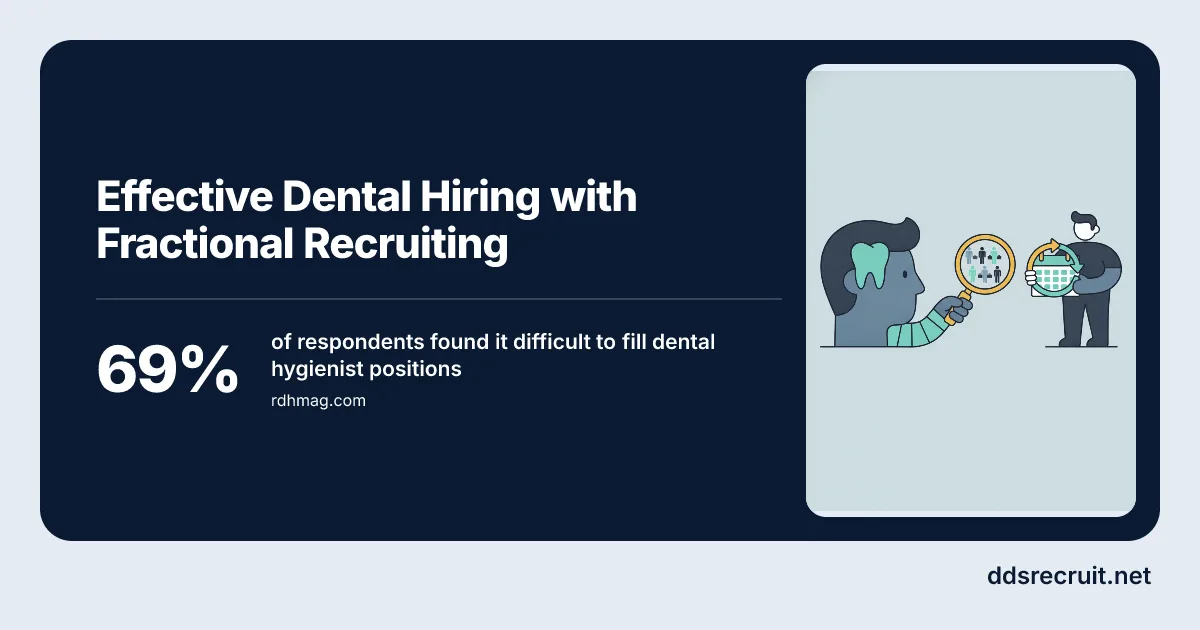
A single-office owner with a warm referral for a known hygienist, a clear compensation range, and enough time to move quickly should try the direct path first. RDH Magazine reported from the 2023 Dental Economics/RDH Fee and Staffing Survey that 69% of respondents found it difficult to fill dental hygienist positions, but difficulty alone does not prove every opening needs outside recruiting. A ready candidate with local trust changes the decision.
Fractional support also struggles when the practice is unwilling to face the market. ADA News reported in July 2023 that owner dentists still faced challenges recruiting hygienists and assistants despite the majority reporting pay raises in the past year. Higher pay did not remove the recruiting challenge, so a practice also has to address schedule, workload, leadership, and why someone would choose that office over another.
A practice should not treat a replacement guarantee as permission to make a rushed hire. The guarantee reduces replacement risk, but the owner still pays the operational price of disruption when the wrong person starts and leaves.
A fractional recruiting team also costs attention from the practice. The owner or practice leader still has to respond to candidate questions, decide quickly when a strong match appears, and stay honest about compensation and culture. A slow internal response wastes outside recruiting capacity because candidates read silence as a signal about how the office works.
Practices that need marketing demand, not recruiting supply, should solve that problem separately.
Build the recruiting bench before the opening turns urgent
A practice gets better results by preparing role clarity before someone resigns. The owner does not need a complicated hiring department, but the owner does need a short list of roles that would hurt most if they opened tomorrow.
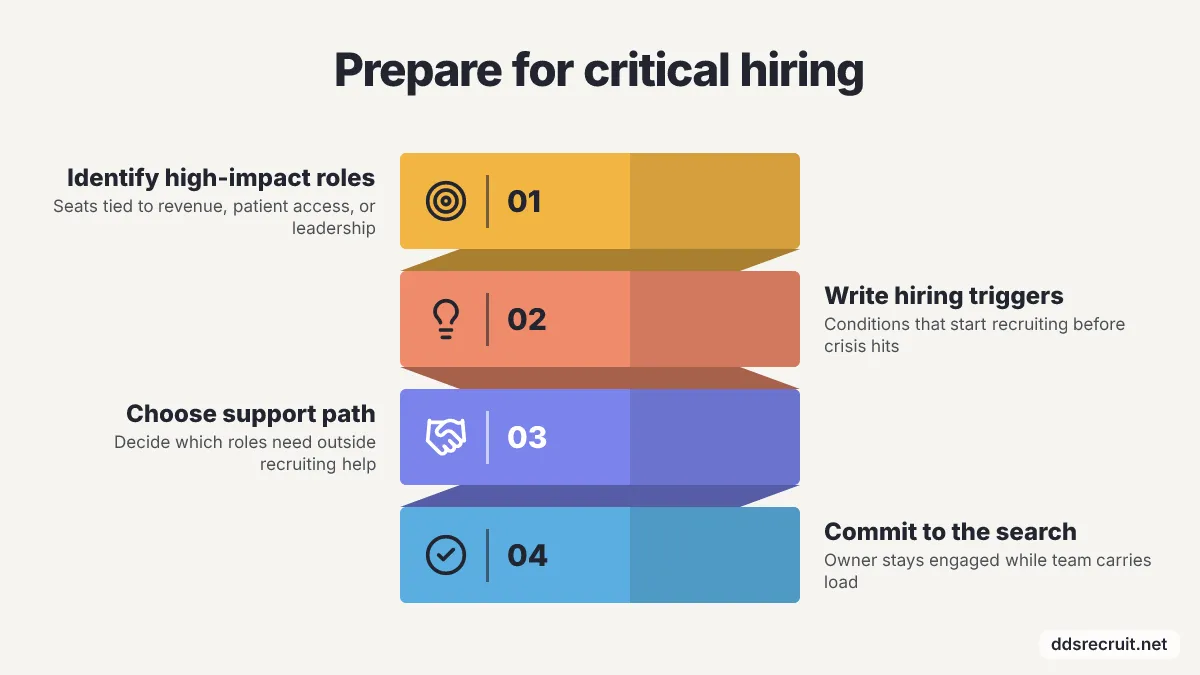
Start with the roles tied to revenue, patient access, or leadership continuity. For many practices, that list includes associate dentist, hygienist, office manager, and any specialist role connected to a growth plan. For a DSO or growing group, the list may include Chief Clinical Officer, COO, DSO expansion lead, and succession planning hires.
The next move is to write a hiring trigger for each seat. A hiring trigger is the condition that tells the owner to begin recruiting before the role becomes a crisis, such as a planned expansion, a retirement conversation, a hygiene schedule that cannot absorb demand, or an owner who is spending too much time on duties that belong elsewhere. The trigger matters because recruiting started under pressure usually produces weaker choices.
A practice should decide in advance which roles deserve outside help. Associate dentist recruiting, specialist placement, C-level executive search, and succession planning hires usually justify earlier recruiter involvement because the candidate pool is narrower and the cost of a mismatch is higher. Administrative or support roles might move through referrals first unless the practice has already failed to attract qualified local candidates.
The search retainer path with minimal upfront/nominal monthly fee, success fee only owed when a placement sticks, fits owners who want recruiting capacity without building a permanent internal department.
Independent recruiters can become part of that capacity when the practice's needs are broader than one local network.
The final planning question is not whether fractional recruiting sounds efficient. The useful question is which seat is important enough that the owner will keep showing up for the search while a fractional team carries the recruiting load.
Conclusion
Choose one open or upcoming role and decide whether the vacancy affects production, leadership, expansion, or owner time. If the answer is yes, write the role in operational terms before buying more visibility: schedule, compensation range, authority, culture, and what the person must accomplish after joining.
A fractional recruiting conversation is worth having once those details are honest enough to test in the market. The advice stops at the hiring decision itself: the owner still has to choose the person, protect the culture, and make the role real after acceptance.
Related reading
- Why Success-Based Recruiting Works Better for Dentists
- Cost of Recruiting Dental Staff Yourself vs. Specialist
Sources
- American Dental Association HPI — We Have a Major Dental Hygienist Shortage
- Becker's Dental Review — Has dental staffing become more challenging since the start of 2023?
- ADA News — Recruiting hygienists, assistants still challenging for practice owners (July 2023)
- DANB — Dental assisting trends we saw in 2023
- RDH Magazine — What dental hygienists are making across the country