

Agency vs. Direct Dental Hygienist Hiring: Which Costs More?
By Dr. Brian Passell and the DDS Recruit team ·
Summary: Hiring a dental hygienist through an agency generally costs more than direct hiring due to agency fees, which cover the clinician's pay and operational costs. However, for small practices, the higher cost can be justified when immediate coverage is needed to avoid empty appointment slots, whereas direct hiring may be more cost-effective for long-term staffing needs if managed efficiently.
A morning huddle starts with an empty operatory chair because a scheduled clinician called out, and the front desk suddenly has to work through a cancellation list. Practice owners looking at staffing choices quickly ask: does hiring a dental hygienist through an agency cost more than hiring a direct employee? On paper, agency placement fees and hourly markups look much pricier than regular payroll. That comparison leaves out the daily production loss from an idle operatory while job board listings sit there with no replies.
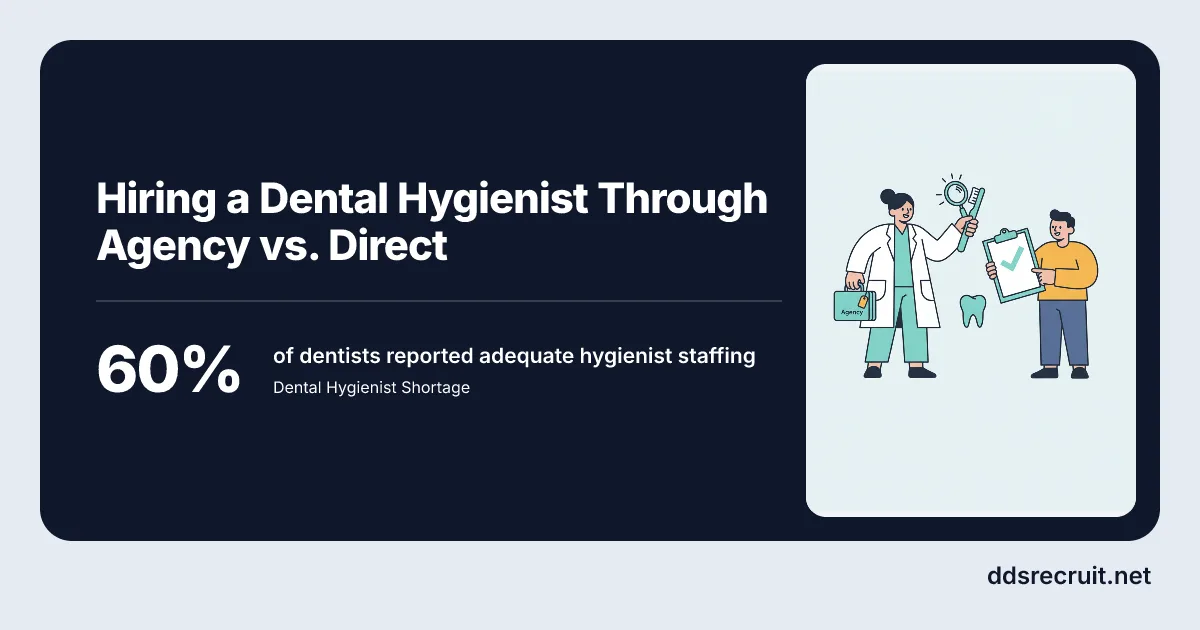
Solo practitioners and independent offices feel that squeeze most sharply, since one office manager often juggles insurance verification, billing, patient check-ins, and talent acquisition. According to ADA Health Policy Institute's 2026 hygienist data, only 60% of dentists reported adequate hygienist staffing, while 91% of dentists recruiting hygienists said that finding qualified candidates was very or extremely challenging.
Choosing between agency support and direct recruitment is not a matter of taste. A temporary clinician keeps treatment volume moving today. Direct hiring builds clinical continuity over time. Practice owners need a clear framework that weighs invoice costs against patient retention and vacancy delays.
Does hiring a dental hygienist through an agency cost more?
A line-item invoice from a staffing firm usually comes out above the gross hourly pay of an in-house employee. Staffing agencies charge a premium that folds clinician compensation, statutory taxes, insurance, and fast placement into an hourly rate. An internal hire brings base wages and statutory benefits onto the practice payroll.
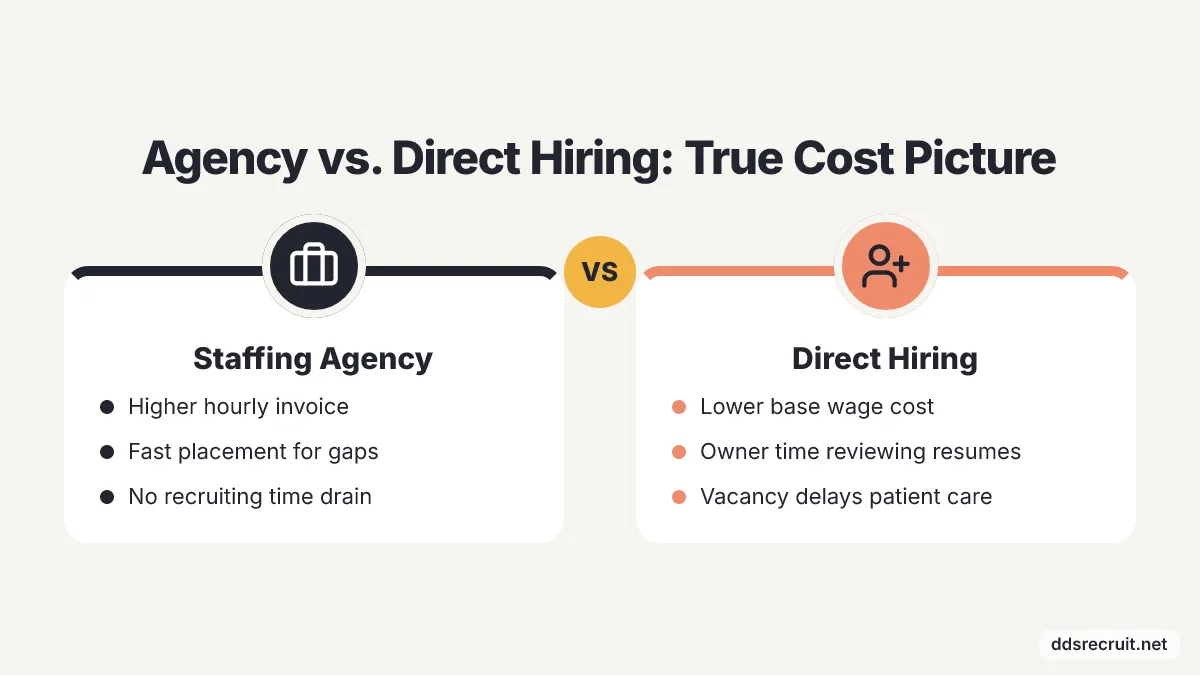
Leave that premium on its own and you miss the real cost picture. Direct hiring looks cheap until an owner-dentist loses productive clinical hours sorting through unqualified resumes, front desk staff cancel diagnostic blocks, and periodontal maintenance recalls slide months past their due date.
Industry developments show how large this staffing model has become: PR Newswire reported in June 2026 that GoTu and Henry Schein announced a nationwide staffing partnership to connect GoTu's workforce technology with Henry Schein's dental client network for temporary shifts and permanent placements. That expansion confirms that on-demand staffing has a real place for short-notice gaps. Treating temporary placement fees as a standing staffing fix, though, drains monthly cash flow.
| Hiring route | What the practice is buying | Best use | Main cost risk |
|---|---|---|---|
| Agency or temp platform | Fast coverage for open hygiene days | A booked column that needs coverage now | The invoice is higher than the wage alone |
| Direct hiring | A practice-employed hygienist | An owner or manager has time to source and follow up | The posting sits while patients wait |
| Dental recruiting firm | A permanent search aimed at fit | A small practice needs a long-term hygienist without adding HR capacity | The fee must be weighed against vacancy time and mismatch risk |
This trade-off stops applying when a practice handles an isolated leave of absence with full appointment books and no desire to add permanent hygiene capacity. Paying an agency invoice for ten days of confirmed patient care becomes a normal coverage expense, not a failed recruitment strategy. Chair production stays intact, and permanent overhead stays flat.
What direct hiring really costs when the job board stalls
Direct hiring costs more than the base wage once a job posting stalls, because the owner's clinical hours, the team's screening time and unfilled hygiene appointments all add to the real bill.
Setting a competitive hourly compensation rate establishes the baseline for any realistic hiring timeline. Becker's Dental Review's 2024 analysis of BLS data compiles the state-by-state mean hourly wage across the country, giving practice owners an empirical benchmark to assess before publishing an open position. Practice leadership can measure their compensation package against current market ranges using the DDS Recruit dental hygienist salary by state calculator rather than guessing why candidates bypass their listing.
A solo clinic experiences severe compounding costs when an ad produces few viable responses. Direct job posts drain clinic resources when the treating doctor reviews resumes between patient appointments and the administrative team splits attention between overdue billing and candidate screening.
State regulatory adjustments demonstrate why administrative overhead rarely alters these core recruitment economics. The Idaho Division of Occupational and Professional Licenses noted that starting in January 2026 it temporarily waived renewal fees for licensees under the Board of Dentistry, while lawmakers established a framework permitting the Board to maintain a dental hygienist license fee between $0 and $175. Waiving fifty or one hundred dollars in annual credential fees offers minor relief to clinicians, but it does not shorten vacancy durations, raise local applicant volume, or solve production bottlenecks.
Practice leaders should review financial comparisons alongside their monthly profit and loss statements. Reviewing a detailed hygienist agency versus direct hiring cost analysis clarifies true expenses once an owner tabulates wages, unbilled chair time, and administrative hours spent managing recruiting channels.
Who can help fill a dental hygienist position quickly?
Selecting an external partner depends entirely on whether an office needs immediate calendar coverage or a permanent clinical hire. A temporary staffing agency or app is the logical choice when tomorrow's hygiene schedule is full of scheduled patients, whereas a dedicated recruiter fits an office that has posted online for months without securing a clinician who matches the patient volume and clinical standards.
Hygiene staffing challenges frequently point to broader structural needs across the clinical team. Practices expanding operatory capacity, establishing regional group leadership, or replacing clinical coordinators may require Dental office manager & key team recruiting or Dental executive search alongside clinical placement. Practice leaders can also examine active market trends across dental job postings to gauge local competition.
Clinics seeking a permanent staff member can review the dedicated hygienist recruiting service to source qualified candidates. Practices also searching for clinical providers should maintain associate dentist hiring as an independent pipeline, since provider credentialing, compensation packages, and chairside autonomy require distinct vetting.
How should a small practice choose agency, direct, or recruiter?
Patient schedule density determines the right hiring channel far better than an initial price comparison. When hygiene chairs are booked solid for the next three weeks, paying for temporary agency coverage protects restorative handoffs and hygiene production; when an office plans to expand hygiene days, running an intentional search prevents perpetual emergency staffing.
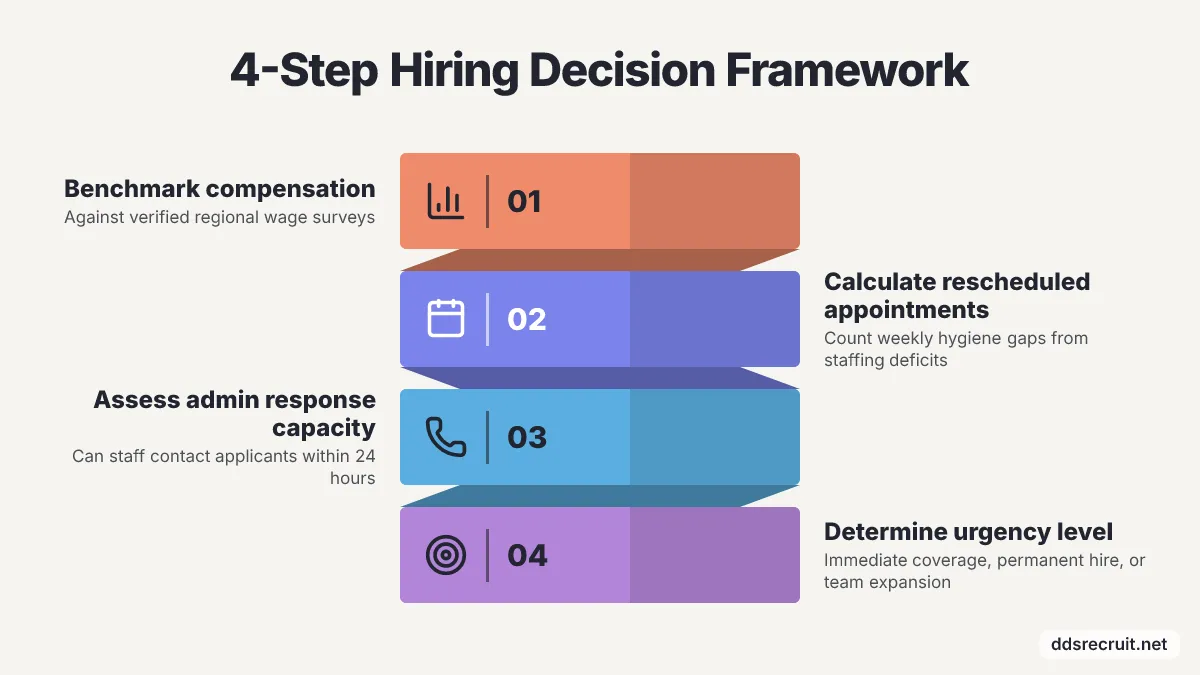
- Benchmark candidate compensation against verified regional wage surveys and target chair production expectations.
- Calculate the exact number of recare appointments and periodontal treatments rescheduled each week due to staffing deficits.
- Determine whether administrative staff can contact and interview qualified applicants within 24 hours of submission.
- Establish whether the clinic requires immediate temporary shift coverage, an in-house employee, or broader team recruiting.
Direct recruiting succeeds when an office offers strong market compensation, administrative staff who conduct same-day outreach, and healthy local candidate traffic. Temporary agency placement remains the practical solution when a booked schedule cannot wait several weeks for an ad campaign to yield results.
Engaging an experienced search firm becomes appropriate once standard job listings fail to produce reliable clinical professionals. Comparing proven recruiting options beyond agency fees helps practice leadership break the expensive cycle of renewing ineffective job listings month after month.
Agency or direct hire: next steps for a small practice
Audit the upcoming four-week appointment schedule to establish whether the office needs temporary shift coverage or an ongoing team member. When hygiene chairs are already scheduled with recall patients, booking agency coverage protects daily diagnostic production while an active search takes place. For permanent positions, calculate a market-rate compensation package, establish dedicated hours for screening applicants, and assign one person to initiate same-day candidate calls.
Take action by benchmarking compensation against regional averages and measuring the exact weekly revenue lost to operatory downtime. If internal administrative bandwidth cannot support rapid interview turnaround and active talent sourcing, partner with a dedicated dental recruiter rather than spending another budget cycle on passive job listings.
Frequently Asked Questions
What are the benefits of hiring a dental hygienist through an agency?
Hiring through an agency provides immediate coverage for open hygiene days, ensuring that patient appointments are not missed and production is maintained. This is particularly beneficial for practices that need quick staffing solutions without the delay of a lengthy recruitment process.
Why might direct hiring be more cost-effective in the long term?
Direct hiring can be more cost-effective for long-term staffing because it avoids the recurring agency fees associated with temporary placements. If managed efficiently, direct hires can provide clinical continuity and integrate better into the practice's culture and workflow.
What challenges do small practices face when hiring dental hygienists directly?
Small practices often struggle with direct hiring due to limited administrative resources. The office manager may have to juggle multiple roles, making it difficult to focus on recruitment. Additionally, job postings may not attract enough qualified candidates, leading to prolonged vacancies and production losses.
How can DDS Recruit assist in hiring a dental hygienist?
DDS Recruit can help practices by providing a dental hygienist salary calculator to benchmark compensation packages against market rates. This tool aids in setting competitive wages, which can attract more qualified candidates and improve the chances of successful direct hiring.
Recommended resource
Related reading
- 6 Hygienist Recruiting Options Beyond Agency Fees
- Finding the Right Dentist: Key Hiring Strategies
- Cost Comparison: Hiring Dental Hygienist Agency vs Direct
- Cost of Recruiting Dental Staff Yourself vs a Specialist
Tools you can use
Sources
- American Dental Association Health Policy Institute — Dental Hygienist Shortage
- Becker's Dental Review — "Average hourly wage for dental hygienists in 2024"
- PR Newswire/GoTu: GoTu and Henry Schein announced a nationwide staffing partnership
- Idaho Division of Occupational & Professional Licenses: Dental Board fee holiday and fee-setting rule change