

Cost Comparison: Hiring Dental Hygienist Agency vs Direct
By Dr. Brian Passell and the DDS Recruit team ·
Summary: Hiring a dental hygienist through an agency may seem more expensive upfront due to fees, but it can save time and ensure a better fit, especially when the practice lacks a warm candidate pool or the capacity to manage recruiting effectively. Direct recruiting appears cheaper but often incurs hidden costs in owner and staff time, potentially delaying patient care and risking poor hires.
The hygienist gives notice right after a recall column has already been moved twice. The office manager adds another job board renewal to a list that already has claims, confirmations, and a front-desk lunch gap.
Direct recruiting feels cheaper because the invoice is visible. Agency recruiting feels expensive because the fee shows up when a hire starts work. The comparison that matters is owner time, lost hygiene capacity, and the risk of hiring someone who fills the column but does not fit the office.
My view is that direct recruiting is not the default low-cost route for a small owner who works chairside when the hygienist ad has gone stale for months. Direct is cheaper only when the practice already has a warm candidate channel and someone can follow up fast. Otherwise, the agency fee buys access, persistence, and fit work that the office is not staffed to do.
What does direct hygienist recruiting really cost?
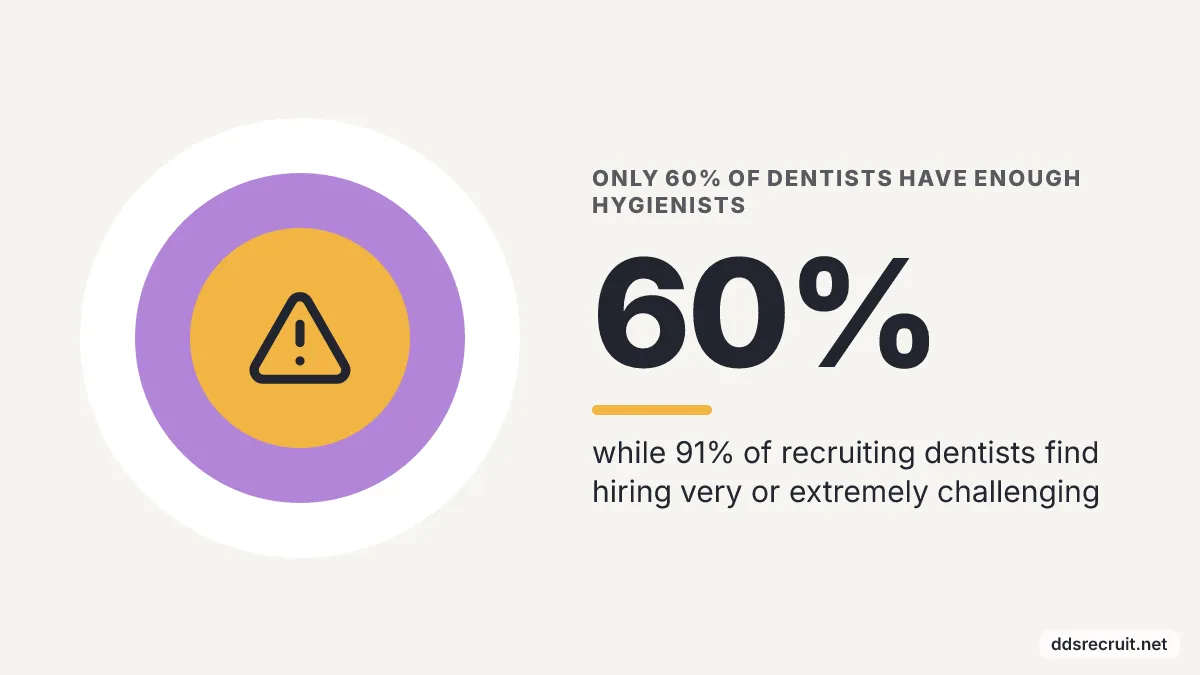
Direct recruiting costs more than the job board receipt because the owner and office manager become the recruiting department while the schedule keeps filling. The visible spend is the posting. The hidden spend is the time spent rewriting ads, calling cold leads, chasing references, and rescheduling patients when the column stays thin. The American Dental Association Health Policy Institute reported in April 2026 that only 60% of dentists had enough hygienists, while 91% of recruiting dentists called hiring a hygienist very or extremely challenging. A direct ad competes inside that market, so a quiet inbox is not proof that the practice wrote a weak post. It shows the labor pool is tight, and every delay matters.
Direct hiring works best when the owner has a local referral base, a flexible schedule, and an office manager who can respond to hygienists the same day. A practice with those conditions should not pay an agency just to duplicate an active network, because the direct route keeps control close to the practice and avoids a success fee.
The direct route starts to fail when the person handling recruiting has no slack. A hygienist who applies after hours or asks about compensation by text is judging responsiveness before anyone talks about culture, and a practice that replies late loses candidates before clinical fit is tested.
Salary research belongs before the ad goes live, not after the first rejection. The U.S. Bureau of Labor Statistics released May 2025 wage data on May 15, 2026, showing the dental hygienist median annual wage was $98,100, and a practice should compare that national number with local expectations before deciding whether direct recruiting is realistic. DDS Recruit hosts a hygienist salary by state tool for that check, and a broader dental salary calculator helps when the offer has to sit beside other clinical roles.
When does an agency earn its fee?
An agency earns its fee when the practice needs a hygienist search to keep moving after the owner returns to the chair. The value is not magic access to unlimited candidates; the value is sustained recruiting attention in a market where good hygienists may not be refreshing job boards.
An owner who wants to find a hygienist recruiting agency should ask about dentistry focus, replacement terms, fee timing, and how the agency handles fit beyond a résumé. The useful question is not whether the recruiter says culture fit matters, because every recruiter says that; the useful question is what information the recruiter needs from the practice before sending anyone.
The work most relevant to this hiring decision is Dental hygienist recruiting, alongside Associate dentist recruiting and Dental specialist recruiting (in-house specialists) when a practice is building a broader clinical team.
The trade-off is control. Direct recruiting lets the owner shape every message and adjust the offer in real time, while an agency requires the owner to explain the practice honestly enough that someone outside the office can represent it. A practice that cannot describe its schedule, patient mix, compensation range, hygiene philosophy, and team expectations will frustrate either route.
Agency recruiting becomes especially useful when a hygienist hire is connected to another staffing move. A practice adding an associate, bringing a specialist in house, or preparing for growth may need the hygiene column, the dentist schedule, and the office manager role to line up rather than fill one seat in isolation.
Cost, time, and fit: compare the route before spending
The right comparison is a working budget, not a gut reaction to a fee. A direct route carries lower outside cost but higher owner labor, while an agency route carries a clearer outside cost and shifts more of the search burden away from the practice.
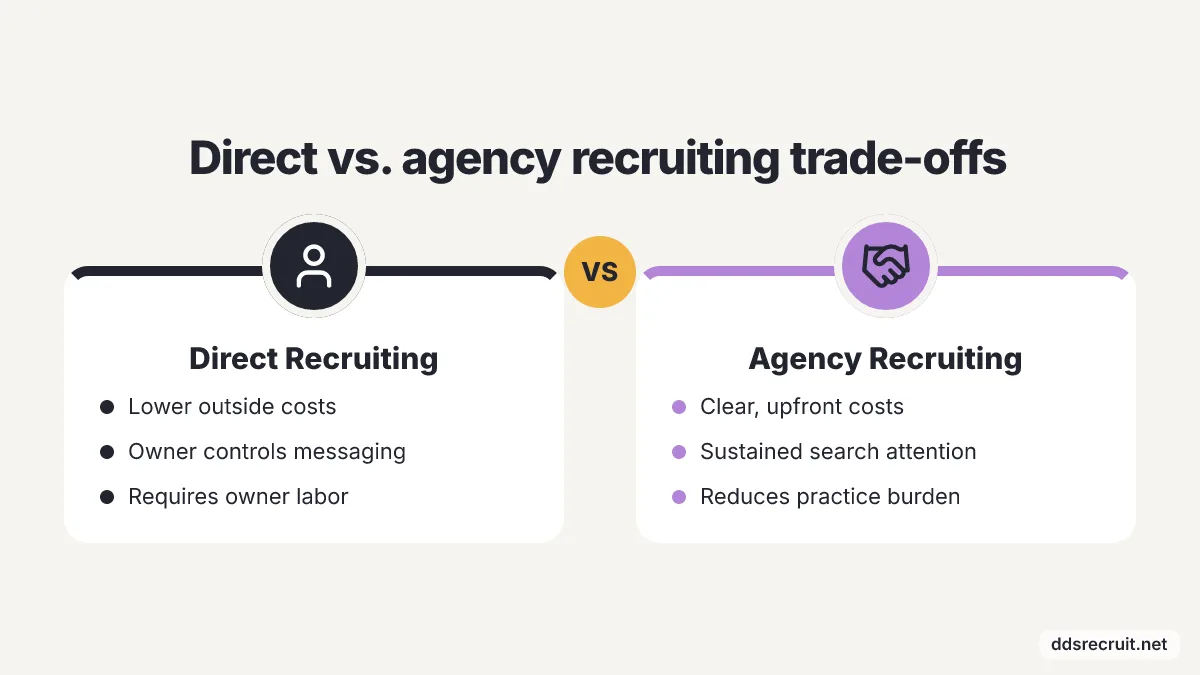
Direct recruiting expenses usually include job postings, sponsored listings, staff time, and the opportunity cost of a slow hire.
Agency recruiting expenses usually include a retainer, a success fee, or some combination set by the recruiting agreement. The owner should ask when money is owed, what happens if the hire leaves, and whether replacement language is written into the agreement rather than described casually on a call.
Time is the hardest cost to see because it hides in small interruptions. A chairside owner may only have short pockets between patients, while the office manager is already covering front desk, insurance questions, schedule changes, and payroll details. A hiring process that depends on perfect follow-up from that person is fragile before a single interview occurs.
Fit is where the agency-versus-direct decision gets less obvious. A direct search gives the owner immediate feel for the candidate, but a busy owner may overvalue availability because the hygiene column is hurting. An agency search adds cost, but it should force the practice to define what good fit means before the interview, not after a resignation.
The most practical fit screen is operational rather than sentimental. The practice should know whether the hygienist is comfortable with the perio protocol, assisted or unassisted hygiene expectations, appointment pacing, patient education style, radiograph workflow, and how the dentist wants hygiene exams called. Those details reveal whether a hire will stay after the first weeks of goodwill fade.
Job boards still belong in the process, but they should not be the whole process once the ad goes quiet.
What changed in the hygienist market recently?
The recent changes point toward continued pressure rather than quick relief. A practice deciding between agency and direct recruiting should treat the shortage as a retention and capacity problem, not just a posting problem.
The American Dental Hygienists' Association issued an April 2026 position statement that framed the shortage as retention failure, not simply a lack of qualified people. That framing matters for hiring because compensation alone may get a conversation started, but schedule design, respect for the hygiene role, and clinical support affect whether the hire stays.
ADA News reported in February 2025 that about 62% named staffing shortages as the top practice challenge dentists expected for 2025. The same ADA News article reported that hygienist recruiting difficulty stayed near 90-95% from late 2022 through late 2024, which means a practice should not plan around the idea that the market will normalize on its own.
The ADA Health Policy Institute report on dental workforce shortages estimated that vacant hygiene and assisting positions reduced practice capacity by 10%. The same report found that 31.4% of hygienists expected retirement within five years, so the hiring plan has to account for future replacement risk as well as the open column today.
Virginia added a narrow operational wrinkle, but not a national substitute for hygienist hiring. On July 1, 2026, the Virginia Board of Dentistry announced that Dental Assistants I/II may perform scaling and coronal polishing under the new state law once statutory requirements are met and the supervising dentist certifies the assistant. A Virginia practice should understand that rule, but a practice outside that state still needs to follow its own dental board rules and cannot treat the Virginia change as a universal staffing answer.
How should an owner choose the route?
The owner should choose direct recruiting when the practice can move fast, pay competitively, and reach candidates without starting from scratch. The owner should choose an agency when the open role is already affecting capacity, the job board has gone stale, or the practice cannot keep recruiting activity alive while seeing patients.
Start with the offer before choosing the channel. A hygienist comparing jobs will look at pay, schedule, benefits, commute, clinical autonomy, appointment length, and how the dentist treats the hygiene department. A weak offer does not become strong because an agency presents it, and a strong offer can still be wasted if no one follows up.
A practical direct plan needs a named owner for every recruiting task. The office manager should not be assigned vague responsibility for hiring while still covering the front desk; the practice should decide who replies to applicants, who discusses pay, who books working interviews if used, and who closes the loop with candidates who are not moving forward.
A practical agency plan needs honest input from the dentist. The recruiter needs the real schedule, the real compensation range, the reason the last hygienist left if the practice knows it, and the parts of the culture that will not change for the new hire. A polished but incomplete story produces introductions that look good at first and break down once expectations surface.
Practices that prefer fees tied closely to hiring outcomes can read about a success-based recruiting model before asking any recruiter how payment works.
A hygienist search also affects the employer brand that candidates see in public.
The decision point is not whether agencies are always better than direct hiring; the decision point is whether the practice has the time, candidate access, and follow-up discipline to make direct recruiting work before the open hygiene column damages production and patient flow.
Conclusion
Start with the hiring limit that is already in front of you. If pay is the issue, change the offer before you call a recruiter. If the trouble is time, stale applicants, or the same culture mismatch showing up again, compare agency cost with the owner hours and the hygiene time already being lost.
The next step is plain: put the pay range, schedule, clinical expectations, and follow-up owner on one page. A direct search deserves one more serious try only if that page can compete and someone can answer fast. Agency help deserves attention when the practice cannot keep that work moving without pulling the dentist or office manager away from patients.
Related reading
- Hiring a Dental Hygienist: Costs and Benefits by Route
- Effective Dental Hiring with Fractional Recruiting
- Why Success-Based Recruiting Works for Dentists
- Cost of Recruiting Dental Staff Yourself vs a Specialist
Where to go next
Sources
- ADA Health Policy Institute, "Dental Hygienist Shortage" (April 2026)
- ADA News, "Five years later: Staffing shortages, infection control since the COVID-19 pandemic" (Feb 2025)
- ADA Health Policy Institute, "Dental Workforce Shortages: Data to Navigate Today's Labor Market" (PDF report)
- Virginia Board of Dentistry: Dental Assistants I/II authorized to perform supragingival scaling and coronal polishing
- U.S. Bureau of Labor Statistics: Occupational Employment and Wage Statistics, May 2025
- American Dental Hygienists' Association: Update on Dental Hygiene Workforce Solutions (Position Statement)