6 Hygienist Recruiting Options Beyond Agency Fees
By Dr. Brian Passell and the DDS Recruit team ·
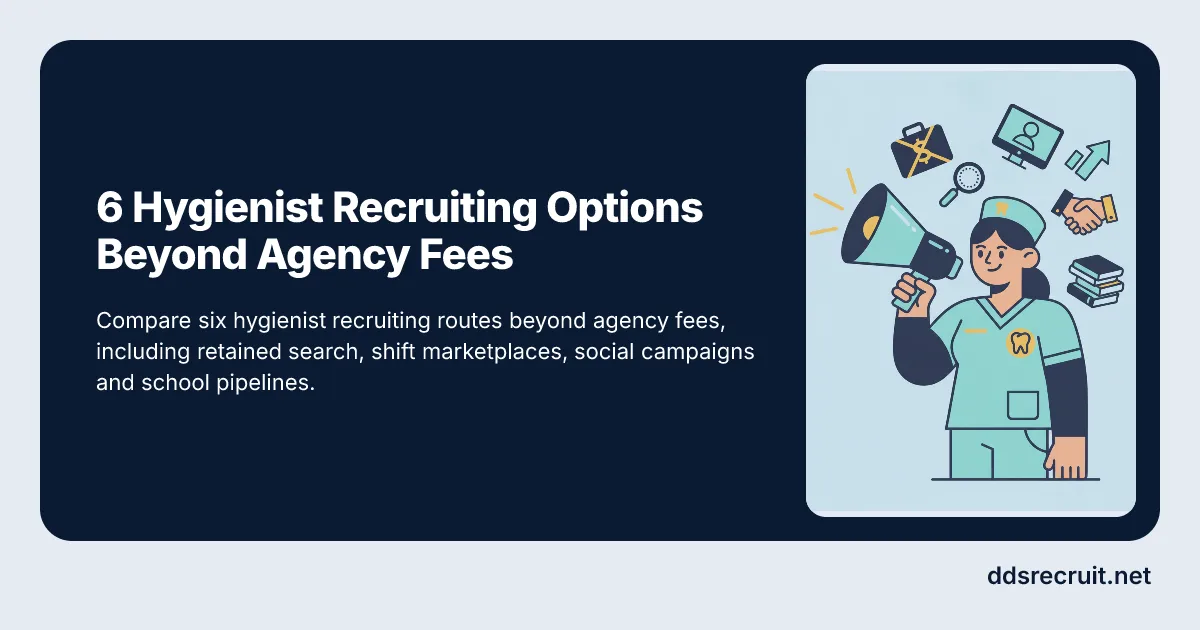
Summary: To recruit dental hygienists without agency fees, practices can explore options like DDS Recruit for culture-fit hiring, Pearly for broader outreach and temp support, TempStars for shift coverage without hourly markups, and DirectDental for marketplace reach without placement fees. Each approach targets different labor pools and needs, allowing practices to match recruitment strategies to specific job requirements.
Only 60% of dentists reported adequate hygienist staffing in the ADA Health Policy Institute's 2026 dental hygienist shortage report, and 91% of dentists actively recruiting said the search was very or extremely challenging. A hygiene opening stops looking ordinary when new-patient wait times are already stretching and the owner is still chairside most of the week.
Agency cost is the obvious frustration, but cost is not the whole problem. The top strategies for recruiting dental hygienists in high-turnover markets work because they reach different labor pools: actively searching hygienists, passive candidates on social platforms, temp clinicians who want control, and students who may not be ready for a permanent role yet.
The best approach beyond agency fees is not one universal replacement. A practice should match the channel to the job: permanent hire, urgent shift coverage, recurring temp need, passive candidate outreach, or a pipeline that will pay off later.
1. DDS Recruit: culture-fit hygienist search
DDS Recruit dental recruiting provides dental hygienist recruiting for U.S. Practices and DSOs by running the search end to end, sourcing, screening, and introductions, with a focus on culture and fit rather than only résumés. That fit point matters for hygienists because a fast hire who dislikes the schedule, perio philosophy, patient pace, or owner communication style turns the opening into a repeated vacancy. DDS Recruit suits an owner-dentist who has tried job boards for months and now needs a real recruiting function without adding a full-time HR role. The firm's positioning is dentistry-only recruiting, and its own site says it has 17 years spent inside dental practices, which gives the search a dental-specific frame rather than a generic healthcare staffing frame.
DDS Recruit's offer is useful when the hygienist hire has to stick, not just start. The exact guarantee is a one-year placement guarantee: if a hire leaves within the first year, we search for a replacement at no charge. The fee model is also stated plainly: Path A, the search retainer: a nominal monthly search fee, plus a success fee owed only when a placement sticks.
DDS Recruit is not the cheapest way to cover a single empty Thursday. A temp marketplace is the better first call when the job is one isolated shift and the practice only needs a licensed person in the column. DDS Recruit fits the owner who wants permanent dental hygienist recruiting tied to culture, compensation, and retention risk, and the same recruiting platform also covers Associate dentist recruiting and Dental specialist recruiting when hygiene hiring is part of a broader staffing plan.
DDS Recruit also publishes current dental openings on its dental jobs posting page, which matters because candidates compare public opportunities before responding to outreach. An owner comparing do-it-yourself hiring with outside support can also use the vacancy cost calculator before choosing whether a longer open hygiene column costs more than a recruiting fee.
2. Pearly: broader outreach and temp support
Pearly's Dentistry Huddle article looks at hygienist recruiting through two moves, using temp help for the non-clinical load and widening the search on LinkedIn. That matters in a small office, where the person answering phones, sorting benefits questions, handling payroll details, and chasing candidates is hardly built to run a full hiring push alone. Pearly's temp-program idea fits a practice that needs coverage while it keeps looking for a permanent hygienist. Renting staff through a temp setup differs from paying a standard placement agency, because the practice is buying coverage and flexibility instead of betting the whole search on one hire.
Pearly's LinkedIn works better than many generic job-board tips because it reaches hygienists who are already looking, not just people who happened to notice a paid ad. A practice owner can post the opening on LinkedIn, show the schedule, and ask dentists, hygienists, and nearby dental contacts to pass it along to people who are already watching career moves. Pearly's approach still takes time, even if it avoids a placement fee. Someone has to write the post, answer quickly, check license fit, field compensation questions, and keep the conversation moving before another office gets there first. The practice manager who is already buried in front desk work and HR may not have that bandwidth during a week full of hygiene cancellations and recall calls.
Pearly makes sense when a practice wants less dependence on paid agencies without locking itself to one platform. The trade-off is simple enough, broader outreach brings more messages to handle, so it works best when the owner or office manager can set aside time for follow-up instead of treating recruiting as something to do between patients.
3. TempStars: shift coverage without hourly markups
TempStars shift marketplace is built for practices that need hygienist coverage without the hourly markup tied to traditional staffing agencies. TempStars says its model charges a flat $73 CAD or $38 USD per completed shift and no hourly markup.
TempStars helps most when the problem is immediate schedule coverage. A maternity leave, a sick day, or a recurring open hygiene day calls for something different from a permanent hire who has to fit the practice's culture and perio standards. A marketplace lets the office post or fill shifts without turning the whole search into a placement process. The cost comparison is why TempStars belongs in a list about options beyond agency fees. TempStars describes traditional agencies as charging a $100 to $150 placement fee plus a $30 to $60 per hour markup, which changes the economics of a short-term hygiene gap. A flat completed-shift fee is easier for an owner to compare with the production loss from an empty column.
TempStars has a clear limit. A good temporary hygienist does not automatically fix a permanent retention problem. A practice with constant turnover still has to look at pay, schedule, patient load, benefits, and manager communication, because a marketplace can cover the day without fixing why the permanent seat keeps reopening.
TempStars is the right first option when the practice needs a hygienist quickly and the open column is already on tomorrow's schedule. A permanent recruiting route should start at the same time if the same days keep going uncovered, because repeated temp use starts to signal a hiring problem, not just a scheduling problem.
4. DirectDental: marketplace reach without placement fees
DirectDental talent marketplace gives dental practices access to a large pool of dental candidates, and DirectDental says practices can reach over 1 million qualified dental candidates across assistants, hygienists, dentists, and front office staff. The platform also says recruiters handle the sourcing work, and there are no placement fees at all. DirectDental fits a practice owner who wants reach but does not want the old agency fee model. That marketplace setup matters because hygienists are not all looking in the same place. A practice that relies on one job board may keep seeing the same small set of applicants over and over.
Its no-placement-fee structure is appealing when the owner wants to keep hiring costs under control while getting sourcing help. A practice can use the marketplace to get beyond stale job ads, especially if the office manager has enough time to answer interested hygienists and move strong candidates toward a visit or a call. The limit is the same one most broad marketplaces run into. Reach does not equal fit. A large pool raises the odds of contact, but the practice still has to judge whether the hygienist wants the office schedule, pace, pay structure, clinical expectations, and culture. A high-volume candidate source can mean more work if the practice has not defined what a good match looks like.
DirectDental works best when a practice wants broad exposure in the dental market and a cost structure without placement fees. The owner should write a specific opening instead of a generic help-wanted post, because hygienists comparing multiple openings need to see the workweek, patient flow, benefits, and why the last person in the role left if the practice can say that plainly.
5. Boostpoint: social campaigns for passive hygienists
Boostpoint dental staffing campaigns use Facebook and Instagram recruitment ads to reach licensed hygienists and assistants who are not actively browsing job boards. The short-application model fits the way many passive candidates behave. They will not rewrite a résumé for a casual inquiry, but they may answer a quick mobile form if the role looks better than the one they have now. Boostpoint suits practices in markets where job boards have gone quiet. A hygienist who is employed, frustrated, and not yet searching may never see a job-board listing. Social recruiting puts the opening inside the feed where the person already spends time. The practice's offer has to be concrete enough to earn a response, especially on schedule, pay range, patient load, and benefits.
Boostpoint's advantage is attention, not final selection. A campaign can generate leads, but the practice still has to contact candidates quickly and answer practical questions before interest cools. Passive candidates usually need a better reason to move than an active job seeker, so the owner should know what the practice is willing to change before paying for traffic. Boostpoint's limit is that advertising exposes weak offers. A practice that posts a vague hygiene job with no schedule clarity and no compensation signal will pay to learn that passive candidates are not persuaded. The better use is to advertise a real value proposition, such as a stable schedule, sane appointment length, or a team structure that reduces burnout.
Boostpoint is a strong option when the practice has a competitive role but the right hygienists are not applying. An owner who wants to compare social lead generation against recruiting support should also read DDS Recruit's discussion of whether to build or outsource dental recruiting, because social campaigns still require fast follow-up inside the practice.
6. Dentplicity: school relationships and employer branding
Dentplicity employer branding advice points practices toward local hygiene and assisting programs as a high-return recruiting strategy, including offering the practice as an externship or clinical rotation site. The strategy is slower than a marketplace, but it builds a hiring channel before the next vacancy appears.
Dentplicity suits an owner who is tired of reacting to every hygienist departure as an emergency. A school relationship gives students and instructors a real view of the practice, and it gives the practice a chance to show its standards before someone applies. That matters when a small office cannot absorb repeated culture misses.
The education pipeline is not imaginary relief, but it is not immediate relief either. ADA News reported in February 2025 that first-year dental hygiene program enrollment rose nearly 20% from 2020-21 to 2024-25, yet the same article quoted Dr. Ricci of the ADA saying the number of graduating hygienists has not been enough to offset losses. A practice should build school relationships while using another route for today's opening.
Dentplicity's approach also becomes more important as states adjust hygiene scope. In August 2026, Delaware's governor signed SB 283 expanding hygienist scope, allowing Delaware patients to receive cleanings, sealants, and fluoride from a hygienist without a prior dentist exam if they see a dentist within 12 months. Delaware practices competing for hygienists need to explain how the role will use that scope, not just list hours and pay.
Dentplicity's limit is timing. A practice with a hygiene column open next week should not treat school outreach as the main fix, because externships and program relationships mature over months and school calendars do not bend around a single vacancy. The stronger plan is to start the pipeline now so the next opening is less dependent on an agency or job board.
How to choose the right hygienist recruiting route
The right choice starts with the type of vacancy, not the cheapest visible fee. A same-week shift, a permanent full-time role, and a long-term pipeline are different buying decisions, even though all three show up as a hygienist shortage on the schedule.
| Option | Best fit | Cost or operating model | Main limit |
|---|---|---|---|
| DDS Recruit | Permanent hygienist hire where culture fit matters | Success-oriented recruiting with a one-year placement guarantee | Not the first choice for one isolated shift |
| Pearly | Broader outreach plus temp support | LinkedIn outreach and temp-program thinking | Requires internal follow-up time |
| TempStars | Immediate shift coverage | Flat completed-shift fee with no hourly markup | Does not solve repeated turnover by itself |
| DirectDental | Large dental candidate reach | No placement fees ever with sourcing support | Reach still needs fit evaluation |
| Boostpoint | Passive hygienists not browsing boards | Facebook and Instagram lead campaigns | Weak offers get exposed quickly |
| Dentplicity | Future pipeline and retention brand | School relationships and externship pathways | Too slow for next-week coverage |
A practical sequence works better than picking one channel forever.
The labor market supports treating hygiene recruiting as a standing system. The U.S. Bureau of Labor Statistics projects 7% employment growth for dental hygienists from 2024 to 2034 and about 15,300 openings each year, mostly from workers transferring occupations or retiring. A practice waiting for the perfect applicant to appear on one job board is choosing the narrowest possible version of the market.
A practice comparing a recruiter, a marketplace, and a campaign should price the open chair before pricing the vendor. The hygienist salary by state tool is the next check if candidate interest is weak and compensation may be the reason.
Conclusion
Start with the problem sitting on the schedule. If the hygiene column is open this week, buy coverage first and keep patients moving. If the vacancy has dragged on for months, stop treating job boards as the whole market and choose a permanent recruiting route that reaches people who are not already applying.
The work takes more than posting a better ad. A practice has to define the role clearly, answer candidates quickly, and decide what kind of recruiting support it can actually manage while patients are in the chairs.
Related reading
- Cost of Recruiting Dental Staff Yourself vs a Specialist
- Build or Outsource Dental Recruiting: How to Decide
- Why Success-Based Recruiting Works for Dentists
- Culture Mismatch in Dental Recruitment: Costs and Signs
Where to go next
Sources
- Pearly – Dentistry Huddle
- TempStars – How Dental Offices Fill Hygiene Shifts Without Agency Markups
- DirectDental – Dental Talent Marketplace
- Boostpoint – Dental Hygienist Shortage: 2026 Data
- Dentplicity – Recruit and Retain Dental Staff: Employer Branding Strategies
- ADA Health Policy Institute — Dental Hygienist Shortage (HPI Perspectives, April 2026)