

Build or Outsource Dental Recruiting: How to Decide
By Dr. Brian Passell and the DDS Recruit team ·
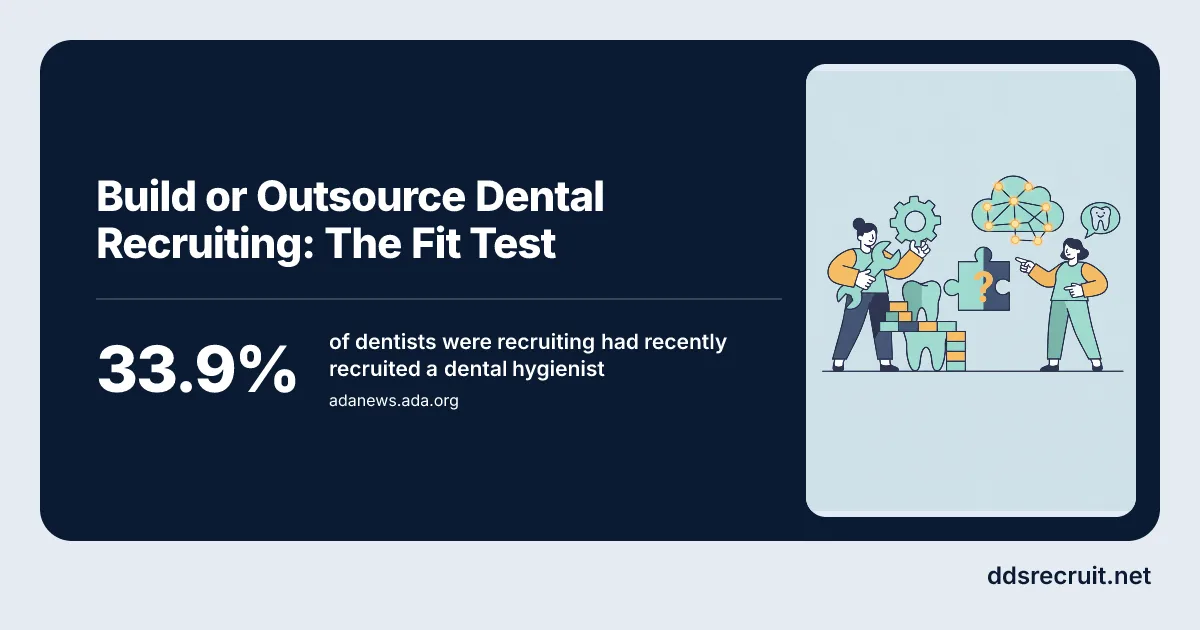
Summary: In-house recruiting is ideal for frequent hiring needs, clear employer branding, and roles familiar to the team, offering direct control and quick responses. A specialized dental recruiter is better for scarce roles, where culture fit is crucial, or when the practice lacks time and market reach, ensuring sustained follow-up and candidate fit.
About 62% of dentists surveyed by ADA News in 2025 said that staffing shortages would be biggest challenge was a problem in their dental practices. The bottleneck shows up fast in the day-to-day schedule. Hygiene chairs sit open, associate production starts slip, and practice owners burn clinical hours on online applications that never should have made it past the first glance.
Choosing between in-house recruiting and dental recruiter strategies depends on internal bandwidth, market reach, and how difficult the opening is. Handling recruiting inside the practice makes financial sense when a dental group hires often enough to justify dedicated staff, already has a strong regional reputation, and fills roles that follow a predictable pattern. Bringing in an outside recruiter makes more sense when the open chair calls for hard-to-find clinical skills, cultural fit matters more than raw applicant volume, or a long vacancy starts cutting into practice profit.
A dental practice can get either choice wrong.
Paying an outside firm for an entry-level assistant, when qualified local candidates already come through the practice website, adds placement cost for no good reason. On the other side, trying to fill an associate dentist role, a dental specialist role, or a Chief Clinical Officer role from inside the office wastes executive time when the administrative team has no direct line to passive candidates.
What does in-house recruiting do better?
Internal recruiting gives a dental practice full control over the message, candidate communication, and interview timing. An experienced office manager who lives the practice every day can talk about patient volume, clinical philosophy, PPO participation, and staff dynamics without passing that reality through another layer. For steady front-desk, sterilisation tech, and dental assistant hiring, that direct contact helps the team sort applicants quickly and move to offers without a long wait. It also builds a candidate pipeline inside the organization over time. Group practices and dental support organisations with several nearby locations can keep in touch with past applicants and move qualified hygienists or future associates between sites as schedules open up. That internal contact is especially practical when the dental group brings in enough recurring hires to support a dedicated in-house talent acquisition coordinator.
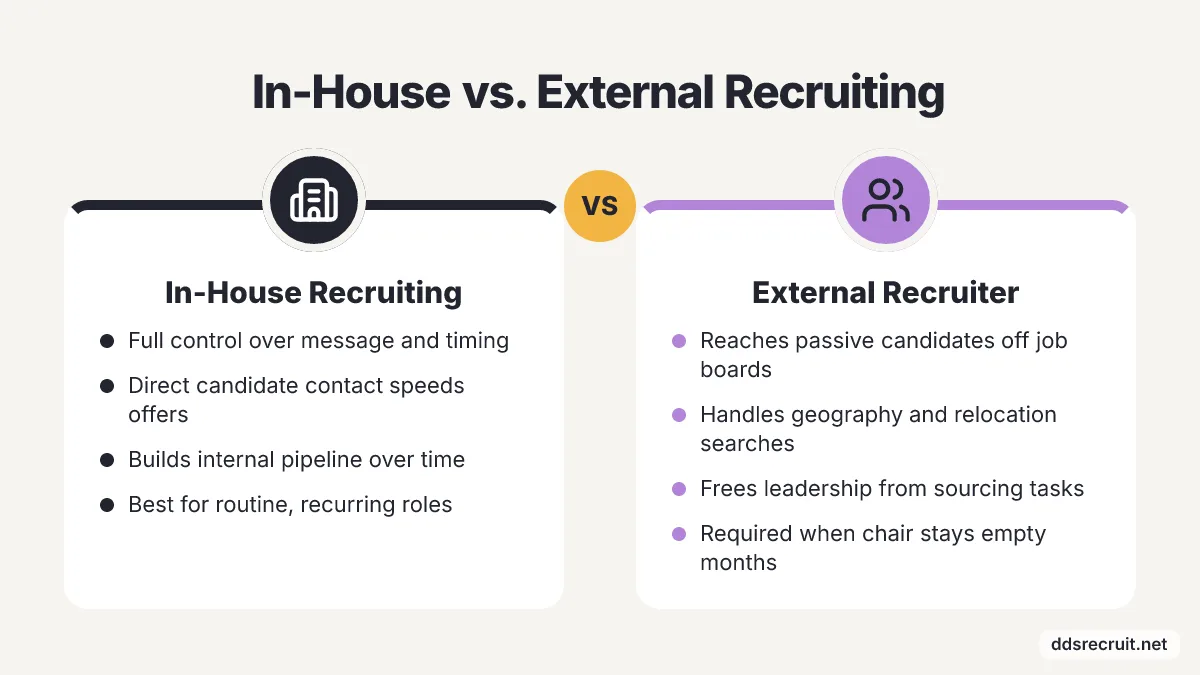
The money case for in-house hiring is clearest when the roles are routine and leadership has real time to manage the queue. An independent dental practice bringing back a familiar team member through local referrals does not need an outside recruiter. Running the search manually is the right call for a smaller, lower-stakes hire when the office has warm candidate inquiries, competitive pay, and staff who can respond within 24 hours. The main limit of the internal model is capacity. ADA News reported on data from the ADA Health Policy Institute showing that, during the third quarter of 2024, 33.9% of dentists were recruiting had recently recruited a dental hygienist, and 91.7% of those dentists said the hiring effort was very or extremely difficult. An office manager who is also handling patient check-in, insurance billing, hygiene re-care, and surprise call-outs cannot spend several uninterrupted hours each day sourcing and vetting candidates.
Internal teams also run into problems with geography and passive candidates. A private practice may know the clinicians down the road, but staff members usually do not have the tools to find an associate who wants to relocate, an endodontist who wants two days of in-house production, or a clinical director thinking about a quiet career move. Relying only on internal hiring becomes an operational barrier when the open role calls for reaching clinicians who never look at standard job boards.
The real measure is daily execution, not control. When a dental office can post open roles, screen applicants within hours, and interview several qualified candidates, in-house hiring works well. When productive chairs stay empty for months because leadership is buried under patient care, keeping the search inside the office costs far more than an agency fee.
What does a specialized dental recruiter do better?
A specialized dental headhunter justifies the investment when an open requisition requires dental industry connections, precise clinical alignment, and proactive outreach. Doctor searches, specialist placements, dental hygiene recruitment, and clinical executive hiring involve far more effort than publishing an internet job ad, because top performers are rarely unemployed or browsing general job boards.
Industry focus matters because clinical nuances dictate retention. Sourcing a general associate for an established family office requires a completely different screening perspective than hiring a traveling periodontist, an orthodontic specialist, or a Chief Clinical Officer overseeing twenty locations. A generalist staffing agency understands basic interview questions, but a dental recruiter understands how daily production quotas, clinical autonomy, laboratory support, and bonus structures influence whether a doctor stays past year one.
DDS Recruit operates as a fractional dental recruiting team backed by 17 years of dentistry-only search experience that matches for fit, not just résumés. The firm conducts targeted searches across associate dentist recruiting, specialist and in-house specialist placement, and C-level executive roles including Chief Clinical Officer and Chief Operating Officer positions.
Retaining an industry specialist provides practices with direct access to dedicated search infrastructure without the overhead of adding an internal recruiter to payroll. The practice partners maintain final hiring authority, while the recruiting partner handles candidate identification, initial vetting, credential verification, and interview logistics.
The trade-off of external recruitment is that an agency cannot compensate for organizational ambiguity. A recruiter cannot resolve uncompetitive daily guarantees, unpredictable chairside scheduling, or hidden partner disagreements over clinical pacing. A practice owner who has not defined the exact clinical competencies and personality traits needed for the office should not expect an outside firm to solve that internal uncertainty.
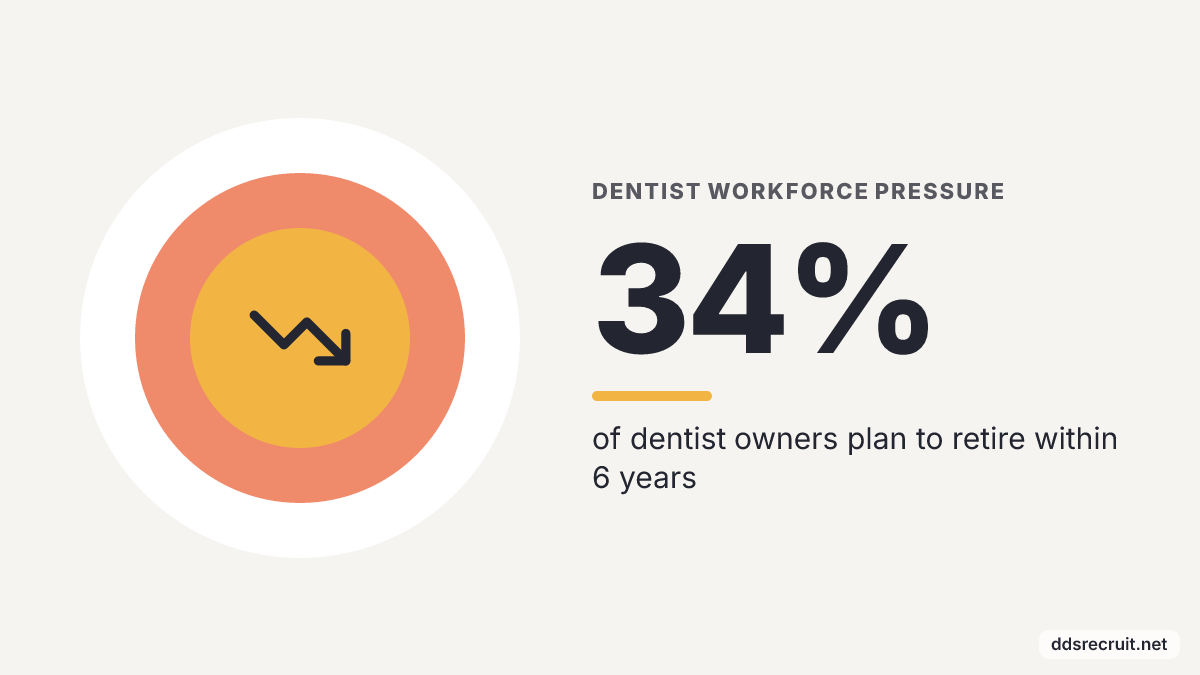
The argument for specialized sourcing grows as replacement costs rise. Becker's Dental Review highlighted findings from DentalPost's 2025 Dental Salary Survey indicating that 34% of dentist owners plan to retire within six years, while more than 28% changed jobs in the last twelve months among surveyed associate dentists. Doctor turnover, owner retirements, and leadership transitions are operational threats that require targeted recruiting solutions.
Job seekers also require centralized directories to discover active positions.
A headhunter cannot rescue an undesirable working environment. An office troubled by rapid turnover, inconsistent patient booking, or sub-market wages will continue to struggle with retention regardless of sourcing methods. The decision to hire an agency works best when the dental business has established clear clinical expectations, market-rate compensation, and an environment that doctors want to join.
When does a hybrid or fractional model make sense?
A hybrid recruiting setup, or a fractional one, fits practices that need real sourcing help but cannot justify paying a full-time in-house recruiter. The dental group still controls compensation terms, brand identity, and the final hiring call. The outside partner does the prospecting, early screening, and back-and-forth with candidates.
This arrangement tends to work for growing private practices and regional groups with uneven hiring needs. A group may need an associate dentist in the spring, two dental hygienists in the summer, and a practice administrator later in the year. That is too much stop-and-start volume for an office manager, but not enough steady work for a full internal recruiting desk. It also helps with specialized growth hires, like an in-house oral surgeon or a regional clinical lead, where the candidate pool is deeper than an office manager can reach on their own.
A fractional recruiting partner still needs someone inside the practice to keep things moving. A clinical director or lead partner has to review candidate profiles quickly, answer clinical questions, and clear time on the calendar for working interviews. Handing off sourcing does not remove the owner's job of judging clinical skill and team fit.
Hiring choices also connect to wider practice management work. Sourcing help, supply purchasing, ownership transitions, and patient demand all feed into clinical production.
A fractional search only pays off when an internal executive stays involved. If doctor owners wait more than two business days to review applicant profiles, strong candidates move on to competing practices while they wait for callbacks.
How should a dental practice choose?
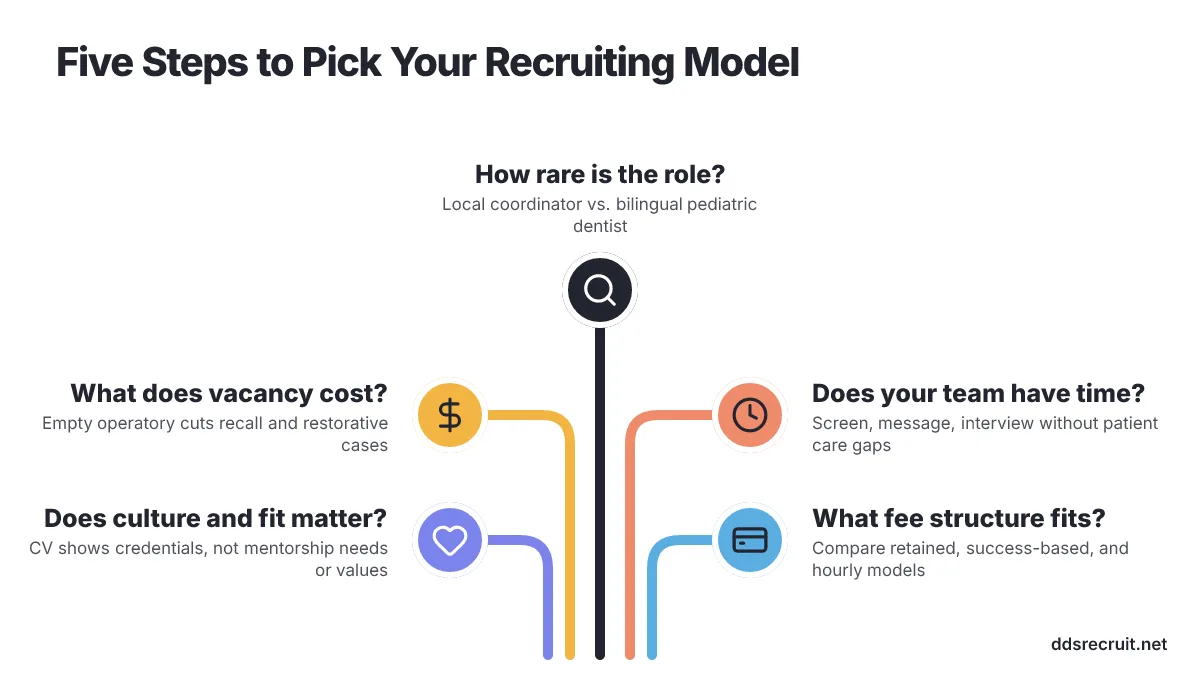
Start with how rare the open role is, then look at who on the team actually has time to do the search. Finding a local scheduling coordinator through classifieds asks for a very different recruiting setup than finding a bilingual pediatric dentist, a strong restorative associate, or a multi-site Chief Clinical Officer.
-
Then look at what an empty chair costs. An open hygiene operatory cuts into recall and the discovery of restorative cases, while an empty clinical leadership post weakens clinical standards and provider production. ADA Health Policy Institute data published in April 2026 showed that only 60% of dentists had adequate hygienist staffing, which is why hard-to-fill clinical openings need direct headhunting instead of a plain job post.
-
Measure the real administrative load inside the office. Keep the search in-house only if someone can screen applicants, message candidates, run phone interviews, and check references without taking attention away from patients. DDS Recruit lays out the money side of internal management time in its breakdown of recruiting dental staff costs, so owners can compare lost production with outside fees.
-
Pick a hiring channel that fits the role. Recruiting hygienists, general dentists, and clinical specialists means very different candidate conversations. Practice owners should study DDS Recruit's dedicated service for associate dentist recruiting when filling doctor production schedules is the main problem.
-
Give practice culture real weight. A curriculum vitae lists dental training and board credentials, but it does not show whether an associate needs daily mentorship, values speed over comprehensive care, or wants future partnership. Review DDS Recruit's insights on dentistry-specialized long-term hires when keeping someone long term matters more than filling an operatory quickly.
-
Match the fee structure with the financial risk. Practices looking at non-retained outside help can review DDS Recruit's breakdown of success-based dental recruiting to understand payment triggers, warranty timelines, and cash flow effects before they sign.
Executive clinical searches call for much tighter review. A Chief Clinical Officer appointment needs deeper assessment than an associate search because that executive directs doctor compliance, quality metrics, and regional expansion. If an agency site does not spell out executive search work, owners should set up a direct scoping call and ask about method and intake requirements. Local hiring swings should push the recruiting timeline forward. Becker's Dental Review noted from DentalPost's 2024 survey that 19% of responding dental hygienists changed employers within the prior year, with 11% actively looking for new jobs before year-end. A practice that waits until a resignation letter lands on the desk will spend months losing revenue.
Base the final choice on bandwidth and market access. In-house recruiting works when the team has time, a local pipeline, and a steady hiring rhythm. A specialized dental recruiter is the better spend when the role is hard to find, competition is intense, and the cost of vacancy is higher than the placement fee.
Conclusion
Pick the single most urgent vacancy in the practice and give one person daily ownership before the end of the day. If the office already has warm applicants on file and an office manager with time to schedule interviews this week, handle the search internally under a thirty-day deadline. If an associate dentist, dental specialist, hygienist, or clinical director search has gone unresolved for weeks, book a discovery call with a specialized recruiter to review role expectations and compensation benchmarks.
This process needs confirmed compensation brackets, an honest read on the workplace, and one leader with hiring authority. Sourcing advice cannot fix a broken office culture; practice leadership has to present a competitive, supportive place that top-tier clinicians want to join.
Related reading
- Recruiting Dental Staff Costs: When to Use Fractional Services
- Dentistry-Specialized Recruiters for Long-Term Hires
- Effective Dental Hiring with Fractional Recruiting
- Why Success-Based Recruiting Works for Dentists
Sources
- ADA News — New ADA policies empower states to alleviate dental workforce shortage
- ADA News — Five years later: Staffing shortages since COVID-19
- ADA.org Health Policy Institute — Dental Hygienist Shortage (April 2026)
- Becker's Dental Review — 34% of dentist owners plan to retire within 6 years: Report
- Becker's Dental Review — 5 notes on dental hygienist turnover in 2024