Evaluating Dental Recruiting Agencies for Hygienists
By Dr. Brian Passell and the DDS Recruit team ·
Summary: Using a dental recruiting agency to fill hygienist positions is worthwhile when the vacancy is causing production delays, job boards are yielding unsuitable candidates, and the office manager is overwhelmed with other duties. Agencies can provide access to a wider candidate pool and save time, but their fees should be weighed against the cost of prolonged vacancies and the risk of hiring unsuitable candidates.
An empty hygiene operatory at 8:00 AM on a Tuesday can send front-desk staff scrambling through the cancellation list, or pushing recall patients weeks farther out on the calendar. Practice owners often react to a quiet job posting by bumping up hourly pay and refreshing the listing on standard job boards. That move rarely solves much when patient waitlists already stretch into next month, because the real problem is time, candidate reach, and the ability to screen someone who will stay.
Whether it is worth using a dental recruiting agency to fill hygienist positions comes down to production loss and administrative bandwidth. A specialized placement firm starts to look sensible when dark operatories slow restorative handoffs, the office manager splits the day between insurance claims and patient intake, and board applicants keep missing the practice's clinical standards. Running the search in-house is still the better path if personal networks keep producing referrals and leadership has time for interviews right away.
Treating professional recruiters as a last-minute rescue after six months of lost recall revenue is expensive. Practice owners have to compare the agency fee with schedule collapse, candidate retention, and the disruption that comes from onboarding a clinician who quits within ninety days.
When does an agency earn its fee?
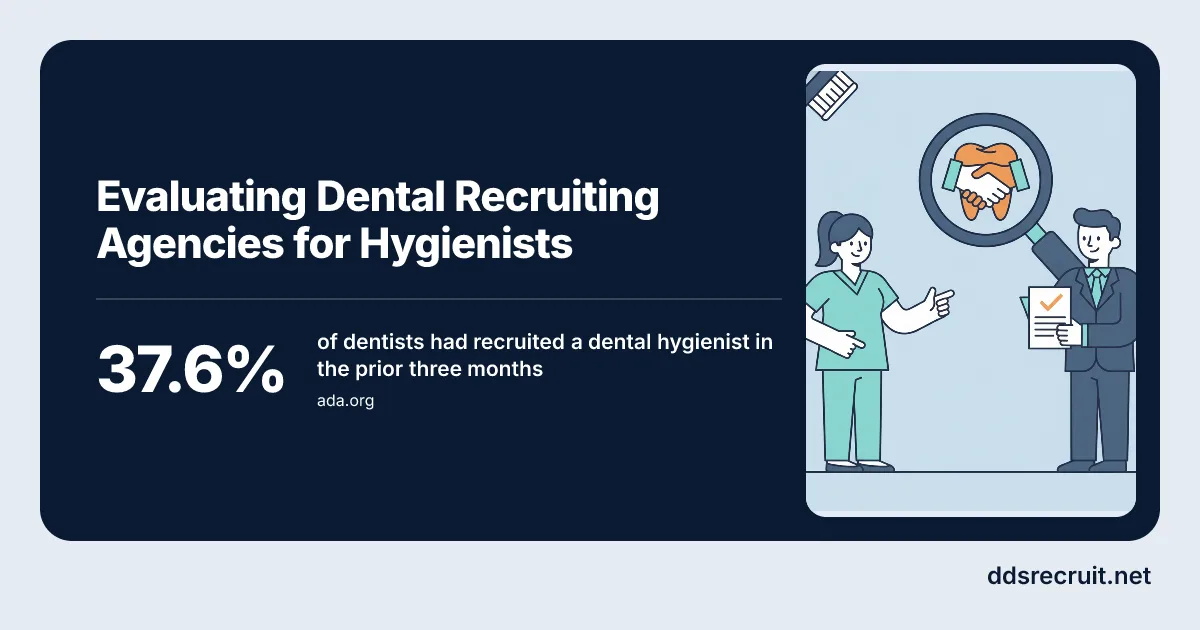
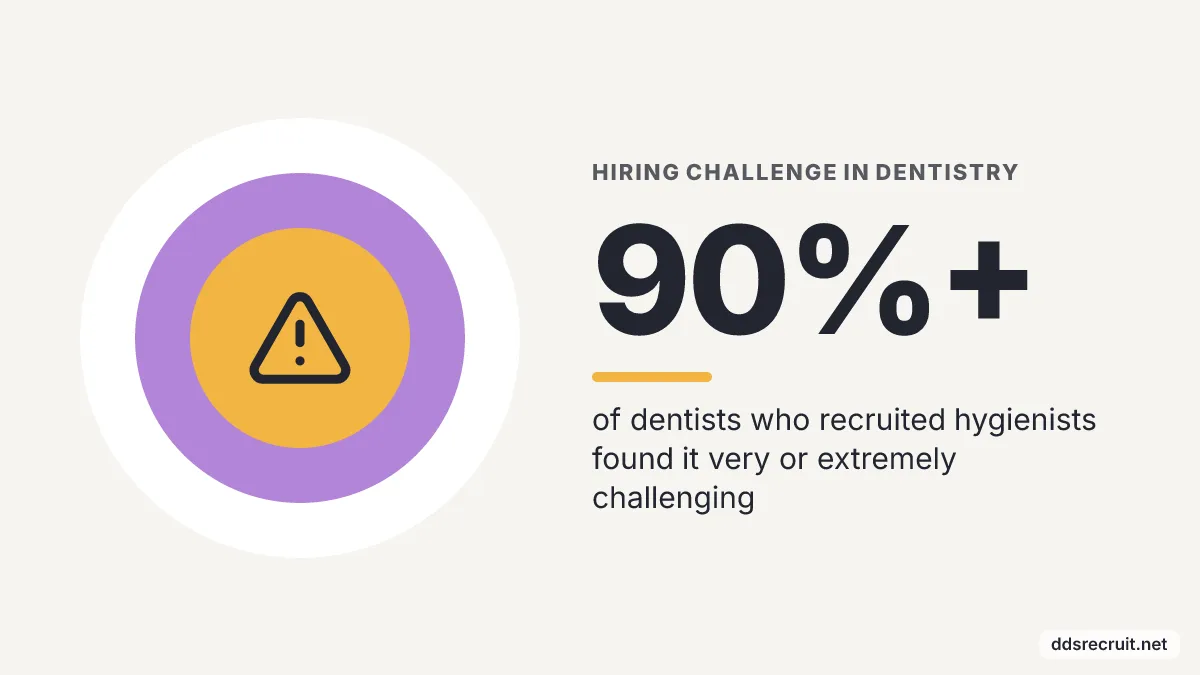
Hiring pressure across dentistry remains severe. According to the ADA Health Policy Institute, during the first quarter of 2026, 37.6% of dentists had recruited a dental hygienist in the prior three months, and more than 90% of those dentists said the hiring effort was very or extremely challenging. Independent practices have to compete with regional dental service organizations, temporary staffing agencies, and wage offers aimed at a limited pool of candidates. Labor data showed some improvement later in the year. The ADA Health Policy Institute reported dental office jobs growing 1.5% in the twelve months leading to the second quarter of 2026, which broke a two-year run of flat workforce counts. That modest growth does not remove the hiring friction, though, because the same data still shows that finding qualified hygienists is very or extremely challenging for most clinics looking for staff.
Recruitment agencies are the wrong choice when an office only needs coverage for an employee vacation, a short medical absence, or a temporary schedule spike. Local per-diem registries or temp services cover that kind of gap with less commitment. An executive or permanent placement agency earns its fee when the office needs an engaged employee who steadies hygiene recall schedules, presents periodontal therapy options, and works smoothly with chairside assistants every day.
What should the cost discussion include?
Financial review has to look at total placement cost, not just recruiter rates. The U.S. Bureau of Labor Statistics established that the median annual wage for dental hygienists reached $98,100 in May 2025 data, which means an under-market compensation offer will stall candidate interest no matter how the search is run. Empty chairs drain revenue through canceled hygiene exams, lost diagnostic fees, and deferred restorative treatment. Dentists need to set agency fees against those operating losses, staff overtime, and the clinical hours spent screening applicants after work. Clinicians who are unsure about local pay levels can consult a dental hygienist salary tool to set pay ranges before spending money on outside candidate search.
Fee structures differ widely across staffing vendors, so nationwide comparisons miss a lot. Practice administrators should spell out the contract before signing, including when payment starts, whether monthly administrative charges apply, what happens if a placement leaves, and whether the agreement covers one opening or a multi-chair expansion.
Dental practices working with DDS Recruit choose Path A as the search retainer: a small monthly search fee, plus a success fee owed only when a placement holds. The company runs a success-based recruiting model backed by a one-year placement guarantee. If a hire leaves within the first year, the firm searches for a replacement at no charge.
What should move faster, and what still takes time?
Recruiting services shorten the hiring timeline by targeting passive professionals and managing communication cadences, yet procedural speed cannot replace careful practice alignment. Outside recruiters expand candidate sourcing well beyond public job boards, but practice leaders must clearly establish production expectations, daily schedules, benefits packages, and periodontal protocols before interviews begin.
Compensation structure and day-to-day working parameters dictate candidate interest from the first outreach. Registered hygienists evaluating opportunities assess appointment lengths, assisted hygiene support, cancellation policies, periodontal charting expectations, and doctor examination styles.
State regulatory shifts also influence clinical responsibilities and candidate expectations. Legislative updates such as Delaware Senate Bill 283 in August 2026 let Delaware hygienists apply sealants, dispense fluoride, and supervise dental assistants without prior dentist examinations, proving that static job templates fail to reflect modern practice models.
Clinics pursuing both a hygienist and an associate dentist must run distinct recruitment workflows rather than mixing clinical requirements into a single generic staffing effort.
How do you protect culture fit before accepting a candidate?
Practice compatibility requires defining tangible daily expectations rather than relying on abstract impressions. A hygienist with flawless instrumentation skills will struggle in an environment demanding sixty-minute prophylaxis pacing, active patient education, or rigorous periodontal tracking if their background focuses strictly on high-volume hygiene blocks.
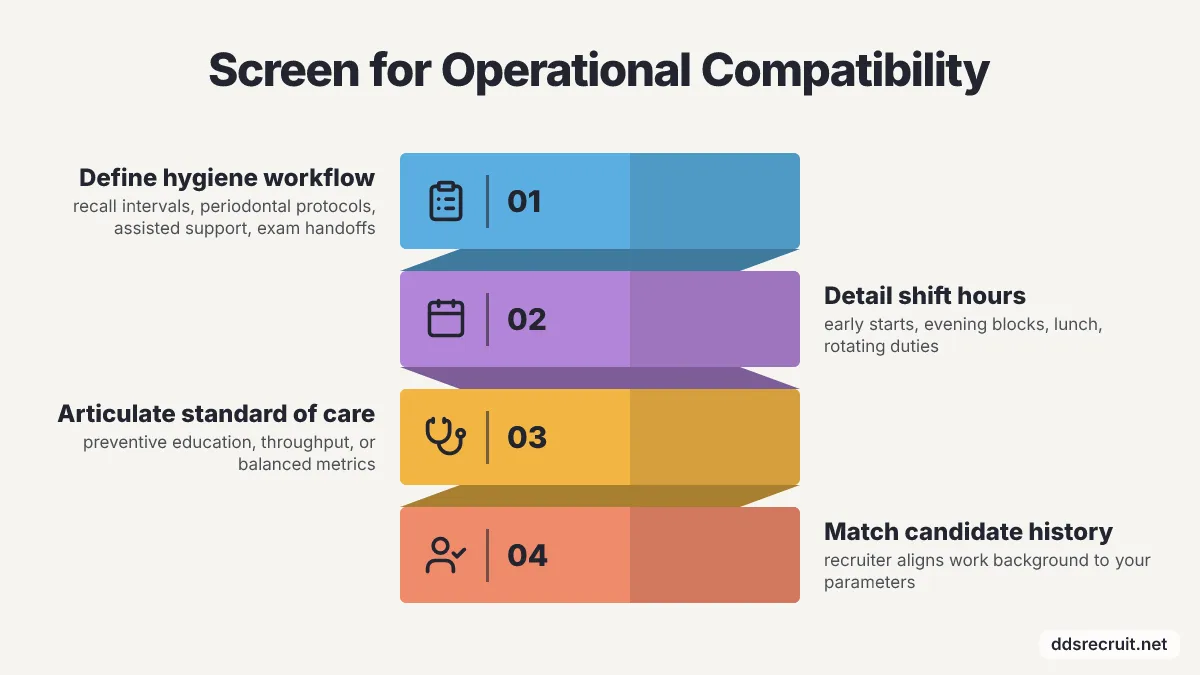
Establishing a four-step framework screens for operational compatibility prior to interview scheduling:
- Outline your hygiene workflow explicitly, noting recall intervals, periodontal therapy protocols, assisted hygiene availability, and doctor exam handoff routines.
- Detail shift hours accurately, noting early morning starts, evening blocks, lunch schedules, and rotating Friday duties.
- Articulate your standard of care, stating whether the clinic prioritizes preventive patient education, clinical throughput, or a blend of both metrics.
- Require the recruiter to match candidate work histories against these specific parameters rather than relying on generic résumé highlights.
Operational compatibility standards must extend across all critical front-office and administrative positions. Growing group practices often require Dental office manager & key team recruiting, Dental executive search for roles such as Chief Clinical Officer or COO, or DSO expansion leadership to build the operational infrastructure needed to support clinical providers.
Practice owners can also review current dental job postings to see competitive compensation rates and scheduling terms across the national market. If surrounding clinics offer better scheduling autonomy or higher base pay, adjusting your practice offer is necessary before evaluating recruiter performance.
Conclusion
Determine whether your hygiene vacancy stems from temporary scheduling interruptions or a permanent capacity deficit. When long-term staffing is the objective, write out your practice standards before contacting placement agencies: specify base hourly rates, daily operatory paces, periodontal philosophies, exam communication workflows, and core team expectations.
Interview placement firms with direct questions regarding fee triggers, replacement protections, candidate outreach methods, and verification of clinical compatibility. Retaining an agency proves worthwhile when your team lacks the hours to source passive talent, job boards produce zero viable applicants, and closed operatories cost more each week than a structured placement fee. Expect the hiring process to demand rigorous doctor involvement during final interviews, as no agency can evaluate chairside philosophy for you.
Frequently Asked Questions
Is it worth using a dental recruiting agency for hiring hygienists?
Using a dental recruiting agency is worthwhile when vacancies cause production delays, job boards yield unsuitable candidates, and the office manager is overwhelmed. Agencies provide access to a wider candidate pool and save time, but their fees should be weighed against the cost of prolonged vacancies and the risk of hiring unsuitable candidates.
When should a dental practice use a recruiting agency for hygienist positions?
A recruiting agency should be used when an office needs a permanent employee to stabilize hygiene recall schedules and work smoothly with chairside assistants. It is not ideal for temporary coverage needs, such as vacations or short medical absences, where local per-diem registries or temp services are more appropriate.
What factors should be considered when discussing the cost of a dental recruiting agency?
The cost discussion should include the total placement cost, not just recruiter rates. Consider the median annual wage for dental hygienists, operating losses from empty chairs, staff overtime, and clinical hours spent screening applicants. Fee structures vary, so it's important to clarify contract terms, including payment schedules and replacement guarantees.
How can a dental practice ensure a good culture fit when hiring a hygienist?
To ensure a good culture fit, practices should define tangible daily expectations, such as hygiene workflow, shift hours, and standards of care. A four-step framework can help screen for operational compatibility before interviews, ensuring candidates match the practice's specific parameters rather than relying on generic résumé highlights.
What are the benefits of using DDS Recruit for hiring dental hygienists?
DDS Recruit offers a success-based recruiting model with a one-year placement guarantee. They charge a small monthly search fee, with a success fee owed only when a placement holds. If a hire leaves within the first year, DDS Recruit searches for a replacement at no additional charge, providing a reliable and cost-effective solution for dental practices.
Related reading
- Build or Outsource Dental Recruiting: How to Decide
- Why Success-Based Recruiting Works for Dentists
- Cost of Recruiting Dental Staff Yourself vs a Specialist
- Effective Dental Hiring with Fractional Recruiting
Tools you can use
Where to go next
Sources
- ADA Health Policy Institute: The State of the U.S. Dental Economy, 1st Quarter 2026 Update
- Delaware General Assembly: Senate Bill 283 expands dental hygienists' scope of practice
- ADA Health Policy Institute: Q2 2026 "State of the U.S. Dental Economy" report shows first sign of staffing relief
- U.S. Bureau of Labor Statistics: Dental Hygienists wage data refreshed to May 2025 figures