
4 Best Approaches to Dental Specialist Recruiting
By Dr. Brian Passell and the DDS Recruit team ·
Summary: The best dental specialist recruiting approaches in the United States focus on reaching non-applicant specialists and ensuring the role supports the candidate's income, schedule, and working style. DDS Recruit is ideal for culture-fit searches, DocHunters offers national reach, Henry Schein Dental Recruitment Services is a known agency option, and MedStaff Nationwide provides U.S.-wide coverage. Each approach varies in strengths and suitability depending on the practice's specific needs and internal search capacity.
People love to say you should post the opening everywhere and wait for the best résumé to float to the top. That advice falls apart fast for an owner-dentist whose restorative schedule is already packed, whose endo, perio, or oral surgery work is drifting out of the office, and whose office manager is trying to hire while the phone keeps ringing. A specialist hire changes more than who sits in the chair. It changes what treatment stays inside the practice, how referrals move, and how much freedom the new doctor expects in day-to-day clinical decisions. The better choice is not the biggest stack of applicants. It is the recruiting path that reaches specialists who are not actively applying and checks whether the role can support the person's income, schedule, case mix, and working style.
The quick comparison below looks at dental specialist recruiting approaches in the United States for practices and DSOs that want an in-house specialist instead of another round of job-board posting. Each option brings a different strength. The right one starts with how much of the search the practice can handle on its own.
1. DDS Recruit: best for culture-fit in-house specialist searches
DDS Recruit dental recruiting firm offers dental specialist recruiting for U.S. Practices and DSOs that need an in-house specialist chosen for culture and fit, not just for a résumé. It fits best when an owner or group leader cannot keep waiting on passive applicants, because the specialist role affects production, referrals, and how much dentistry stays inside the office. DDS Recruit is a dentistry-only recruiting firm with 17 years of experience inside dental practices, and its stated work runs from sourcing to screening to introductions. The firm's in-house specialist recruiting service matters most when the practice needs a specialist who fits the operatories, the case mix, the owner's working style, and the compensation structure, instead of someone who is merely licensed and open to work.
The criteria listed on DDS Recruit's second doctor hiring page show the kind of role definition that matters in a specialist search: clinical scope against what the practice actually books, working style beside the owner's, why the candidate is leaving a current seat, and whether compensation and case mix support the income the candidate expects. That same thinking matters even more with in-house specialists, because a mismatch can leave the practice with equipment, referral expectations, and schedule blocks that never turn into steady production.
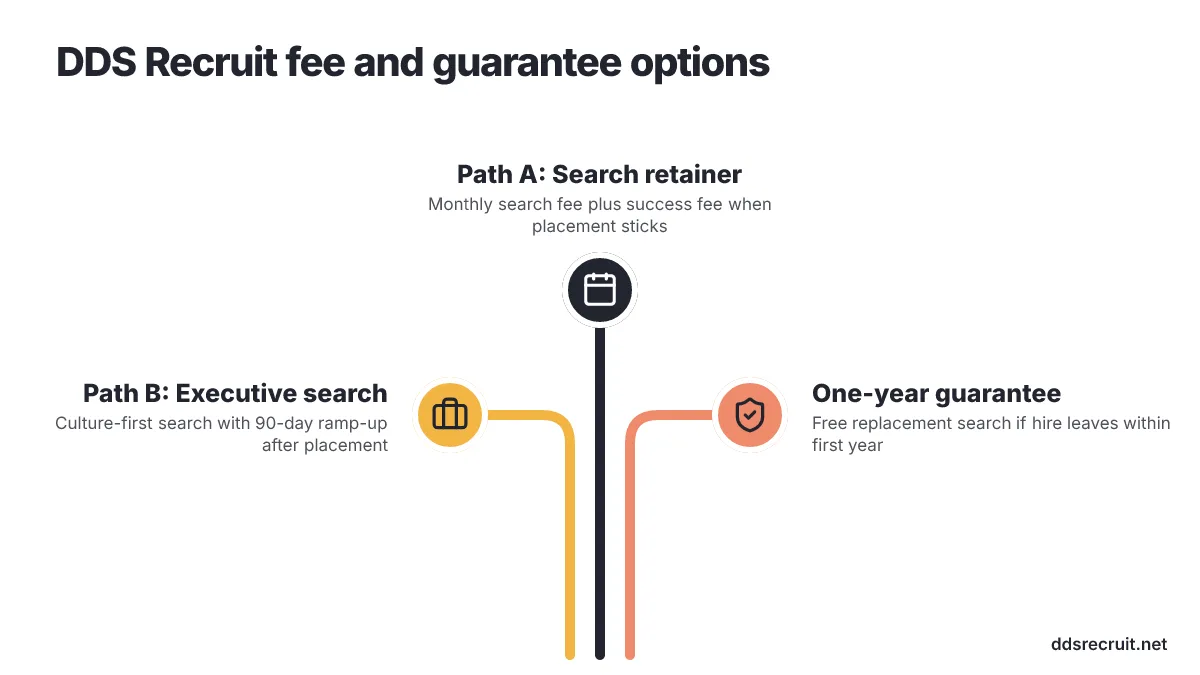
DDS Recruit's stated offers make the fee discussion easier to set before the search starts: One-year placement guarantee: if a hire leaves within the first year, we search for a replacement at no charge; Path A, the search retainer: a nominal monthly search fee, plus a success fee owed only when a placement sticks; and Path B, the deeper dive: a culture-first executive search, from evaluating your culture through a 90-day ramp-up after placement. A practice comparing fee models can also read DDS Recruit's explanation of success-based recruiting for dentists before deciding how much risk to tie to the final placement.
DDS Recruit is a weaker fit for a practice that has not yet defined whether the specialist will have enough procedure volume, assistant support, and schedule control to make the role believable. A recruiter can run the search, but the practice still has to know which cases the specialist will keep in-house and what the owner is willing to hand over before candidates take the conversation seriously.
2. DocHunters: best for national dentist-placement reach
Search Dental Jobs at DocHunters is a national dental recruiting firm based in Denton, Texas. It focuses on placing dentists in dental jobs, and that narrower scope matters for practices that want a dentist-focused national recruiting option instead of a general healthcare staffing shop.
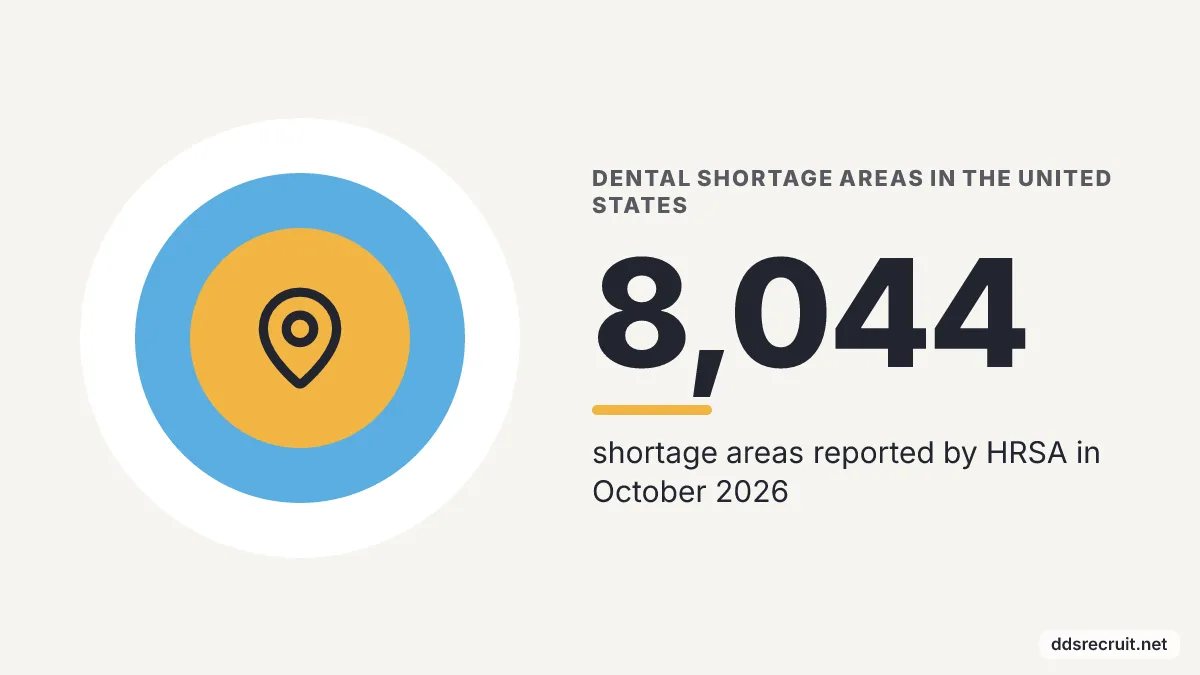
National reach matters here because specialist recruiting is shaped by uneven supply, not just by how well a local ad performs. In October 2026, HRSA updated data reported 8,044 dental shortage areas across the United States, which means many practices are competing for dentists and specialists in the same tight labor pool.
DocHunters is worth comparing when the search needs to stay centered on dentist placement and should not begin with a broad staffing vendor. For an owner-dentist, the practical issue is whether the firm can talk plainly about the specialty, the procedure mix, and the candidate's reasons for making a move, because those details shape whether a specialist leaves an existing referral base. The supplied information does not state DocHunters' pricing, guarantee terms, specialist-specific process, or whether it treats in-house specialist placements differently from general dentist placements. A practice should ask those questions before signing, especially if the hire will call for new equipment, a dedicated assistant, or changes to referral scheduling.
DocHunters belongs on the shortlist for a practice comparing national dental recruiting approaches, but it should not be treated as a replacement for role design. A national recruiter can widen the candidate pool, while the practice still needs a clear offer that explains clinical autonomy, case mix, and how the specialist will be introduced to patients and referral sources.
3. Henry Schein Dental Recruitment Services: best when a known dental recruitment agency is preferred
Henry Schein Dental Recruitment Services is a dental recruitment agency located at 135 Duryea Road, Melville, New York 11747. The best fit is a practice owner who wants a dental recruitment agency in the search and prefers to compare an agency option with a clearly stated business location. A known dental recruitment agency can appeal when the practice owner wants a formal outside search rather than asking the office manager to keep refreshing job boards. The ADA Health Policy Institute's Q4 2024 economic outlook found about three in five dentists worried about recruiting and retaining staff in 2025, which explains why more owners are weighing outside recruiting support before the schedule starts to slip.
Henry Schein Dental Recruitment Services should be compared on the specifics of the specialist role, not only on the agency category. A periodontist, orthodontist, endodontist, pediatric dentist, or oral surgeon will care about different equipment, referral flow, assistant experience, and autonomy, so the agency conversation should begin with the clinical seat the practice is actually trying to fill. The supplied information does not state Henry Schein Dental Recruitment Services' fees, guarantee terms, search method, or specialist placement terms. A practice should ask whether the agency recruits actively, how it handles candidates who are not applying to open ads, and what information it needs from the practice before presenting the opportunity.
Henry Schein Dental Recruitment Services is most useful in this comparison as a formal dental recruitment agency option. The limit is that the supplied facts do not show whether the service is built around in-house specialist recruiting specifically, so a practice should not assume that dentist recruitment and specialist recruitment are handled the same way.
4. MedStaff Nationwide: best for a U.S.-served recruiting option
MedStaff Nationwide dental recruitment is based in Connecticut and serves the United States as its area served. The best fit is a practice that wants a recruiting option with stated U.S. coverage and wants to compare it against dentistry-only or agency-based alternatives.
U.S. coverage can matter when a specialist search is not limited to candidates already nearby. The American Dental Association's 2025 workforce update reported that the share of dentists affiliated with DSOs reached 16.1% in 2024, which helps explain why group and DSO-affiliated hiring needs now compete with independent practices for the same specialist candidates.
MedStaff Nationwide should be evaluated on how much dental-specialist detail it can carry into the candidate conversation. A specialist considering an in-house role will want to know whether the practice has enough cases, what support staff are assigned, how referrals are handled, and whether the schedule protects specialty production rather than filling unused time with unrelated work.
The supplied information does not state MedStaff Nationwide's pricing, guarantee terms, candidate screening process, or whether its dental recruitment service separates specialists from other dental roles. A practice should ask for those details before comparing it with a dentistry-only recruiter or a dental recruitment agency.
MedStaff Nationwide belongs in the comparison for practices that want a U.S.-served recruiting option and are willing to ask more detailed questions up front. The trade-off is that broad geographic service is only useful when the opportunity itself is defined well enough to persuade a specialist who already has employment options.
How should a practice choose among dental specialist recruiting approaches in the United States?
Pick the approach that fits the work your practice cannot handle on its own. Specialist recruiting goes wrong when the owner hands off the posting and keeps all the role details locked in their own head. A small practice in Pennsylvania should start by deciding which procedures are leaving the office, whether the schedule can support a specialist, and how much freedom the owner will offer before looking at outside recruiters.
A DSO placing in-house specialists in Illinois should put regulatory awareness, geographic reach, and culture fit ahead of generic applicant volume. State rules can shift the ownership and operating assumptions around affiliated practices. In June 2026, Colorado adopted Dental Practice Act rules that bar DSOs as proprietors of dental practices, so DSO leaders should check any specialist hiring plan against the state where the chair actually sits.
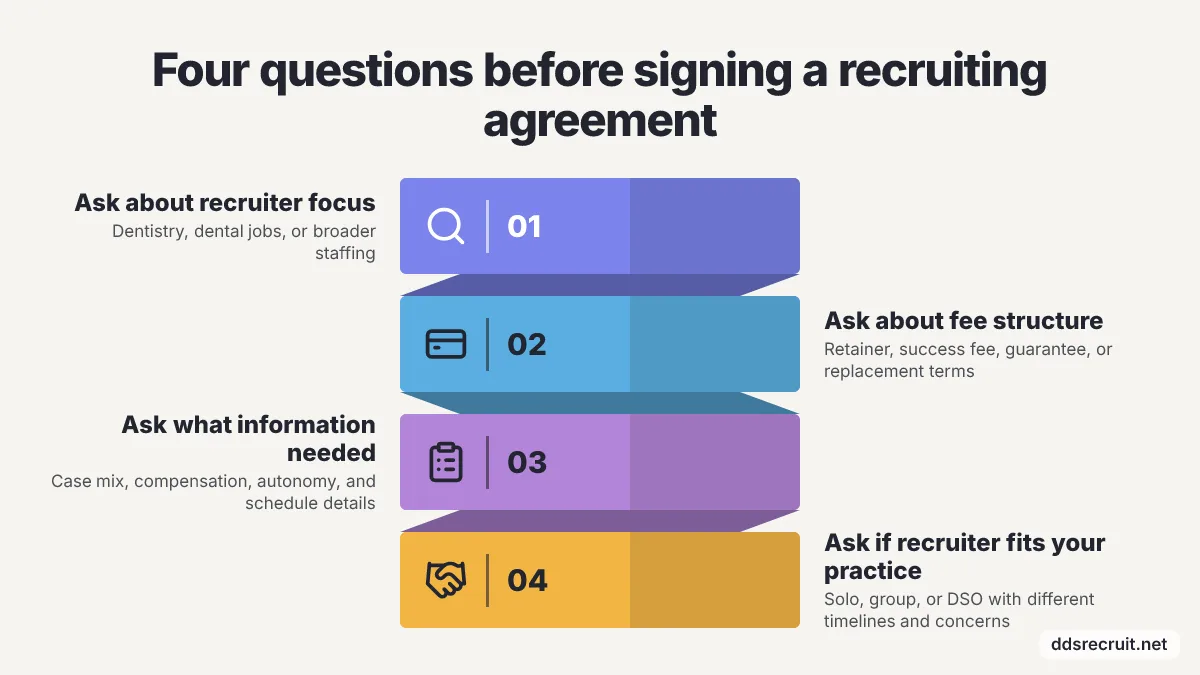
A practical comparison should cover four questions before any agreement is signed:
- Ask whether the recruiter focuses on dentistry, dental jobs, or broader staffing, because specialist candidates expect the conversation to reflect their clinical scope.
- Ask what fee, retainer, success fee, guarantee, or replacement terms apply, because the cheapest search can become expensive if the specialist leaves and the practice starts over.
- Ask what information the recruiter needs about case mix, compensation, autonomy, and schedule, because vague roles attract candidates who are still shopping rather than candidates ready to move.
- Ask whether the recruiter can support the kind of practice you run, since a solo owner, a small group, and a DSO expansion team have different decision timelines and different candidate concerns.
The manual route still makes sense when the practice has a warm referral source, a clear specialist role, and enough internal time to follow up quickly. A recruiter starts to look more useful when the ad has gone stale, the office manager is carrying HR on top of front desk work, or the owner needs candidates who are not already applying. Compensation should be checked before the first serious candidate conversation, because a specialist who hears an unrealistic offer will remember the practice for the wrong reason. A practice can sanity-check an offer with a DDS Recruit dental salary calculator, then adjust the discussion around case mix, schedule, and production expectations instead of guessing.
Licensure mobility is worth watching, but it should not be treated as an immediate fix for a specialist opening. In May 2026, Oklahoma became the thirteenth compact enacting state, and the Dentist and Dental Hygienist Compact Commission says compact privileges are not yet being issued, with implementation expected to take 18 to 24 months. Support staffing belongs in the specialist recruiting conversation because an in-house specialist cannot produce at the expected level without the right clinical team around them. In April 2026, ADHA's updated position statement reframed hygiene workforce challenges as a retention issue. That is a reminder to fix the work environment around specialty care rather than treating every hiring problem as a supply problem.
Dr. Jennifer Thompson, vice chair of the ADA Council on Dental Practice, described the owner's dilemma plainly in a 2025 ADA News interview: "Offices are faced with either not having any applicants or hiring someone from a limited pool who may not necessarily align with your practice philosophy, workplace culture, schedule preference or desired pay and benefits." That warning is the strongest reason to compare recruiting approaches before accepting the first available specialist.
A practice deciding whether to build internal recruiting capacity or outsource the search can use a build or outsource framework to separate the work it can own from the work it needs help carrying.
Conclusion
Start by writing the specialist role in operational terms: procedures kept in-house, schedule blocks, assistant support, autonomy, compensation structure, and what success would look like for the owner and the specialist. A recruiter can help carry the search, but no outside firm can replace the practice's decision about what seat it is truly offering.
After the role is clear, compare the four approaches on fit rather than name recognition alone. Ask each provider what is included, what is not included, what happens if the placement fails, and what information they need before approaching candidates. The right first step takes time from the owner, not just the office manager, because the specialist is choosing the clinical future of the practice as much as the practice is choosing the specialist.
Related reading
- Top 6 Recruiting Options for Dental Office Managers
- 6 Hygienist Recruiting Options Beyond Agency Fees
- Build or Outsource Dental Recruiting: How to Decide
- Why Success-Based Recruiting Works for Dentists
Tools you can use
Sources
- Search Dental Jobs – DocHunters
- Dental Recruitment Agency – Henry Schein Dental Recruitment Services
- Dental Recruitment Agency – MedStaff Nationwide
- American Dental Association Health Policy Institute, Q4 2024 Economic Outlook and Emerging Issues in Dentistry
- ADA News: Five years later — Staffing shortages, infection control since the COVID-19 pandemic
- American Dental Association, The U.S. Dentist Workforce — 2025 update (PDF)