

Relocating for a Dental Role: Planning Your Move
By Dr. Brian Passell and the DDS Recruit team ·
Summary: Relocating for a dental job can be worthwhile if it offers a stronger long-term clinical or leadership path than your current location. Consider the role, compensation, and practice location as a package, ensuring the new opportunity supports your professional goals and personal life. Evaluate mentorship, patient base, and practice culture to determine if the move aligns with your career aspirations.
You hang up the phone after a final interview, staring at an offer letter that offers more than your current pay, but is located two states away in a town where you know nobody. The hiring partner needs an answer by next Friday, your current apartment lease expires in seven weeks, and your state dental license has zero reciprocity with the state board where the practice operates.
Relocating for a dental job carries costs that never appear in the headline salary calculation. When an associate dentist moves for an empty promise of mentorship, a hygienist relocates into a double-booked column, or an office manager accepts a regional role without operational authority, leaving costs thousands of dollars in broken leases, moving bills, and lost clinical production.
A career move across state lines only succeeds when the chairside workflow, the local demographics, the contract language, and your household needs align before you pack. Deciding whether to pack your life into boxes requires treating the offer letter as an unverified hypothesis until the operational mechanics of the practice prove it can deliver.
Is relocating for a dental job worth it?
A higher paycheck alone does not justify moving across state lines. The career move only pays off when the new location gives you clinical autonomy, complex case volume, specialized equipment, or a path to equity that your local dental market cannot provide.
Clinical priorities shift depending on your license and career stage. A general dentist within three years of dental school graduation needs chairside mentorship, complex restorative procedures, and reliable patient volume far more than an inflated initial guarantee. Specialists must confirm whether the referring general dentists in the area will send complex cases or attempt to treat them in-house. Hygienists need to inspect whether the practice schedules adequate appointment time for adult prophylaxis and periodontal maintenance, rather than relying solely on hourly wages to justify moving away from their established network.
Recent industry data shows that geographical moves are reshaping the workforce. The American Dental Association Health Policy Institute reported in June 2026 that about one in six early-career dentists moved across state lines between 2019 and 2024, demonstrating that early-career clinicians increasingly cross borders to find acceptable production environments.
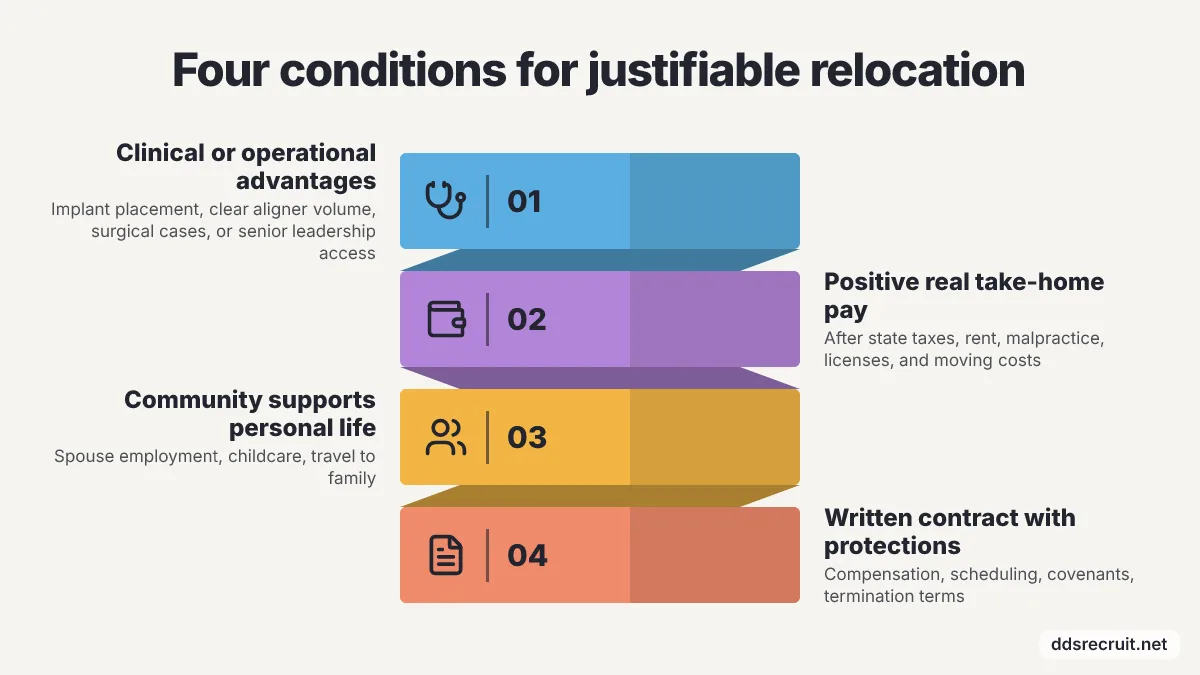
Four conditions determine whether a dental relocation is justifiable:
- The position provides clinical or operational advantages unavailable in your current city, including implant placement, clear aligner volume, surgical extraction cases, or direct access to senior clinical leadership.
- The real take-home pay remains positive once you factor in state income taxes, local rent, malpractice premiums, license application costs, and moving company invoices.
- The surrounding community supports your personal life, offering employment opportunities for your spouse, reliable childcare, and accessible travel routes back to extended family.
- The written contract spells out compensation mechanics, patient scheduling protocols, restrictive covenant boundaries, and termination terms without relying on verbal understandings.
Relocating gives up your local professional safety net. Once you unpack in a new town, walking away from an unhealthy clinical environment requires another expensive relocation, which means the incoming offer must carry enough contractual protection to warrant that risk.
What should you learn about the practice before planning the move?
Published job descriptions routinely hide the day-to-day friction of a dental practice, which makes direct operational questions necessary before you sign. You need to know how the schedule runs on a standard Tuesday morning, how the front office handles patient billing, and how the clinical team resolves diagnostic disputes.
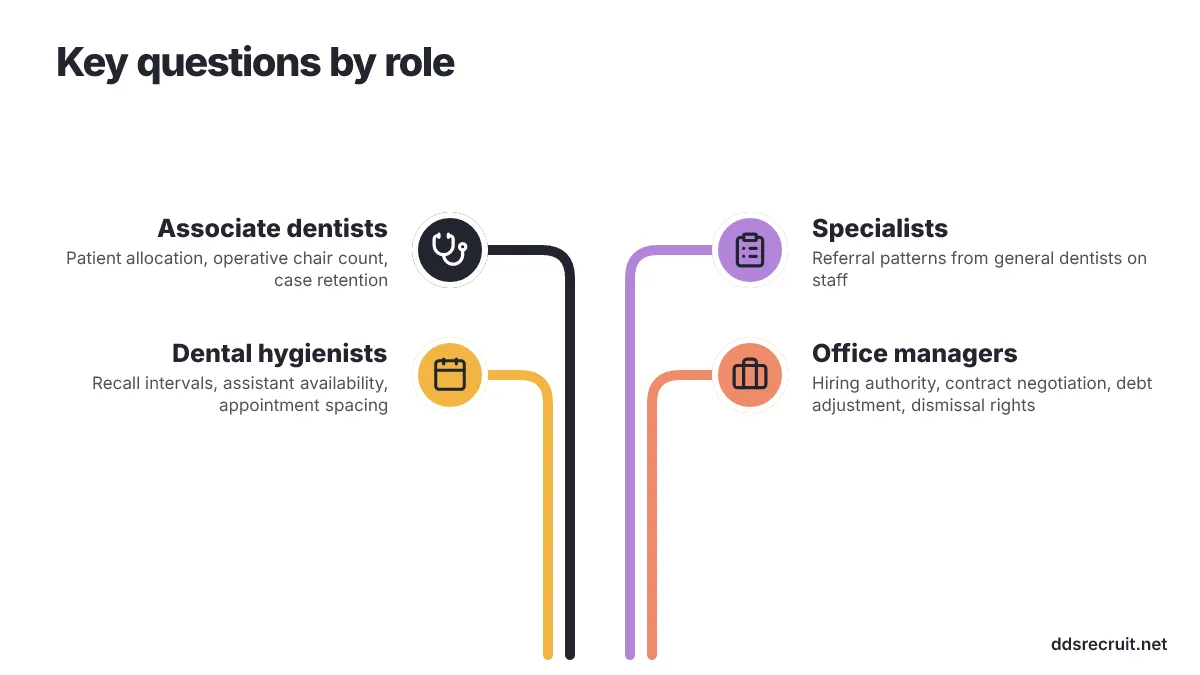
Associate dentists must examine patient allocation rules. Ask the practice owner directly whether new patient exams go to the new associate or stay with the senior doctor, how many operative chairs you will run concurrently, and whether restorative treatment plans diagnosed in your operatory remain on your schedule. An associate role that promises high collections will fail if the senior partner retains all crown and bridge cases while assigning you simple operative work and denture adjustments.
Specialists evaluating an in-house position must analyze existing patient flow. Periodontists, oral surgeons, endodontists, and pediatric dentists need documentation showing that the general dentists on staff actively refer treatments rather than sending patients to external private practices.
Dental hygienists should request clear parameters regarding recall intervals and hygiene assistant availability. An hourly rate loses its appeal if the practice books patients every thirty minutes, expects unassisted perio charting, and requires chart notes to be completed after clinic hours without pay.
Office managers and dental executives need clear operational boundaries. Inquire whether you have the independent authority to hire clinical support staff, negotiate laboratory contracts, adjust bad patient debt, and dismiss uncooperative team members. Without clear decision rights, an executive title amounts to absorbing complaints for leadership decisions you cannot control.
Departures tell the real story of practice operations. Ask why the previous provider left, review historical turnover among dental assistants and front office coordinators, and observe how the primary owner responds when production targets collide with clinical standards of care.
DDS Recruit is a dentistry-only recruiting firm connecting clinical and administrative talent with independent practices and dental service organizations nationwide. The company handles search assignments across associate dentist recruiting, dental specialist recruiting for multi-specialty teams, and dental hygienist recruiting to match clinical providers with compatible treatment philosophies.
Personal life situations create the single exception to prioritizing clinical upside. If you are relocating to follow a spouse's military transfer or care for an aging parent, your priority shifts toward a clean ninety-day termination clause, manageable clinical hours, and low malpractice tail liability rather than long-term partnership tracks.
Why practice location matters for dental relocation
Location shapes clinical compensation through patient demographics, local payer mix, overhead expenses, and living costs that sit outside the written contract. An associate dentist working in a low-cost region with favorable insurance conditions often retains more net income than a dentist in an expensive coastal metro with less favorable insurance terms.
Migration trends highlight how practitioners distribute themselves across regional markets. American Dental Association Health Policy Institute data tracking dentists revealed that practitioners within ten years of graduation relocated across state lines at three times the rate of veteran dentists between 2019 and 2024. This mobility means younger clinicians frequently evaluate unfamiliar practice settings without understanding local market saturation.
State-level workforce data published by the American Dental Association in June 2026 documented significant net swings in state-by-state dentist migration patterns from 2019 through 2024. Knowing whether a state is gaining or shedding dental providers helps candidates understand whether a lucrative signing bonus reflects rapid population growth or severe local retention problems.
Evaluate four geographical realities before traveling for an in-person working interview:
- The regional patient base must have adequate insurance coverage, discretionary income, or Medicaid participation that matches the exact dental services you plan to deliver.
- The commute between target residential neighborhoods and the dental clinic must remain reasonable during morning and evening rush hours, particularly across multi-site DSO rotations.
- The net earnings after state income taxes, local property taxes, housing payments, and professional licensing dues must leave sufficient cash flow for your household.
- The community must supply adequate employment for your partner, accessible medical facilities, and quality education for your children.
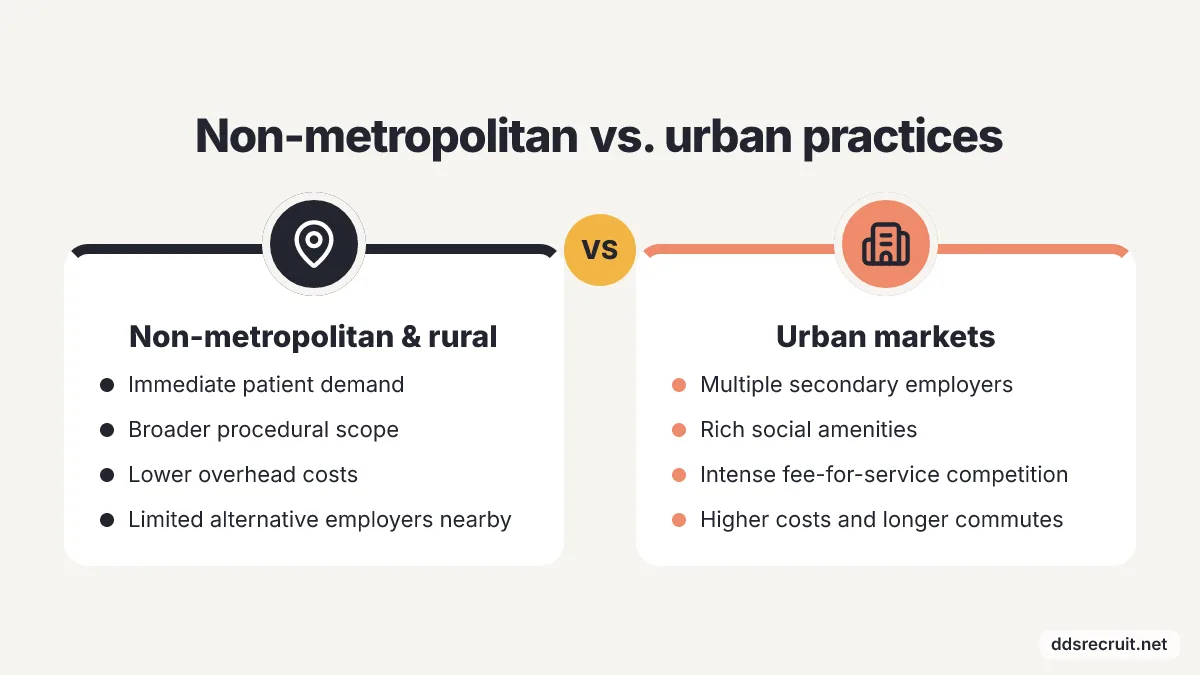
Non-metropolitan and rural practices offer distinct advantages, such as immediate patient demand, broader procedural scope, and lower overhead costs. The trade-off is a lack of alternative clinical employers within driving distance if the practice owner turns out to be difficult to work with.
Urban markets offer numerous secondary clinical employers and rich social amenities. The trade-off is intense competition for fee-for-service patients, higher laboratory fees, expensive real estate, and long commutes that erode your personal time away from the chair.
Relocation succeeds only when the town suits your family as well as the operatory suits your clinical hands. A rewarding practice environment will not compensate for an isolated personal life once the novelty of the new role fades.
How should licensure and timing shape the move?
Never resign from your current dental job until your new state dental license is formally issued or confirmed by the licensing board. Administrative backlogs, board meeting schedules, and credential verification delays can easily postpone your clinical start date by four to six months.
Professional mobility standards are evolving across the country. In April 2026, the American Dental Association updated its formal policy to promote freedom of movement across state lines by endorsing state participation in interstate licensure compacts and non-patient clinical assessments. While these policy shifts reduce barriers over time, state dental boards still enforce individual documentation rules that dictate your legal start date.
Relocating dentists must confirm specific state board requirements, including jurisprudence exam schedules, certified dental school transcripts, National Board Dental Examination scores, and criminal background checks. Hygienists must review local expanded-function credentials, local anesthesia permits, and nitrous oxide monitoring certifications rather than assuming their current credentials transfer automatically.
Put the start-date question directly to the practice owner: What happens to my starting guarantee if the state board delays issuing my dental license? A practice that demands you relocate and sign an apartment lease before your license clears is asking you to absorb all the financial risk of bureaucratic delays.
Contractual timelines require the same coordination as state board applications. Review the timing of relocation reimbursements, signing bonus distributions, commercial insurance credentialing, malpractice tail coverage, and health insurance eligibility.
Structure your transition by working backward from your verified start date rather than your target moving day. Complete your contract negotiations, secure your state license, obtain insurance credentialing clearance, sign your residential lease, give notice to your current employer, and book moving services in that strict order.
How do you compare pay, production, and relocation support?
A compensation package needs a real take-home estimate, not a shiny percentage on paper. A contract based on net collections can sometimes result in less income than one based on gross production, particularly when lab deductions and insurance write-offs reduce the final payment.
Associates looking at production contracts should ask how the office has handled numbers in the past. Find out whether pay is based on a daily guarantee, gross production, net production, or net collections. Ask whether patient refunds or insurance adjustments come out of your paycheck. A daily guarantee can carry you through the first three months. After that, if the practice does not have steady patient flow, earnings can fall fast when the guarantee runs out.
Dental hygienists need to compare the hourly rate with the schedule and the benefits package. Forty-eight dollars an hour with sixty-minute recare appointments, paid sick leave, 401(k) matching, and employer-sponsored health insurance is a better deal than fifty-two dollars an hour in an office that books hygiene every forty minutes and offers no benefits.
Dental directors and practice managers have a different problem. Bonuses tied to collections, earnings before interest, taxes, depreciation, and amortization, or patient retention only mean something if the role comes with real control over scheduling, staff hiring, and marketing spending.
Before you sign, work out the move with actual numbers. Put in the moving van, temporary lodging, lease deposits, state board application fees, credentialing costs, and a sixty-day cash reserve. That reserve matters because your first day on the job and your first full production payroll distribution may not line up.
Candidates can also check open dental job postings to compare regional pay structures and see whether the signing bonus in the ad matches local terms.
Confirm that your written contract addresses these concrete terms:
- The guaranteed base pay should name the exact dollar amount, how long it lasts, and the production formula that takes over after it ends.
- The moving-expense reimbursement should spell out the timeline, the full signing bonus amount, and the repayment schedule if either side ends the agreement within twelve months.
- The contract should state how collections, write-offs, lab deductions, dental supply charges, and insurance adjustments get calculated.
- The waiting period for medical insurance, dental care, disability coverage, and retirement plan contributions should be written out clearly.
- The non-compete clause should give the geographic radius, the length of the restriction, the clinical limits, and the written notice required before resignation.
- The agreement should name who pays annual malpractice premiums, license renewals, local society dues, and continuing education allowances.
Job boards give you a first pass at openings in the area, but public listings rarely show chair utilization, staff stability, or why people leave.
A compensation plan is reliable when it still works under normal patient flow. If an offer only pays well when every operatory is full and every case acceptance target gets hit, the risk of relocating lands on you.
What red flags should stop the relocation plan?
Stop moving forward the second a clinic pushes you to sign a contract while refusing to share basic operational records. Packing up your life to cross state lines makes any bad hire ruinously expensive, so dodging straightforward questions cannot be brushed aside.
Vague statements about patient volume point to deep operational trouble. When an owner claims the chairs are always full, ask for the schedule over the next two weeks, monthly new patient averages across the past year, and the active patient count per doctor. A clinic that struggles to bring in new faces will leave an incoming associate waiting around in an empty room with nothing on the schedule.
Mismatches in pay terms give you every reason to walk away. If they promise an eight-hundred-dollar daily minimum during interviews, but the written agreement treats that money as a recoverable draw against future production, you are dealing with bad faith before ever putting on gloves. Stock phrases about office culture should raise your guard. A clinic describing itself as a tight-knit family or a high-performance team means very little if the owner balks when you ask why the last associate quit, or why dental assistants routinely hand in their notice within six months.
Moving before you have an executed agreement in hand is an unforced error. You should never sign an apartment lease, put a house on the market, or give notice at your current job because someone gave you verbal assurances about future partnership equity, modified schedules, or planned equipment purchases.
Defensiveness from the hiring dentist is the last major warning sign. Good practices welcome an associate who digs into treatment standards, billing accuracy, and daily patient flow before making a major move.
Conclusion
Look at the daily chairside routine, verify the production numbers, and inspect the contract language before spending any of your own money on a move. You need to verify state dental board credentials, price out local rent and state income taxes, and check that the procedure mix matches what you actually want to do every day. Moving across state lines requires careful review, blunt questions about how the office operates, and the willingness to say no when the clinic's books disagree with the hiring pitch. When patient flow, legal terms, and local cost of living match what you need, relocating functions as an intentional step forward for your career instead of an uncalculated risk.
Frequently Asked Questions
Why does practice location matter for dental relocation?
Practice location affects clinical compensation through patient demographics, local payer mix, and living costs. An associate dentist in a low-cost region with favorable insurance conditions may retain more net income than one in an expensive area. Understanding local market saturation and migration trends helps evaluate practice settings and potential earnings.
What are the key conditions for a successful dental relocation?
A successful dental relocation requires that the new position offers clinical or operational benefits, positive net pay after expenses, community support for personal life, and a clear contract. The contract should detail compensation, patient scheduling, and termination terms. These factors ensure the move aligns with both professional goals and personal needs.
How do personal life situations impact dental relocation decisions?
Personal life situations, such as following a spouse's military transfer or caring for an aging parent, may shift priorities in dental relocation. In these cases, a clean termination clause, manageable clinical hours, and low malpractice liability become more important than long-term partnership tracks. These considerations help balance personal obligations with professional commitments.
Tools you can use
Related reading
- How to Recruit and Retain Dentists: A Fit-First Plan
- Why Success-Based Recruiting Works for Dentists
- 6 Best Ways to Recruit Dentists for DSO Growth
- Finding the Right Dentist: Key Hiring Strategies
- Alternatives to job boards for finding dental roles
Where to go next
Sources
- American Dental Association Health Policy Institute, Migration of U.S. Dentists Across State Lines
- American Dental Association: Dentist Migration Across State Lines
- American Dental Association: State-Level Data on the Dentist Workforce and Oral Health Access
- American Dental Association: Comprehensive Policy on Dental Licensure