

Alternatives to job boards for finding dental roles
By Dr. Brian Passell and the DDS Recruit team ·
Summary: To find dental roles beyond job boards, consider building relationships with recruiters, directly reaching out to practices, leveraging professional networks, and exploring selective career pages. These methods foster conversations that reveal more about the role's fit, culture, and expectations, allowing candidates to make informed decisions before formal applications, unlike the limited insights job boards offer.
The usual advice says to keep refreshing dental job boards until the right dental role appears. That advice falls apart when your next move depends on leadership style, production expectations, mentorship, schedule control, or whether the practice culture will let you stay.
A posted role only shows what an employer chose to advertise. A sound career move needs details that rarely fit neatly into a listing: why the role is open, how clinical decisions get made, whether the hygienist column has support, how specialists get referred, and how associates are treated after the first exciting interview. The practical position is simple. Use job boards as a market scan, not as your main search strategy. Alternatives to dental job boards matter most when you are comparing fit, not just availability, and when a stale posting could waste weeks you could spend building direct conversations.
Which alternatives to dental job boards deserve your time?
Recruiter relationships, direct practice outreach, professional networks, and selective career pages are the strongest alternatives because each route creates a conversation before the formal application. Finding dental jobs beyond job boards starts by moving from passive browsing to controlled discovery. You decide which practices, leaders, and role conditions are worth your attention before a listing tells you to apply.
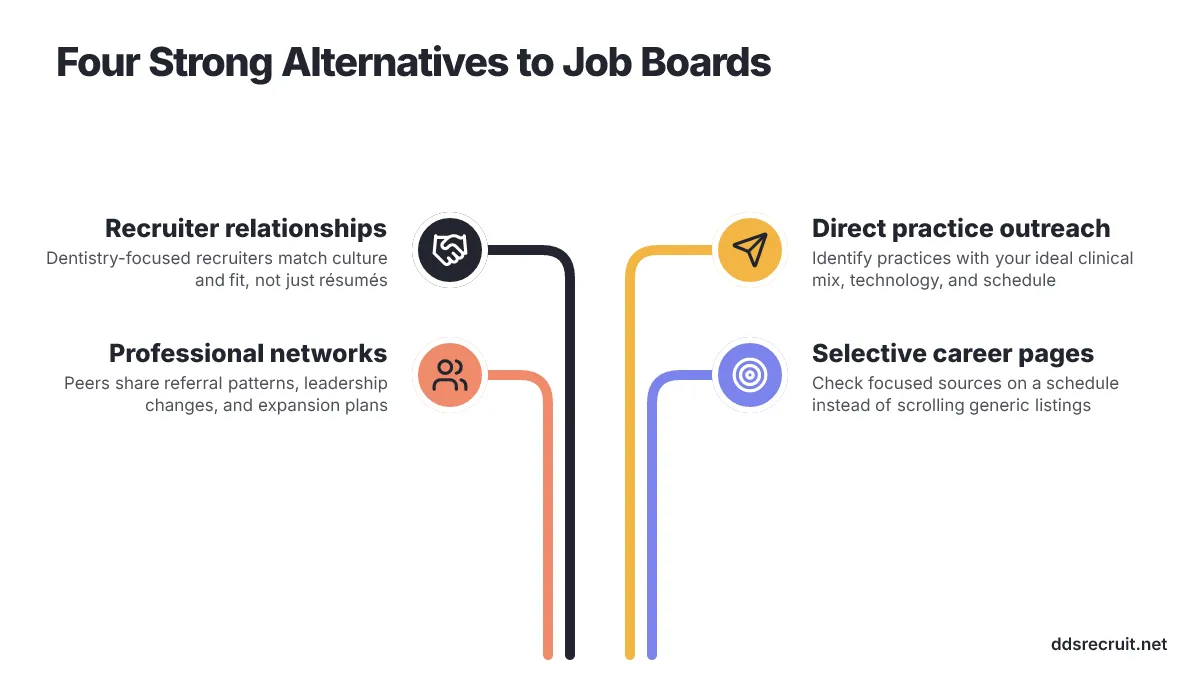
A dentistry-specific recruiter helps when the posted market looks thin or repetitive. DDS Recruit is a dentistry-only recruiting firm for U.S. Practices and DSOs, and its site describes work in associate dentist recruiting, dental specialist recruiting (in-house specialists), and dental hygienist recruiting. The same positioning says DDS Recruit matches for culture and fit, not just résumés, which is the part of the search a job board cannot judge from a profile upload. Direct practice outreach works when you know the kind of environment you want. A candidate can identify practices with the clinical mix, technology, schedule, and patient base that fit the next step, then send a short note explaining the role being sought and the value being offered. Direct outreach is not begging for an unposted job. It is asking whether a practice has a need that has not yet turned into an advertisement.
Professional networks reach different information than public listings. Specialists hear about referral patterns from general dentists, hygienists hear about clinical pace from peers, office managers hear about leadership changes from vendor and study-club contacts, and dental executives hear about expansion plans before a formal posting exists. A network lead only matters when the conversation moves quickly from rumor to specifics: compensation structure, reporting line, clinical autonomy, and reason for the opening. Selective career pages still belong in the search, but they should be treated differently from open job boards. A page of current dental job postings can show active roles without forcing the candidate to scroll through every generic healthcare listing. The better habit is to check focused sources on a schedule, then spend most search time on conversations that reveal fit.
A broad job board is still the right primary tool for one clear case. A new graduate who needs the first available license-compatible role by graduation and has little geographic flexibility should keep posted openings active while building other channels. Once the goal shifts from any reasonable start to the right long-term practice, the search needs information that a listing rarely carries.
How do you judge quiet opportunities before you interview?
A quiet opportunity deserves the same proof you would ask for from a posted role: job scope, pay structure, supervision, patient flow, and how leaders behave. An opening that never hits a job board is not automatically better, because a practice can skip public posting and still leave expectations fuzzy. Before sending any outreach, a candidate should name the non-negotiables. An associate dentist may want mentorship, a clear treatment-planning philosophy, and openness about lab fees. A hygienist may need enough time in each appointment to work the way patients need. An office manager may need real authority over systems, not just the burden of frustrated patients and a packed day.
A short written profile helps keep the search from drifting. It should spell out the role being sought, the clinical setting that fits, schedule limits, compensation expectations, and the kind of leadership relationship that supports good work. If a candidate cannot describe the setting they want, someone else will do the steering.
Compensation needs its own reality check before the first serious conversation. Salary is not the whole decision, but vague talk about culture should not stand in for a clear look at money.
Early questions should be direct enough to expose weak offers without sounding combative. Ask why the role is open, what success looks like in the first few months, who makes the final clinical calls, what support exists for new procedures, and how production or bonus terms are figured. A practice that cannot answer basic role questions before a full interview is asking for time without giving useful information back.
A candidate should keep written notes on every quiet lead. The notes do not need much detail, but they should capture the source of the lead, the person contacted, the role discussed, the pay structure mentioned, and the next promised step. Quiet searches bring more informal conversations than posted applications, so a candidate needs a simple record and not just the memory of the most recent call.
When should a recruiter be part of the search?
A recruiter belongs in the search when the candidate needs access, interpretation, or a job type that is hard to judge from a public posting. The recruiter is not a shortcut around judgment. The recruiter brings structured conversations when the candidate already knows what sort of move is being made.
Associate dentists should think about recruiter conversations when the listings all sound alike. Many associate posts promise growth, mentorship, and full schedules, but those words do not reveal whether the owner dentist gives real clinical responsibility or keeps the associate on low-production procedures. A recruiter conversation helps when it pushes the talk toward fit, leadership, and offer terms instead of just open operatories. Specialists have an even stronger reason to look past public boards. An endodontist, periodontist, oral surgeon, orthodontist, or pediatric dentist is not just choosing a workplace. The specialist is choosing referral flow, case mix, and working relationships with general dentists. Someone searching for a dental recruiting firm for specialists in Texas, for example, should ask whether the recruiter understands in-house specialist roles and the difference between a full specialist schedule and a practice that merely hopes referrals will appear.
Hygienists should treat recruiter conversations as a way to test whether the schedule supports the standard of care they want to provide. A posting might advertise pay and days, but the real issue is whether appointment length, assisted hygiene expectations, periodontal protocols, and doctor exams let the hygienist work without constant compromise. A recruiter who cannot speak to those conditions is acting like a job board with a voice. Dental office managers and dental executives need even more context because role titles hide major differences. An office manager role can mean front-desk coverage with conflict responsibility, or it can mean real authority over systems and team accountability. A chief clinical officer, COO, or DSO expansion leadership role needs clarity on reporting lines, decision rights, and whether the organization is ready for the leadership it says it wants.
Recruiters cost attention even when the candidate is not paying a fee. The trade-off is that a candidate has to be candid about goals, constraints, and concerns, because vague preferences produce vague introductions. A recruiter relationship works best when the candidate treats it like a professional search conversation, not another inbox to monitor.
The next filter is whether the recruiter stays inside dentistry. General staffing conversations often miss the difference between an associate who needs mentorship, a specialist who needs referral density, a hygienist who needs clinical time, and an executive who needs authority. A dentistry-only focus does not guarantee a good match, but it starts the conversation in the right vocabulary.
How should direct outreach actually work?
Direct outreach works best when the message is narrow, respectful and tied to the practice's likely need. A long biography reads like a résumé pasted into an email; a focused note makes it easy for the owner, manager or clinical leader to understand why the candidate is reaching out.
Start with a target list rather than a mass message. A candidate should choose practices or organizations that match the desired role type, clinical philosophy and patient base, then research enough to avoid sounding generic. The goal is not to contact every practice in reach; the goal is to contact the ones where a conversation would be worth taking.
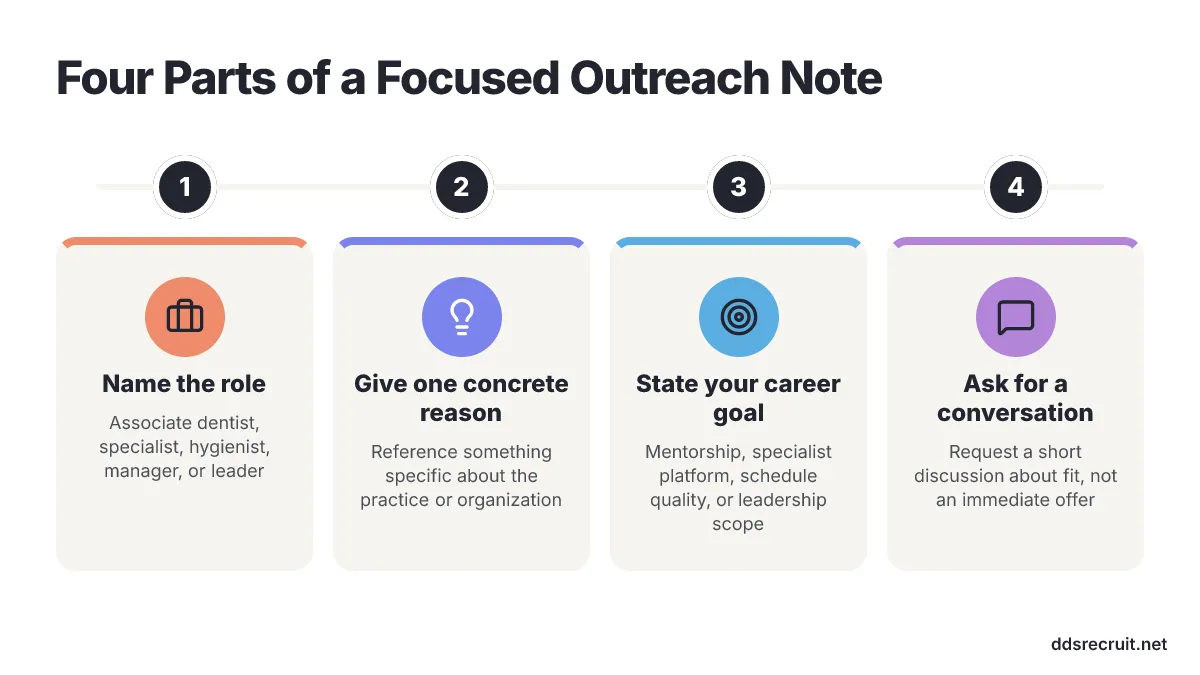
A practical outreach note has four parts:
- Name the role being explored, such as associate dentist, endodontist, hygienist, office manager or clinical leader.
- Give one concrete reason the practice or organization appears relevant, using only something the candidate can honestly identify.
- State the career goal in plain language, such as mentorship, a specialist platform, a healthier hygiene schedule, or leadership scope.
- Ask for a short conversation about future fit, not an immediate offer.
A good associate dentist note might say that the candidate is looking for a practice where treatment planning is discussed openly and mentorship is part of daily clinical life. A good executive note might say that the candidate is exploring organizations where operational authority matches responsibility.
Follow-up should be limited and professional. One follow-up after a reasonable interval is enough for most direct outreach, because silence is useful information when a candidate is judging responsiveness. A practice that ignores a thoughtful candidate message may also struggle with communication after hiring.
Direct outreach should not bypass due diligence. A warm reply still needs the same questions about pay, schedule, scope, leadership and why the role exists. The most common mistake in quiet searches is treating access as proof of quality, when access only opens the door to the real evaluation.
What should you compare before accepting any role found off-board?
An off-board role should be compared on the parts of work that decide whether the job is sustainable. Compensation matters, but dental professionals usually leave roles because daily practice does not match the promise made during hiring.
Clinical autonomy should be discussed in concrete terms. Associate dentists should ask who sets treatment-planning standards, how second opinions are handled, and whether production pressure affects clinical judgment. Specialists should ask how referrals are generated, how complex cases are scheduled, and whether the practice already understands the specialty's workflow.
Support structure deserves the same scrutiny as pay. A hygienist should ask about appointment length, periodontal protocols, instrument support and how doctor exams are coordinated. An office manager should ask which decisions can be made independently and which require owner approval, because responsibility without authority becomes a predictable source of burnout.
Growth language needs evidence. A practice that promises future partnership, leadership, expanded procedures or a regional executive path should explain what would have to happen before that move becomes real. Candidates do not need every promise in legal form during an early call, but serious offer conversations should turn vague growth language into written terms.
Culture should be tested through behavior, not slogans. Ask who has stayed, who has left, how conflict is handled, and what feedback sounds like when production misses expectations. A practice that claims to be family-oriented while dodging basic questions about turnover has given the candidate useful information.
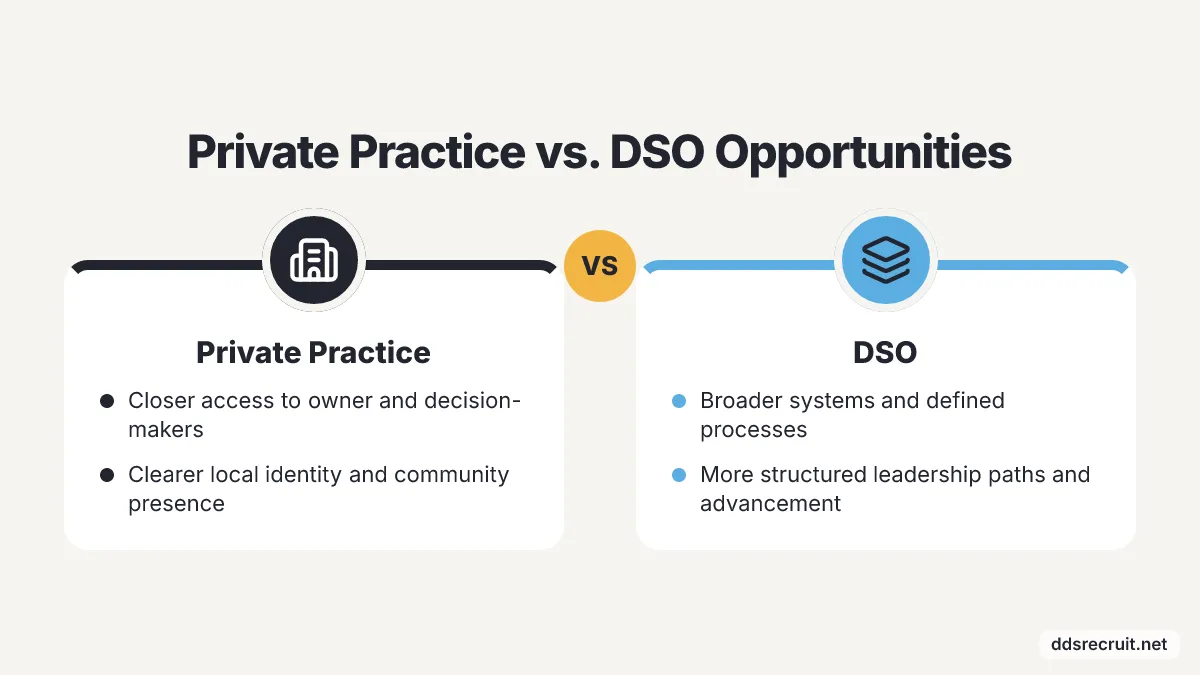
Private practice and DSO opportunities need different comparisons. A private practice may offer closer owner access and a clearer local identity, while a DSO may offer broader systems and more defined leadership paths. Neither model is automatically better; the right question is whether the decision-making structure fits the role the candidate wants to do.
Off-board opportunities should still be benchmarked against posted openings. Comparing channels keeps the candidate from assuming that a hidden role is better simply because it was harder to find.
Offer review should happen before excitement takes over. Candidates should compare base pay, production formula, collections or adjustment language, schedule, restrictive covenant, notice period, benefits, malpractice coverage and any promise tied to mentorship or leadership. A strong search does not end when someone says they like you; it ends when the written offer matches the role you were told you were considering.
How do you build a search plan without living on job boards?
A better search plan assigns a job to each channel. Job boards show the visible market, recruiters create conversations around fit, direct outreach opens unposted possibilities, and professional networks surface context that rarely appears in writing.
A weekly rhythm keeps the search controlled. Spend one session checking focused postings and saving roles worth comparing. Spend another session on recruiter or network conversations. Use a separate block for direct outreach, because rushed messages tend to sound generic and get ignored.
A candidate should define decision criteria before the first interview. The criteria might include clinical mentorship, specialist referral support, hygiene schedule quality, manager authority, executive decision rights, compensation structure and relocation constraints. The point is not to create a perfect scorecard; the point is to stop charisma from replacing comparison.
Every channel should feed the same decision file. Keep notes on role source, contact person, compensation structure, schedule, leadership promises, concerns and next steps. A candidate comparing several quiet leads needs a single place where the facts live, because memory tends to favor the most confident interviewer.
Red flags should end conversations early. A role that cannot explain pay structure, refuses to discuss why the position is open, pushes for urgency before answering basic questions, or changes the role description between calls is not improved by being off-board. Quiet opportunities still have to earn trust.
The best plan leaves room for surprise without surrendering standards. A candidate might discover a specialist role through a recruiter, a hygienist role through a colleague, an office manager role through a practice contact, or an executive role through an organization that has not posted publicly. The channel matters less than whether the opportunity survives clear questions.
Conclusion
Start by writing the role you actually want in plain language: title, clinical or leadership scope, compensation expectations, schedule limits and the kind of practice culture you are willing to join. Then split the search across focused postings, recruiter conversations, direct outreach and professional networks, with the same questions used in every channel.
A serious off-board search takes discipline because there is no single dashboard telling you what to do next. The payoff is better information before you commit time, interviews or relocation energy. Stop where the facts stop: if a practice or organization will not explain the role, the pay structure or the leadership relationship clearly enough for you to compare it, keep looking rather than filling in the gaps yourself.
Frequently Asked Questions
What are the best alternatives to dental job boards?
The best alternatives to dental job boards include building relationships with recruiters, directly reaching out to dental practices, leveraging professional networks, and exploring selective career pages. These methods allow candidates to engage in conversations that provide deeper insights into the role's fit, culture, and expectations, which are often missing from job board listings.
How can I use recruiter relationships to find dental roles?
Recruiter relationships can be valuable when the job market seems thin or repetitive. A dentistry-specific recruiter like DDS Recruit can help match candidates with roles that fit their culture and professional goals. Recruiters provide structured conversations and insights that go beyond what a job board can offer, focusing on the right fit rather than just available positions.
Why should I consider direct practice outreach in my job search?
Direct practice outreach is beneficial when you know the type of environment you want to work in. By identifying practices that match your desired clinical mix, technology, schedule, and patient base, you can reach out to them directly. This approach is about discovering unadvertised needs rather than begging for a job, allowing you to find opportunities that align with your career goals.
How can professional networks help in finding dental jobs?
Professional networks provide access to information that isn't available in public listings. Dentists, hygienists, office managers, and dental executives can share insights about referral patterns, clinical pace, leadership changes, and expansion plans. These conversations can quickly move from rumors to specifics, helping you understand compensation structures, reporting lines, and clinical autonomy before a formal job posting appears.
When is it appropriate to use selective career pages in a dental job search?
Selective career pages are useful for finding active dental roles without sifting through generic healthcare listings. They should be checked regularly as part of a broader job search strategy. While they provide a list of current openings, the main focus should be on engaging in conversations that reveal more about the role's fit and expectations, rather than relying solely on job postings.