

Evaluating Dental Pay: Salary, Production, and Real Earnings
By Dr. Brian Passell and the DDS Recruit team ·
Summary: When comparing dental associate pay, focus on controllable earnings rather than advertised compensation. Evaluate guaranteed salary, production-based earnings, and the conditions required to achieve them. Consider the pay structure, benefits, and working conditions, as these factors significantly impact real earnings. Understanding the risks and asking detailed questions about compensation terms can lead to a more accurate comparison.
Most dental associates are told to judge offers by the largest number on the page, then bargain from there. That advice falls apart fast when a practice advertises a strong salary but cannot keep the schedule full, or when a production plan looks generous until adjustments, write-offs, chair time, and lab fees pull the total down. The more useful position is narrower: compare controllable earnings, not advertised compensation. A serious look at dental associate pay should spell out what is guaranteed, what is paid only after certain conditions are met, and what the practice has to provide for a dentist, specialist, hygienist, office manager, or dental executive to reach the number under discussion.
Start with the pay floor, not the headline number
The guaranteed floor tells you how much risk the practice is asking you to carry before patient flow, scheduling, and collections are proven. A base salary, daily minimum, or draw matters because it pays you while you learn the office, build case acceptance, and find out whether the posted opportunity matches the chair schedule. A salary is easiest to judge when the practice lists the pay period, clinical schedule, benefits, paid time off, malpractice coverage, continuing education support, and any conditions that can change the amount. A base number without those details is not something you can compare cleanly, because the cost of earning it may sit in the contract rather than the compensation line.
A daily minimum can help when a practice is growing but still working out patient flow. The minimum protects an associate from slow early days, but the agreement should say whether the minimum is a true guarantee, a recoverable draw against future production, or a temporary ramp arrangement that ends once production starts.
A draw is not the same as a salary, because a draw can leave an accounting balance if future production does not cover the amount advanced. Candidates should ask whether any unearned draw must be repaid at departure, whether the balance resets, and whether the practice will provide regular statements showing how the draw was calculated.
A bigger headline number can still be the weaker offer if the floor is vague. The next question is whether the production formula actually gives the associate a fair path above the floor.
What does base salary plus production actually pay?
Base salary plus production pays well only when the formula, the schedule, and the office systems all pull in the same direction. For a dental associate, real earnings under base salary plus production come from guaranteed pay, patient volume, procedure mix, hygiene exams, treatment acceptance, collections timing, and deductions all working together. A production bonus should identify the measurement source before anyone starts arguing about money. Practices may calculate production from gross production, adjusted production, or collections, and those terms produce different results once insurance adjustments, refunds, discounts, and uncollected balances show up in the ledger.
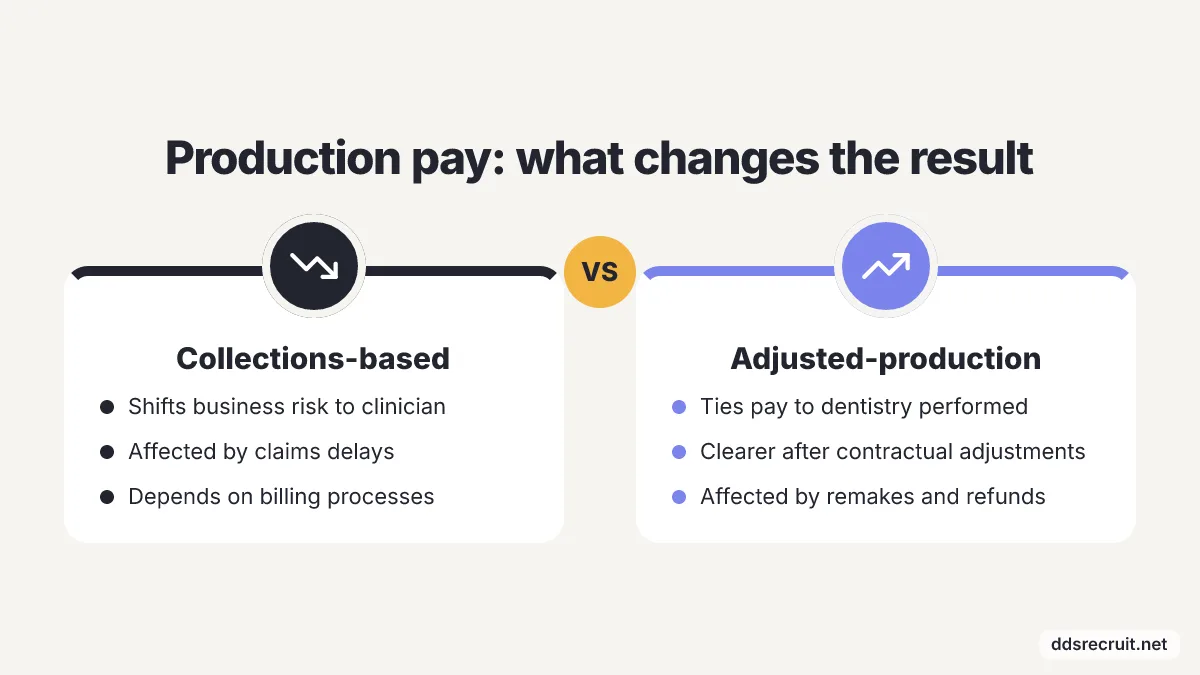
A collections-based plan shifts more business risk to the clinician. Collections compensation can be fair in an office with clean insurance systems and predictable payment posting, but the associate should not carry the cost of claims delays, poor front-desk follow-up, or billing processes they do not control.
An adjusted-production plan can feel clearer because it ties pay to dentistry performed after contractual adjustments. The candidate still needs to know whether remakes, refunds, lab bills, hygiene exams, radiographs, and doctor exams are counted, because the line between provider production and office accounting changes the paycheck.
A threshold changes the meaning of a percentage plan. If production pay begins only after a set level, the candidate should ask how the threshold was set, whether it moves with schedule changes, and whether holidays, practice closures, no-shows, and broken equipment affect the target. Specialists need a narrower review than general dentists because referral flow, case acceptance, sedation support, assistant skill, and scheduling blocks can outweigh the percentage itself. An oral surgeon or endodontist may earn less under a higher percentage if the office cannot consistently present and prepare the right cases.
Hygienists and office managers should translate bonus plans into controllable behaviors before accepting them. A hygiene bonus tied to perio enrollment, reappointment, or production has to account for appointment length and provider diagnosis, while an office manager bonus tied to collections or growth should come with clear authority over the systems being measured.
Dental associate pay comparison: what to put side by side
A useful comparison table puts pay mechanics next to working conditions, because a compensation formula only means something inside an actual schedule. Candidates should weigh the offer itself, the proof behind it, and the remaining risk after follow-up questions get answered.
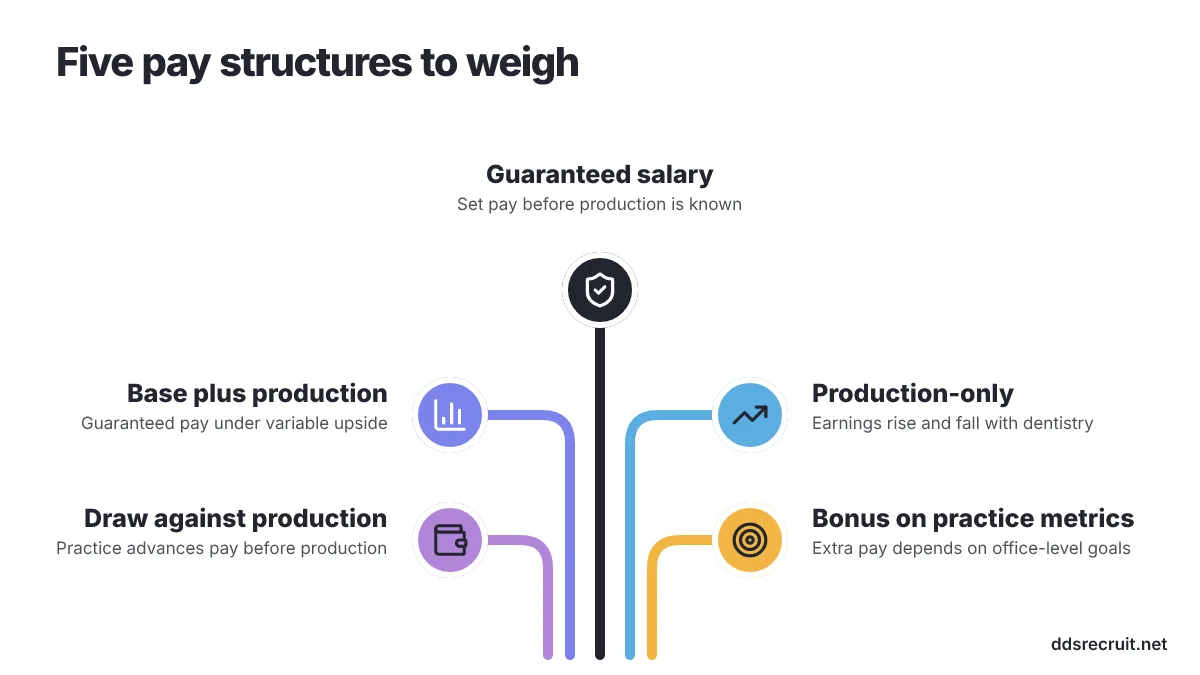
| Pay structure | What the number usually means | What to ask before accepting | Main risk to the candidate |
|---|---|---|---|
| Guaranteed salary or daily minimum | Pay is set before production is known | Ask whether the amount is permanent, temporary, or tied to a ramp period | The offer may limit upside if the practice gets busy |
| Base salary plus production | Guaranteed pay sits under a variable upside formula | Ask whether production means collections, adjusted production, or another ledger figure | The upside may depend on systems outside the clinician's control |
| Production-only compensation | Earnings rise and fall with the measured dentistry or collections | Ask for schedule history, active patient flow, and the exact deduction rules | The candidate carries more risk when chair time is light |
| Draw against production | The practice advances pay before production catches up | Ask whether any shortfall carries forward or must be repaid | A future paycheck or departure could be affected by the draw balance |
| Bonus tied to practice metrics | Extra pay depends on office-level goals | Ask who controls the metric and how results are reported | The candidate may be judged on decisions they do not make |
The comparison should include benefits as money, not as pleasant extras. Health insurance contribution, malpractice coverage, continuing education support, licensing fees, retirement match, paid time off, relocation help, and lab-fee treatment all change real compensation because they change what the candidate keeps. The comparison should include capacity as well as pay. A general dentist with empty chair time, limited assistant coverage, and low case acceptance may earn less than a candidate in a lower advertised plan with full books, clear diagnosis protocols, and reliable hygiene exams.
Private practice and DSO comparisons need the same discipline. A private practice may offer more direct access to the owner and faster decisions, while a DSO may offer broader benefits, specialist pathways, or defined leadership tracks, but neither model answers the pay question until the actual compensation documents and schedule assumptions are visible. A new graduate with heavy mentorship needs should not chase the richest production plan if the practice cannot show teaching time, clinical feedback, and a pace that supports development. Early career mistakes in fit can cost more than a lower starting guarantee, especially when the contract limits movement after the role begins.
Candidates who want a quick estimate before building a spreadsheet can test assumptions with a DDS Recruit dental salary calculator, and associate dentists can model offer mechanics with an DDS Recruit associate dentist pay calculator. A calculator will not verify a practice's numbers, so the next step is asking for the details that make the offer auditable.
Requesting compensation details from dental practices
A serious practice ought to explain pay before it asks for a signature. Asking dental practices for compensation details is not rude if the request is specific, tied to the offer, and framed as a way to compare fit rather than pry into private finances.
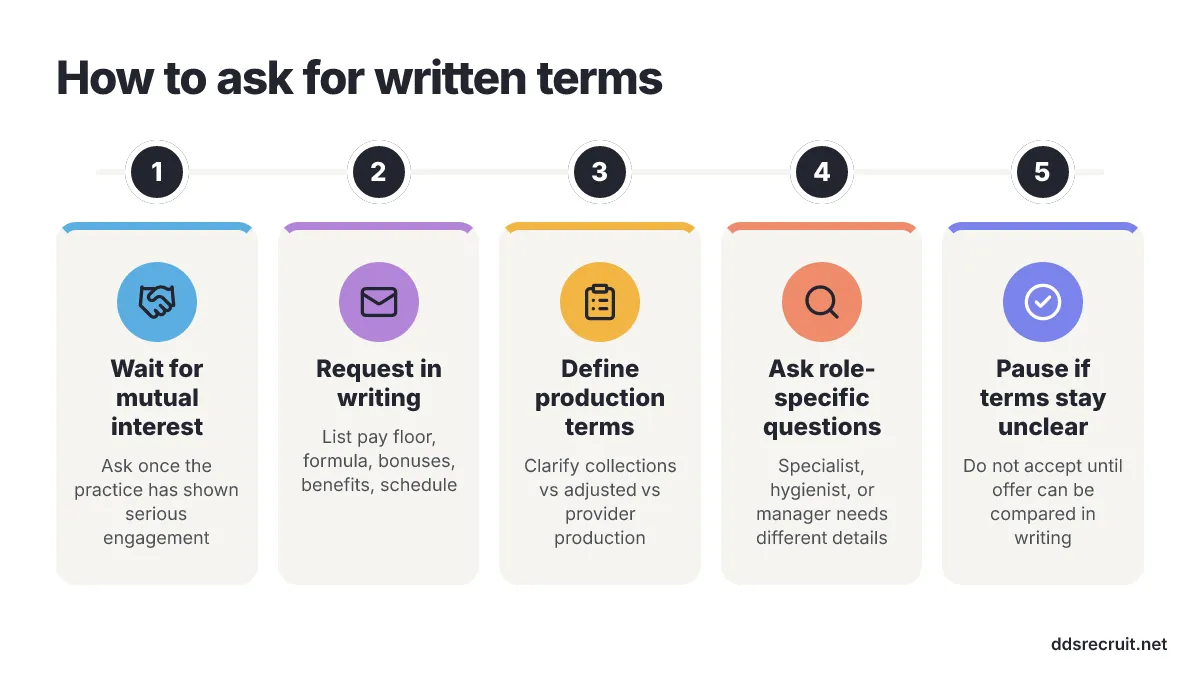
A candidate can ask for the pay structure in writing once mutual interest is clear. The request should list the pay floor, the production formula, bonus triggers, benefits, schedule expectations, restrictive covenant, termination terms, and any repayment obligations tied to a signing bonus, relocation, continuing education, or draw advances.
A practical request can be direct without sounding hostile:
I am interested in the role and want to compare the offer carefully. Could you send the compensation terms in writing, including the guaranteed pay, production calculation, bonus rules, benefits, schedule expectations, and any repayment or noncompete terms that would apply?
An associate dentist should ask for production definitions in the same conversation. The practice should spell out whether pay is based on collections, adjusted production, provider production, hygiene exams, radiographs, emergency exams, lab deductions, and any treatment completed but not yet paid. A specialist should ask about referral flow and case volume instead of asking only for a percentage. An endodontist, periodontist, oral surgeon, orthodontist, or pediatric dentist needs to know whether the practice has the patient mix, equipment, scheduling blocks, and trained support to deliver the promised earnings path.
A hygienist should ask how appointment length and diagnostic authority affect bonus eligibility. Hygiene compensation that rewards production or periodontal care has to match the time allowed per visit and the clinical philosophy of the supervising dentists. An office manager or executive candidate should ask which metrics they will own and which resources come with the goal. A bonus tied to revenue, collections, expansion, or team retention has little value if the candidate lacks authority over staffing, fee schedules, systems, or hiring decisions.
A practice that will not define compensation until after acceptance is asking the candidate to take avoidable risk. The better move is to pause the process until the offer can be compared in writing, because unclear money terms rarely get clearer after notice has been given elsewhere.
Use salary data without letting averages decide the job
External salary data helps with context, but averages cannot tell you whether a specific practice will generate the earnings in its offer. A survey number should start the question, not end the negotiation.
DentalPost's 2024 annual salary survey belongs in the background when candidates want a market reference before they discuss pay. A salary survey helps most when the role, clinical setting, schedule, and benefits are close enough to the offer being considered.
The ADA Health Policy Institute report on dentists' income, revenue and hours gives a better view of the broader business context behind dentist earnings. The report title points to the right relationship, since income, revenue, and hours worked move together, so a candidate should not separate pay from schedule and production capacity. Practices and DSOs. Candidates comparing offers can review current dental job postings while thinking about compensation, culture, and fit, and the same pay questions apply whether the role is associate dentist recruiting, dental specialist recruiting for in-house specialists, or dental hygienist recruiting.
A recruiter should not stand in for your own review of the contract. A recruiter can give context and keep the conversation moving, but the candidate still needs written terms, a clear pay formula, and professional contract advice when legal language affects future options.
Salary data becomes useful when it sharpens better questions. The next decision is whether the practice can support the earnings path it is advertising, and that means looking beyond the compensation paragraph.
Where real earnings hide outside the pay paragraph
The schedule belongs in the compensation review because earnings depend on filled chairs, not only on the signed terms. A practice can promise a strong formula and still leave an associate with weak income if the days are short, chair use is uneven, treatment is presented badly, or assistant support is thin. Patient mix changes what the same percentage is worth. A dentist who does mostly limited exams and single-surface restorations will not earn the same amount as a dentist with steady hygiene flow, treatment planning time, and broader care, even when the written production percentage is identical.
Collections timing matters when pay is tied to money received instead of dentistry completed. Candidates should ask when collections get posted, how insurance payments are assigned, and what happens if the patient pays after the associate has left the practice.
Lab fees and supply deductions can quietly cut take-home pay. A candidate should ask whether deductions are taken before or after the compensation calculation, whether specialist procedures are handled differently, and whether the associate controls lab selection.
Contract terms can turn a decent pay plan into a bad career move. Restrictive covenants, repayment clauses, termination notice, ownership promises, schedule-control language, and outside-work limits all change the value of the offer because they shape what the candidate can do if the role does not match expectations. Culture affects earnings because production plans depend on trust between the clinician and the office. A candidate who dislikes the diagnosis philosophy, leadership style, or pace of care will not perform well for long, even when the compensation model looks attractive on paper.
The cleanest offer is not always the richest one. The better offer is the one where the practice explains the formula, shows that the schedule can support it, gives the candidate authority over the work being measured, and leaves enough clarity that both sides know what success costs.
Conclusion
Start with the written offer, not the negotiation script. Put the guaranteed pay, production formula, benefits, deductions, schedule assumptions, and contract obligations into one comparison, then ask the practice for any missing details before you rank the opportunity.
A strong dental compensation decision takes patience and a little skepticism. Use calculators and salary surveys to set expectations, but ask the practice to show how its own offer turns into real earnings. When the money terms are still unclear after direct questions, stop treating the gap as a communication issue and treat it as part of the offer itself.
Frequently Asked Questions
What should I focus on when comparing dental associate pay?
When comparing dental associate pay, focus on controllable earnings rather than advertised compensation. Evaluate the guaranteed salary, production-based earnings, and the conditions required to achieve them. Understanding the risks and asking detailed questions about compensation terms can lead to a more accurate comparison.
Why is the guaranteed salary important in dental associate pay?
The guaranteed salary, or pay floor, is important because it indicates how much risk the practice is asking you to carry before patient flow, scheduling, and collections are proven. It provides financial stability while you learn the office, build case acceptance, and assess whether the opportunity matches the chair schedule.
How does base salary plus production work for dental associates?
Base salary plus production works well when the formula, schedule, and office systems align. Real earnings come from guaranteed pay, patient volume, procedure mix, hygiene exams, treatment acceptance, and collections timing. It's crucial to understand whether production is calculated from gross production, adjusted production, or collections, as these terms affect the final earnings.
What should I consider when evaluating a production-only compensation plan?
When evaluating a production-only compensation plan, consider the schedule history, active patient flow, and exact deduction rules. Earnings rise and fall with measured dentistry or collections, so the candidate carries more risk when chair time is light. Understanding these factors helps assess the potential financial impact.
How can I request compensation details from a dental practice?
Requesting compensation details from a dental practice is appropriate if the request is specific and tied to the offer. You can ask for the pay structure in writing once mutual interest is clear, including the pay floor, production formula, bonus triggers, benefits, schedule expectations, restrictive covenant, termination terms, and any repayment obligations.
Recommended resource
Related reading
- Associate Doctor Placement for Practice Transition
- Dental Associate Placement Built for Long-Term Fit
- Cost Comparison: Hiring Dental Hygienist Agency vs Direct