

Red Flags in Dental Job Offers: What to Check Before You Sign
By Dr. Brian Passell and the DDS Recruit team ·
Summary: Red flags in dental job offers include vague compensation terms, pressure to sign quickly, and discrepancies between verbal promises and written agreements. Missing details about clinical context, such as patient mix and mentorship, are also concerning. Candidates should be wary of offers that lack clarity on restrictive covenants, termination clauses, and malpractice coverage, as these can impact future career decisions.
The message lands on your personal phone at 7:30 PM. The practice owner says the clinical team liked your chairside manner, the staff is eager to have you, and they need your signed acceptance by noon tomorrow so next month's column can be set. The base pay looks better than your last associateship, the operatory equipment seemed modern on your tour, and the contract itself runs only four pages. Before you finish evening charting and can read it, another notification arrives. Two other clinicians are interviewing for the exact same seat, and the office manager wants your answer tonight. That made-up urgency lands at the worst time, because reviewing red flags in dental job offers takes patience. An associateship contract controls your daily patient mix, your production expectations, lab bill deductions, clinical autonomy, and your ability to practice nearby if you leave.
A job offer weighed down by fuzzy math, artificial deadlines, or culture claims you cannot verify on your own is not ready for a signature. Taking a step back does not mean you think anyone is lying. A well-run practice will accept clear paperwork and will answer operational questions in writing before asking you to tie your clinical career to their chairs.
Which red flags in dental job offers should stop the process?
Ambiguous contract language is the most common warning sign because clinical income depends on how the practice counts daily procedures. Big promises about lucrative earnings or competitive packages mean little if the contract leaves out the daily guarantee, the exact production formula, net collection definitions, adjustment deductions, lab fee splits, and schedule minimums during slow seasons.
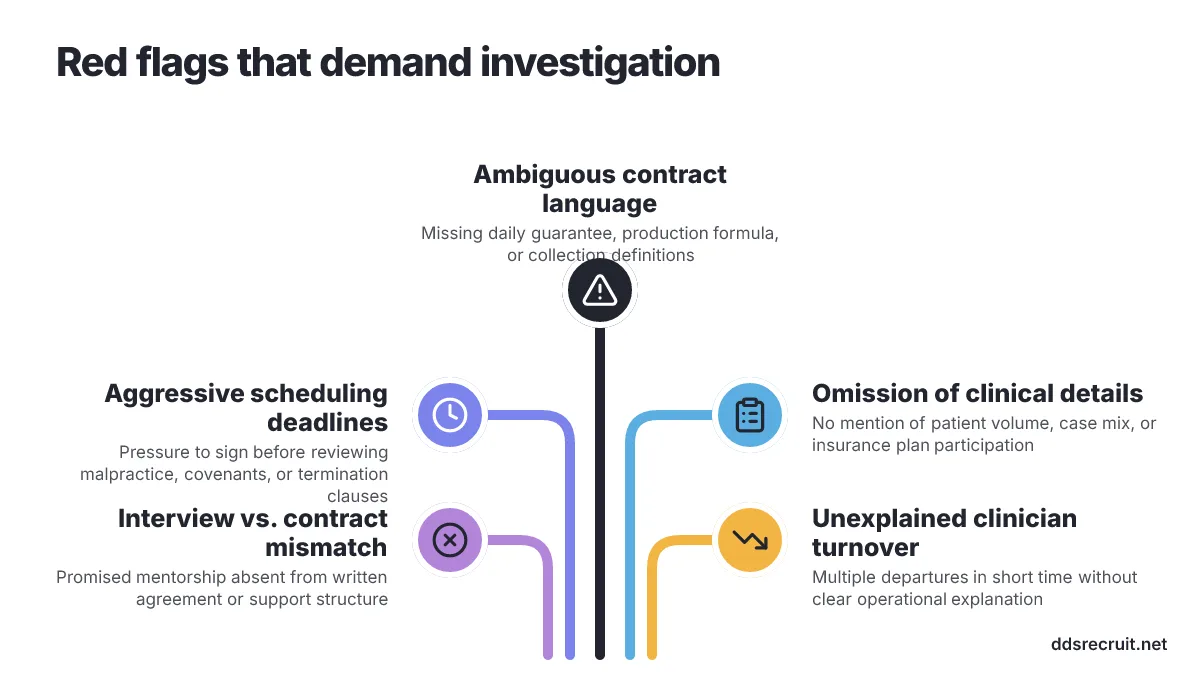
Aggressive scheduling deadlines are the second major warning sign because a stable, well-managed dental office gives candidates time to review terms. A firm decision window is normal business practice, but an owner who wants an immediate signature before you have read malpractice tail coverage, restrictive covenants, or termination clauses is pushing for a commitment you have not earned.
Omission of daily clinical details is the third critical warning sign because contract percentages mean very little without patient volume. A production payout can result in minimal take-home pay if your day involves many emergency recaps, limited problem-focused exams, and deeply discounted insurance plans.
A lower percentage can produce better earnings in a practice with full hygiene recall, capable dental assistants, and an owner who shares restorative cases. A direct mismatch between interview talk and written contract terms is one of the clearest warning signs in a dental job offer. When an owner promises dedicated mentorship during the interview but the contract gives you no dedicated chart review blocks, no designated senior clinician, and no protocol for reviewing complex treatment plans, trust the written agreement over the verbal pitch.
An unwillingness to explain why the previous clinician left deserves direct investigation. An associateship built to absorb real patient growth has very different operational realities from a chair vacated by three straight dentists in two years, so you need to ask who sat in that operatory before, how long they stayed, and why they left.
Temporary locum tenens coverage is the clean exception where limited documentation about career progression makes sense. When both sides agree that an assignment will last only four weeks for emergency relief, you can accept the absence of partnership language or deep mentorship protocols, though compensation rates, daily hours, malpractice insurance, and termination rules still need clear written confirmation.
A professional question works better than an emotional exit when bad terms appear. Ask for the missing operational details in writing and watch the owner's tone, because an irritated response to basic business questions shows how that owner will react to equipment requests or schedule changes after you start.
Pay language in dental job offers that hides the real economics
Compensation traps usually sit in the accounting definitions, not in the headline rate. A fair offer spells out the pay method in plain terms. It says whether earnings come from a set day rate, base salary, adjusted production, net collections, or some mix of those. It also puts patient refunds, insurance adjustments, lab cost splits, and hygiene exam billing in writing.
A guaranteed daily draw can help a dentist through the first stretch of the job. The contract still has to say whether that draw gets paid back. A recoverable draw means the dentist owes deficit balances from later clinical earnings. A nonrecoverable daily guarantee sets a real floor, and the clinician does not slide into practice debt.
Collections-based pay deserves close scrutiny because the associate does not control billing speed or front desk collection rates. The contract should say how fast insurance claims go out, how aged accounts receivable are handled, and whether the practice pays collections that arrive months after the associate leaves.
Production-based pay needs the same kind of plain wording. The agreement must state whether compensation comes from gross production, adjusted production after contracted insurance write-offs, or net posted production after laboratory fees come off the top. Each version changes the paycheck for the same day of operative dentistry.
| Compensation structure | What to confirm before signing | Main red flag |
|---|---|---|
| Daily rate or salary | Whether the rate drops after a set period and what daily hours it requires | A high rate tied to six-day work weeks or unpaid emergency coverage |
| Percentage of production | Whether production means gross fees, net adjusted fees, or posted collections | A tempting percentage that leaves out hygiene exams or deducts full lab costs |
| Percentage of collections | How the office handles insurance billing, past-due accounts, and patient refunds | Associate pay falls because front-office delays slow the money |
| Hybrid guarantee plus incentive | Whether the early daily guarantee is recoverable against later production | Future monthly paychecks get cut to repay negative draw balances |
Bad compensation estimates often rest on past numbers that cannot be repeated. An owner may point to the income of a departing associate and leave out the parts that made it possible. That dentist may have worked five clinical days, brought ten years of specialty experience, done third-molar extractions, and stepped into a mature patient roster that a new hire will never see.
Associates in Pennsylvania run into these same financial traps. Finding misleading dental compensation offers in Pennsylvania means checking the daily schedule, insurance plan participation, and contract adjustments, not trusting verbal income estimates passed around in professional circles. Anyone moving from another state should ask for written financial terms, not regional promises spoken out loud and left there.
Benefits change take-home pay and belong in the same conversation as the base rate. Employer money for health insurance, continuing education allowances, state license renewals, DEA registration fees, retirement matches, and malpractice policies all affect annual income. If the job skips standard benefits, a slightly higher production split can disappear fast.
Market data gives associates something firmer to stand on when the employer will not share formula details. Dentists can review compensation baselines using the DDS Recruit dental salary calculator to compare local averages with the scheduling demands the practice is putting on the table.
A careful financial discussion ends with a written model. Ask the office manager or owner to walk through the compensation formula with actual monthly numbers from an active operatory. Include realistic insurance write-offs, typical lab costs, and ordinary patient schedules, so the math shows itself.
Contract terms in dental job offers that make a good offer hard to leave
Restrictive language becomes dangerous when a dental practice environment proves clinically incompatible. A newly hired dentist might encounter compromised sterilization practices, disorganized scheduling, high cancellation rates, or an owner who disputes clinical diagnoses, making an affordable exit route necessary.
Termination clauses must establish equal rights and reasonable notice periods for both parties. A contract allowing an owner to dismiss a dentist immediately without cause while requiring the associate to provide ninety days of written notice creates an untenable power imbalance that demands formal legal revision.
Restrictive covenants require rigorous scrutiny because geographical noncompete terms limit future employment options. Have a dental attorney examine noncompetition distances, nonsolicitation restrictions on staff and patients, and patient record access provisions, especially when restrictions apply across a multi-mile radius from every branch location the organization operates.
Professional liability coverage must be defined explicitly in the contract. Dentists need to know whether the employer provides occurrence-based malpractice coverage or claims-made coverage, because a claims-made policy leaves the question of who pays thousands of dollars for tail coverage when employment ends.
Partnership and equity options often serve as vague verbal incentives without legal weight. A path to ownership offers no tangible value unless the contract details qualification timelines, operational metrics, clear practice valuation methods, purchasing mechanisms, and prospective governance authority.
Clinical decision-making rights must be settled in writing before any contract is executed. Associates need written confirmation that they retain full control over treatment planning, material selection, appointment durations, lab vendor choices, and specialty referral decisions without interference from production quotas.
Dental specialists face even more complex contract dependencies. An oral surgeon, periodontist, endodontist, orthodontist, or pediatric dentist must confirm that the practice delivers sufficient referral volume, specialized dental assistants, required instrumentation, and sedation infrastructure before accepting an in-house specialty role.
Dental hygienists and practice office managers face parallel risks regarding daily authority. A hygiene agreement should establish appointment times, periodontal treatment standards, and hygiene-assistant ratios, while an office manager agreement must delineate clear authority over staff management, billing collections, and practice policy enforcement.
Dental executives must watch for inflated titles that lack matching administrative power. Roles such as Clinical Director, Regional Director of Operations, or Vice President of Clinical Support require defined reporting lines, operational budget discretion, and concrete performance scorecards to prevent leadership positions from becoming pure liability.
Never finalize a professional dental contract without independent legal counsel. Highlight ambiguous paragraphs, ask the employer for written corrections, and retain an experienced dental attorney to examine the complete document before putting your signature on the page.
What should the practice prove before you accept?
Workplace culture claims mean little without observable operational proof. Ask the owner to share recent examples of how the office responded to a broken appointment column, an unhappy restorative patient, a clinical complication, or a new associate who needed an extra thirty minutes to complete a difficult molar endodontic access.
A paid working interview or extended shadowing session reveals daily clinic realities far better than a dinner interview. Observe how the scheduling coordinator greets walk-in emergencies, how assistants turnover operatories, how hygienists communicate diagnostic findings, and whether the daily schedule permits the thorough clinical care the practice advertises.
Patient scheduling distribution requires honest discussion. You need to know how many new patients join the practice each month, how new patient exams are divided between the owner and the associate, who takes walk-in emergency visits, and how the front office fills empty blocks in the associate's column.
Clinical mentorship must be defined as an operational routine rather than a broad sentiment. A recent graduate or an associate expanding into clear aligner therapy or implant placement should verify who reviews cases, how often reviews occur, whether senior dentists are present during procedures, and how treatment disagreements are resolved away from the patient.
Independent private practices and dental support organizations present contrasting workplace dynamics. A private office often provides immediate owner communication and diagnostic freedom, whereas a DSO frequently provides established operational systems, standardized employee benefits, and multiple location options, but either setting becomes hazardous if local management cannot define your daily support.
Staff retention rates indicate the daily stability of the practice. High turnover among expanded-functions assistants, hygienists, and front-office billing staff directly impairs an associate's ability to produce quality dentistry, so an owner must be able to explain recent departures and demonstrate that adequate clinical support is in place.
Active job listings provide an objective check against verbal recruiting pitches.
A direct question about practice conflict exposes how an owner manages adversity. Ask the owner to recount a recent disagreement between an associate and the front desk, how leadership addressed the problem, and what concrete policy changed as a result, because evasive answers highlight poor operational management.
Every productive interview sequence should resolve questions rather than introduce new contradictions. When each conversation uncovers unresolved discrepancies regarding compensation, daily hours, or staffing support, the associate is no longer exploring an opportunity, but trying to rationalize a defective practice environment.
When is a recruiter better than another job board?
Specialized dental recruitment provides value when you need reliable insight into daily practice realities rather than another list of openings. Public job boards display vacancies, but they do not confirm whether a practice is actively hiring, whether the advertised compensation is achievable, or whether the operational culture supports an incoming associate.
Outdated job board listings consume valuable time and risk exposing your career transition to the local dental community. A job post that sits active for months might represent ongoing practice growth, but it often indicates high staff turnover, unrealistic owner expectations, or compensation formulas that prospective associates consistently reject upon reviewing the contract.
An informative discussion with a recruiter focuses on operational mechanics rather than superficial sales encouragement. A candidate should ask about the owner's management history, the practice's daily patient volume, historical associate turnover, and the precise compensation model before agreeing to an interview.
A search firm's placement guarantee should encourage candidates to ask thorough operational questions, because a bad placement creates significant friction for both the clinician and the hiring practice.
Working with an intermediary does not replace your personal review of the legal contract. A recruiter introduces relevant openings and provides practice context, but the final compensation terms, restrictive covenants, malpractice tail responsibilities, and termination obligations require your personal review and the oversight of a dental attorney.
Traditional job boards still serve a practical purpose when you want to scan overall market openings or observe compensation trends across regions. The best approach is to treat public postings as broad reference points, then consult a job boards comparison to evaluate when a self-directed search suffices and when direct representation offers greater protection.
Direct representation proves most valuable when your employment needs involve nuanced practice variables. Dentists transitioning from corporate DSOs to private equity partnerships, clinicians relocating across state lines, specialists negotiating dedicated operatory days, and administrative managers seeking real authority need concrete clarity before contract generation begins.
How should you respond when an offer raises concerns?
A structured written response preserves professional goodwill while requiring the practice to document vague terms. Send a cordial note thanking the practice for the offer, listing the specific operational and compensation items that require documentation, and stating that you will make your decision once those elements are finalized in writing.
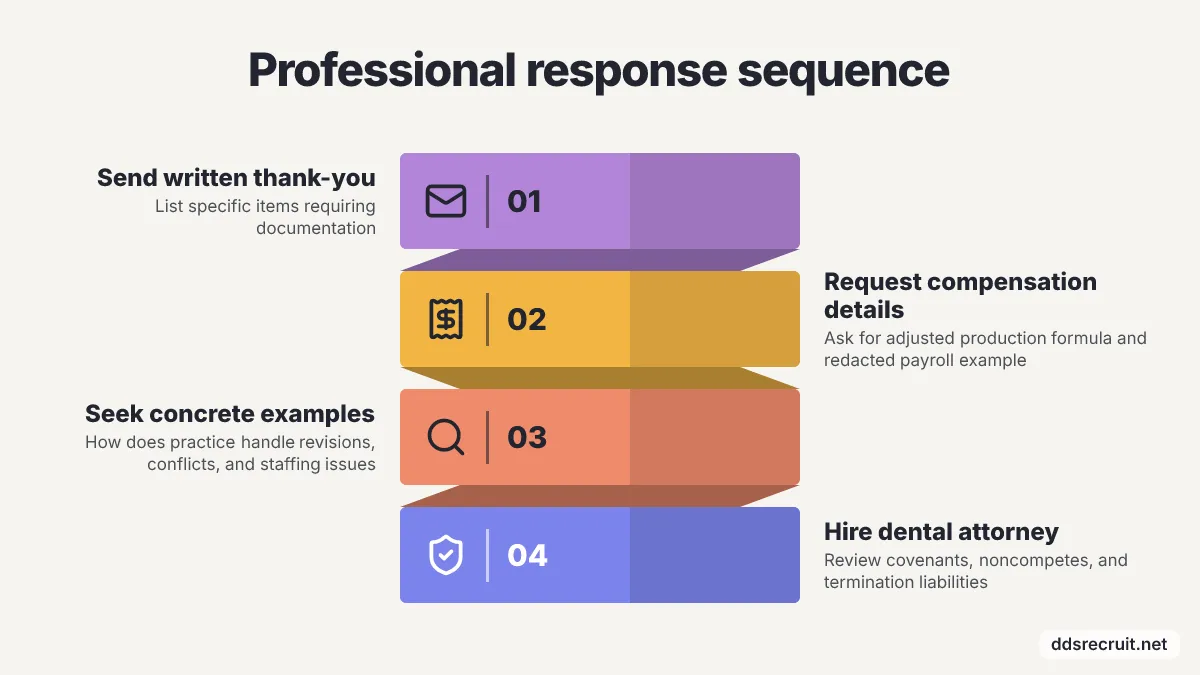
A professional response can state: Thank you for the offer to join your clinical team and for the time spent introducing me to your staff. Before I can evaluate the contract, I need written clarification regarding the daily production adjustments, the lab cost deductions, the malpractice tail coverage, the termination notice periods, and the clinical mentorship structure. I look forward to reviewing the agreement once these details are incorporated into the document.
Compensation inquiries must target specific accounting mechanisms rather than general reassurances. Request written confirmation of whether pay relies on adjusted production or collections, how insurance write-offs affect your compensation, whether a daily draw is nonrecoverable, and ask for a redacted monthly payroll summary from an active provider.
Culture questions should seek concrete historical examples rather than abstract values. Inquire how the office handles restorative revisions, how scheduling conflicts are resolved between the owner and the associate, and how the practice manages an assistant who struggles to keep pace with complex clinical procedures.
Legal provisions must be addressed dispassionately. You can appreciate an owner's personality and clinical skill while still requiring a dental attorney to examine restrictive covenants, noncompete radii, termination liabilities, and partnership buyout stipulations.
The practice owner's response to your inquiries reveals more than the initial interview. A capable practice leader will answer reasonable questions directly, whereas an owner who acts offended when asked for routine business clarity will likely display the same hostility toward clinical or staffing issues once you start practice.
Reserve your final commitment until the written employment agreement, the compensation structure, the staff interactions, and the interview discussions align completely. Genuine enthusiasm is a great start, but clear contract terms are what protect your peace of mind and allow you to deliver quality patient care for years to come.
Final checklist before you sign a dental job offer
Examine the compensation formula and the legal contract first, because those written pages determine your real daily experience in the practice. Highlight every undefined accounting term, request written confirmation on lab fees and collection rules, and evaluate whether the owner's answers match what you witnessed during your office visit.
A viable dental position does not have to be flawless, but it must be transparent. Your immediate next action is to run a thorough contract audit: examine daily pay structures, patient allocation rules, malpractice tail provisions, noncompete limits, and the operational history behind the job opening. Consulting a dental attorney, checking local compensation benchmarks, or speaking with a specialized recruiter requires an upfront investment of effort, but it safeguards your clinical license, your personal earnings, and your future career mobility.
Frequently Asked Questions
What are the red flags in dental job offers that should stop the process?
Ambiguous contract language, aggressive scheduling deadlines, and omission of daily clinical details are major red flags. These issues can lead to misunderstandings about compensation and work expectations. If the contract terms do not match verbal promises, especially regarding mentorship or patient volume, it's wise to halt the process.
Why is vague compensation language a red flag in dental job offers?
Vague compensation language can hide the real economics of the job. Without clear terms on pay methods, such as set day rates or production percentages, and details on deductions like lab fees or insurance adjustments, you risk unexpected financial outcomes. Ensure the contract specifies these elements to avoid surprises.
How can aggressive scheduling deadlines in a dental job offer be a warning sign?
Aggressive scheduling deadlines can indicate a practice that prioritizes its needs over a candidate's due diligence. A well-managed dental office allows time for thorough contract review, including malpractice coverage and termination clauses. Rushed decisions can lead to commitments that are not in your best interest.
What should you do if there's a mismatch between verbal promises and the written contract in a dental job offer?
If there's a mismatch, trust the written contract over verbal promises. Ensure that all aspects discussed, such as mentorship or clinical autonomy, are clearly outlined in the contract. If they are not, request written confirmation before proceeding, as this discrepancy is a significant red flag.
Why is it important to understand the previous clinician's departure in a dental job offer?
Understanding why the previous clinician left can reveal potential issues within the practice. Frequent turnover may indicate problems such as poor management or unrealistic expectations. Asking about past departures helps assess whether the position is stable or if similar issues might affect your tenure.