

Evaluating Practice Culture Before You Commit in Dentistry
By Dr. Brian Passell and the DDS Recruit team ·
Summary: Evaluate culture fit by tracing how specialty cases move from diagnosis to follow-up: where they come from, who presents fees and prepares records, whether the assistant and equipment are ready, and how patients are contacted afterward. Before committing, clarify pay, supplies, lab costs, contract restrictions and travel radius, and get the clinical and financial terms in writing.
A periodontist or oral surgeon who walks in for an in-house surgical day finds out quickly where the culture really lives. It lives in the operatory, not in a polished dinner chat. Once chair time begins, the assistant may still be waiting on a surgical tray, and the front desk may have skipped the specialist fee deposit. At that point, manners do not run the day. To understand how to evaluate the culture fit of a dental practice, you have to look past the owner's enthusiasm and inspect the systems that carry complex care.
Most advice says to visit the office and get a feel for the staff. That sounds reasonable, but it misses how specialty dentistry actually works. A friendly greeting tells an endodontist nothing about whether the general dentists diagnose pulpal pathosis (disease affecting the tooth's pulp) correctly, whether hygiene charts probing depths, or whether the office manager stumbles through financial talks with anxious patients. Check how the office runs before you sign an agreement, so you can identify scheduling gaps and discuss the support your specialty work would need.
Dental office culture also shows up in things you can verify. Clinical routines, handoffs, and patient communication tell you more than a polished interview ever will. The right questions reveal whether a prospective office can support specialty procedures without friction, or whether it expects an outside clinician to patch internal bottlenecks without enough help.
Start with the operatory, not the office vibe
The operatory shows practice habits faster than any talk in a private room. A host general practitioner may promise a steady stream of third molar extractions or bone grafting procedures, but the team still has to show how those patients get identified, scheduled, and readied before you arrive.
Handoff protocols separate organized host offices from disorganized ones. You need to know who explains the clinical diagnosis, who presents the out-of-pocket costs, who updates systemic health histories, and who sets up the room before treatment begins. Good morale does not cover missing surgical suction tips, uncalibrated handpieces, or an assistant who does not know basic implant componentry.
Make patient communication part of your practice visit. Opencare's discussion of staff behavior and ratings is background reading, not proof of how this particular office works. Ask the administrative team how they explain why an in-house specialist is involved, and ask who handles questions the team cannot answer. Listen for a clear handoff rather than assuming that courtesy alone means patients understand the arrangement.
Include the referring dentist's chairside dialogue in your assessment of case acceptance. Ask how the dentist introduces the specialist, explains the proposed referral, and leaves room for patient questions. The listed SAGE reference on explanations and patient loyalty could not be independently verified during this review; do not treat it as evidence of a specific sample size or a causal effect. Instead, ask the host dentist to walk through the introduction they would use for your own specialty cases.
How to evaluate dental practice culture fit in the workday
Tracking an individual specialty chart through the host practice's daily schedule exposes the operational habits you will inherit. A structured assessment evaluates the specific points where patient care passes between the primary dentist, the clinical staff, and your chair.
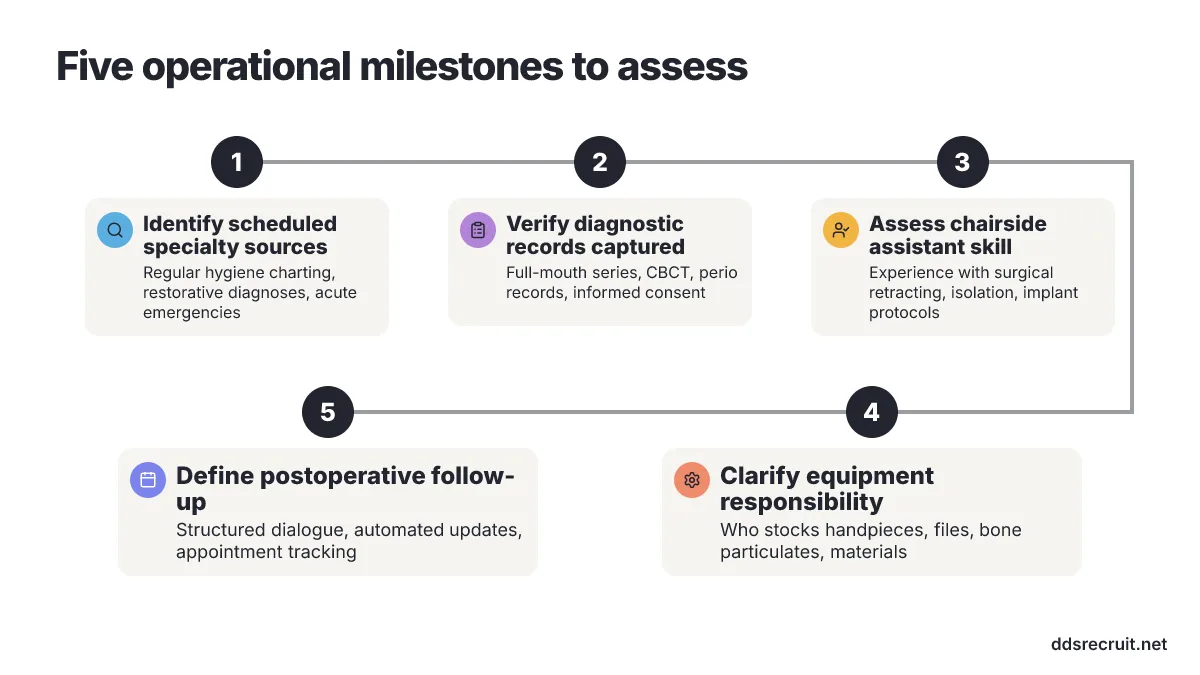
Use the operational milestones below to review daily workflow:
- Identify the origin of scheduled specialty procedures within the practice. Ask to review appropriately de-identified examples of periodontal charting, documented cracked tooth diagnoses from restorative exams, and acute referrals. Compare what is actually recorded with the owner's description of available specialty work; a list of possible procedures is not a confirmed schedule.
- Verify which diagnostic records the team captures before reserving specialist block time. Discuss which records your cases need, including any relevant full-mouth radiographs, cone-beam computed tomography (CBCT) imaging, periodontal records, and consent documentation. Ask who confirms readiness and who resolves missing information; this checklist is not a requirement to obtain every imaging type for every patient.
- Determine the direct experience of your assigned chairside assistant. Ask the assistant to describe their experience with the tasks your cases require, such as surgical retracting, endodontic isolation, or implant torque protocols. Discuss where training or additional support would be needed rather than assuming that an assigned assistant is ready for every specialty procedure.
- Establish clear responsibility for instruments, capital equipment, and disposable materials. The general dentist must state in writing whether the practice stocks specialty handpieces, rotary files, and bone particulates, or expects the visiting doctor to provide mobile kits.
- Define the exact protocol for postoperative patient follow-up. The American Dental Association notes that managing specialty cases requires coordinated, structured dialogue across both clinicians and the patient throughout the treatment cycle, as outlined in its guidance on specialty referral communication.
Ask the practice to demonstrate its post-treatment tracking rather than inferring follow-up quality from interview answers. Intiveo's release on referral and communication benchmarks describes sections covering waitlists, referrals, chat, and surveys; it does not establish how this prospective office performs. Clarify who receives patient messages, who alerts the treating clinician, and who covers questions when you are not in the office. The ADA's referral guidance supports clear, ongoing communication between providers and with the patient.
How should you record what the practice shows you?
Record the evidence, the unanswered question, and the person responsible for resolving it, rather than giving the office an overall score based on friendliness. Keep any case discussion de-identified and within the practice's privacy procedures.
| Area to assess | Evidence to request | Question to resolve before committing |
|---|---|---|
| Specialty demand | A de-identified view of relevant referrals and the proposed schedule | Which cases are ready to book, and which are only anticipated? |
| Clinical preparation | The team's record-readiness and room-setup process | Who confirms the specialist has what the case requires? |
| Chairside support | A conversation with the assistant assigned to your sessions | Which specialty tasks are familiar, and where is support needed? |
| Equipment and materials | The proposed inventory and written supply responsibilities | Who provides, maintains, and replaces each required item? |
| Follow-up coverage | The patient-message and clinician-escalation process | Who responds while you are working elsewhere? |
If the owner's explanation and the team's description differ, write down the discrepancy and ask them to resolve it together. An unanswered question is a reason for further diligence, not proof that a practice has poor culture.
What contract terms reveal before the first treatment day
Compensation structures reveal how the practice owner views risk and partnership. A guaranteed daily minimum and a percentage of collections allocate pay differently. Ask how the minimum applies while the practice builds demand, and ask how percentage pay is calculated, collected, and reconciled. Evaluate those terms against the proposed schedule and expenses rather than treating either model as automatically preferable.
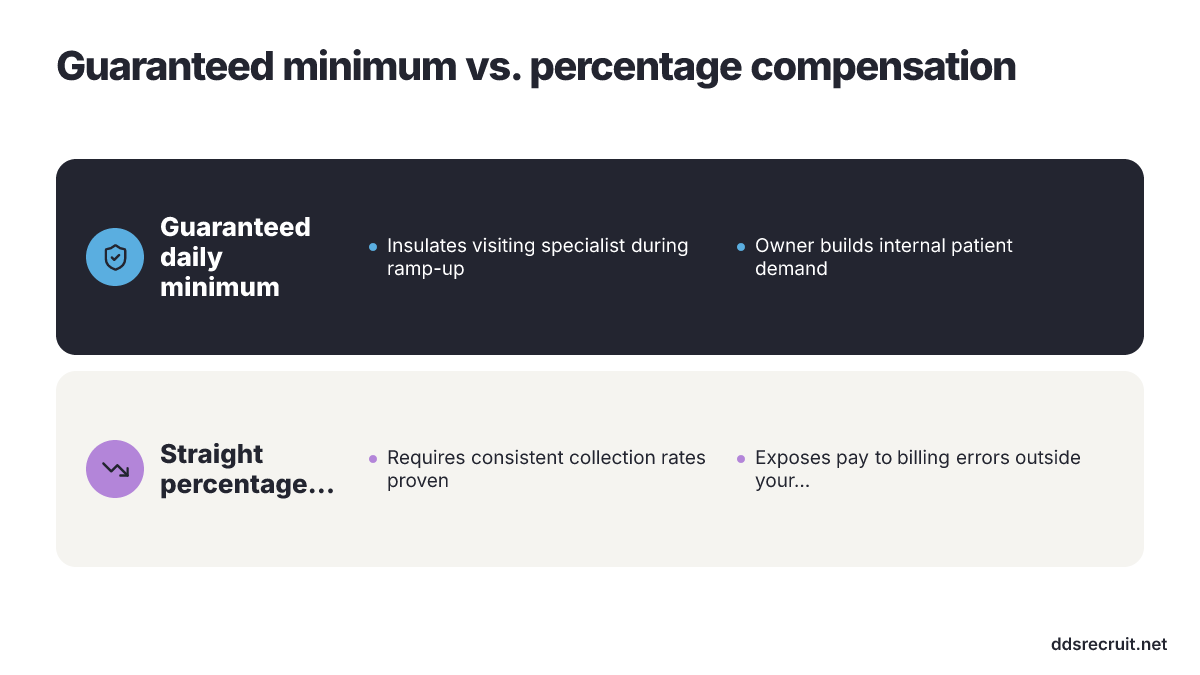
Specialists should evaluate production percentages, collection timing, laboratory fee deductions, and supply costs concurrently before signing. Clinicians comparing guaranteed daily minimums against percentage models can benchmark market expectations with the DDS Recruit dental salary calculator, establishing a baseline before negotiating specific operational provisions with the owner.
For a collections-based arrangement, ask how billing corrections, insurance delays, and unpaid balances enter the compensation calculation. The Journal of Patient Experience article on cost conversations and satisfaction provides background on patient financial discussions; it should not be read as evidence that a particular practice will collect reliably or pay you as expected. Ask who presents fees, who handles disputed balances, and how you can review the records used to calculate your pay.
Restrictive covenants define the boundary where a seemingly ideal culture match becomes an unacceptable professional risk. An in-house contract containing an aggressive restrictive radius can jeopardize your relationships with nearby referring practices or prevent you from adding days at adjacent offices. Ask an attorney familiar with the applicable jurisdiction to review any restriction that overlaps your referral base or other practice locations. Assess the wording, scope, and practical effect with counsel instead of assuming that a particular radius is enforceable or acceptable simply because the office feels welcoming.
Practice ownership models further influence operational autonomy and scheduling pace. Clinicians weighing a single-doctor private clinic against a corporate platform must evaluate differences in clinical autonomy, capital equipment procurement, and administrative oversight, issues analyzed in detail regarding private practice and DSO roles.
Compare the proposed pay terms in writing before judging the offer by its headline arrangement:
| Proposed arrangement | Questions to put to the owner |
|---|---|
| Guaranteed daily minimum | When does the guarantee apply, what conditions limit it, and what happens if the office cancels your session? |
| Percentage of collections | Which receipts count toward your pay, when are they attributed to you, and how are adjustments handled? |
| Either arrangement | Who pays for laboratory work and specialty supplies, when is payment due, and what records can you inspect? |
Treat a verbal answer as something to confirm in the draft agreement. Keep compensation questions separate from the clinical-support checklist so that attractive pay does not leave an equipment or follow-up responsibility unresolved.
How can a recruiter protect fit without overexposing your name?
Ask the recruiter to assess the role without identifying you, agree on what may be shared, and obtain your permission before introducing you to a practice. A careless introduction can put your CV in front of a general dentist who already sends surgery cases to your main practice, or someone working right inside your restrictive covenant boundary. Candidates can review current openings across locations through open dental specialist jobs.
Ask your rep how they handle disclosures before they contact a single office. Ask for a process that covers chair setups and pay structure with the owner while holding back your name, identifiable training history, and contact information until you authorize disclosure. Clarify which details could identify you indirectly, who will receive them, and whether permission is needed before forwarding your CV.
Keep confidentiality ground rules separate from the clinical and financial responsibilities in your provider agreement. Ask who controls clinical decisions, when payment is due, and who communicates with patients when questions arise. The ADA ethics code remains listed for professional reference, but the linked PDF's specific wording and edition could not be verified in this review.
For the chairside discussion, ask how the team makes room for patients to discuss alternatives and raise concerns. The listed reference on shared decision-making in dentistry also could not be independently verified, so no study sample or findings are relied on here. Instead, ask the owner and assigned assistant to explain who handles a patient question that changes the planned appointment. Look for a workable communication process rather than a promise of an automatically smoother day.
Make the final practice-fit decision from evidence
Walk through the office on a working day before signing anything. You want to see actual schedule logs, check the sterilization area, inspect the surgical handpieces, and meet the specific assistant assigned to your cases. Have an attorney review the draft contract to verify base pay, supply budgets, and non-compete language before you lock in your calendar.
Walk away if the owner hedges on case acceptance steps or hesitates to put instrument promises into the contract. Bringing your specialty into a host office takes working autoclaves, honest ledgers, and solid clinical support. Put those logistical boundaries in ink so your treatment days stay clean.
Frequently Asked Questions
How do I evaluate dental practice culture fit before accepting an in-house specialty role?
Follow a specialty case from diagnosis through follow-up rather than relying on a friendly visit or the owner’s promises. Ask where cases come from, which records are prepared, who explains the diagnosis and fees, and whether the assistant, instruments, and materials are ready. Also clarify who contacts patients after treatment. These routines show whether the office can support specialty care or expects you to fix workflow gaps.
What should I check during a practice visit to assess culture fit?
Look at how the team prepares for a specialty day and handles patient handoffs. Find out whether hygienists and general dentists document findings that generate cases, and whether required images, periodontal records, and consent forms are ready before block time. Ask about your assigned assistant’s relevant experience, who supplies instruments and materials, and who presents costs. These details reveal more about daily support than office friendliness alone.
Which contract terms should I clarify before committing to a dental practice?
Review the pay arrangement, collection timing, production percentage, laboratory deductions, and supply costs together. A daily minimum can protect you while the practice builds demand, while percentage pay depends on reliable collections and treatment acceptance. Clarify any restrictive covenant and its radius, since it could affect nearby referral relationships or work at adjacent offices. Get clinical and financial terms, including supply responsibilities, in writing before signing.
How can I tell whether a practice will support specialty patients after treatment?
Ask the office to explain its exact postoperative follow-up process, including how communication is coordinated between the patient and clinicians. A structured routine helps track patient stability after treatment. If the office has no clear follow-up process, emergency triage may fall to you during personal time. The article treats follow-up as part of the full specialty-care cycle, not as a task that ends when the patient leaves the operatory.
Recommended resource
Related reading
Where to go next
Sources
- SAGE Journals: Patient Satisfaction as a Determinant of Patient Loyalty to the Dentist in Dental Clinics
- Journal of Patient Experience: Examining the Relationship Between the Quality of Cost Conversations and Patient Satisfaction in the Oral Health Setting
- Journal of Evidence-Based Dental Practice: Introducing Shared Decision-Making to Dentistry
- American Dental Association: Principles of Ethics and Code of Conduct
- American Dental Association: Specialty Referrals
- Intiveo: New dental patient engagement report adds referral and communication benchmarks